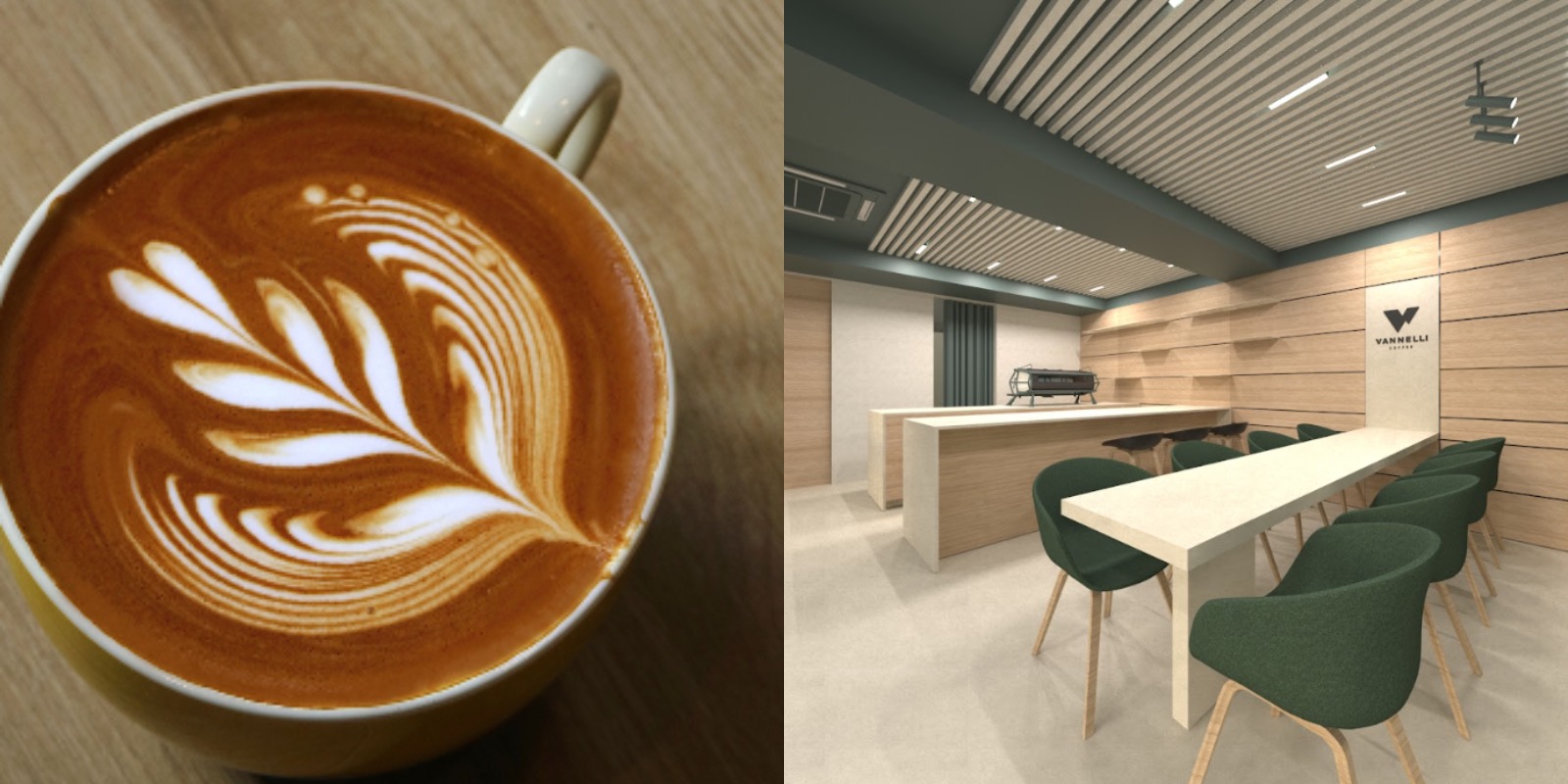
Why an Italian brand opened its first shop in TokyoThe first Vannelli Coffee flagship in the world, opened February 5, 2026 in Kita-Aoyama, Tokyo. 18 pyeong, 18 seats. It belongs to brothers who are Italian roasting champions, yet the first shop was not Milan or Rome but Omotesando. ⓒTime Out Tokyo
Daily drink
Vannelli Coffee in Omotesando: the same espresso, five times the price
2026.07.26
An espresso drunk standing at an Italian bar costs 1.20 euro, about KRW 1,900. The price has been set for more than a century. That country's roasting champion opened his first shop in the world in Omotesando, Tokyo in February 2026. The name is Vannelli Coffee, and an espresso here costs 1,000 yen, about KRW 9,400. The same person, the same skill, almost the same bean cost. Only the price differs, by five times. What we look at today is not coffee but where a price gets decided. The answer is not in the cup.
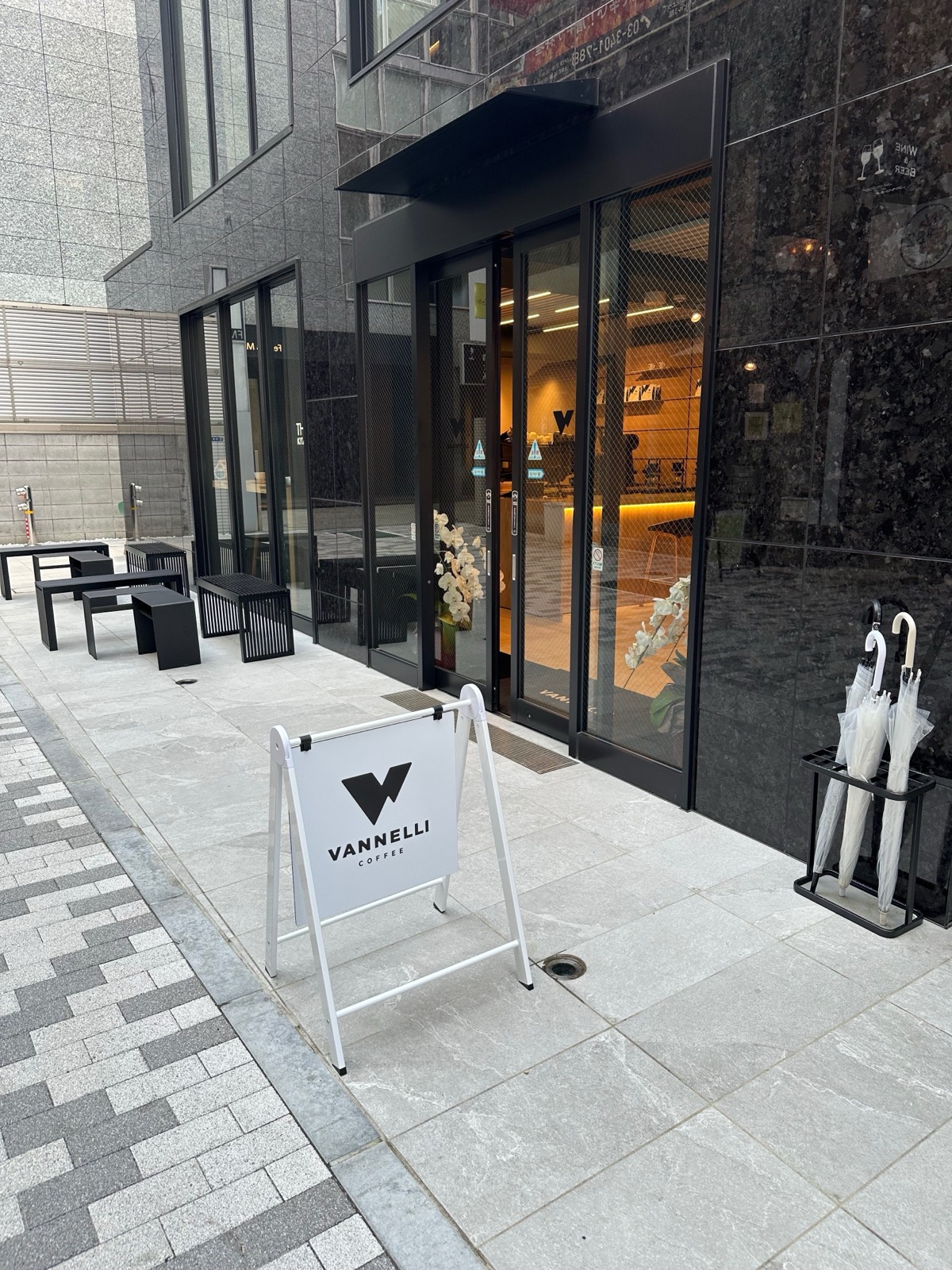
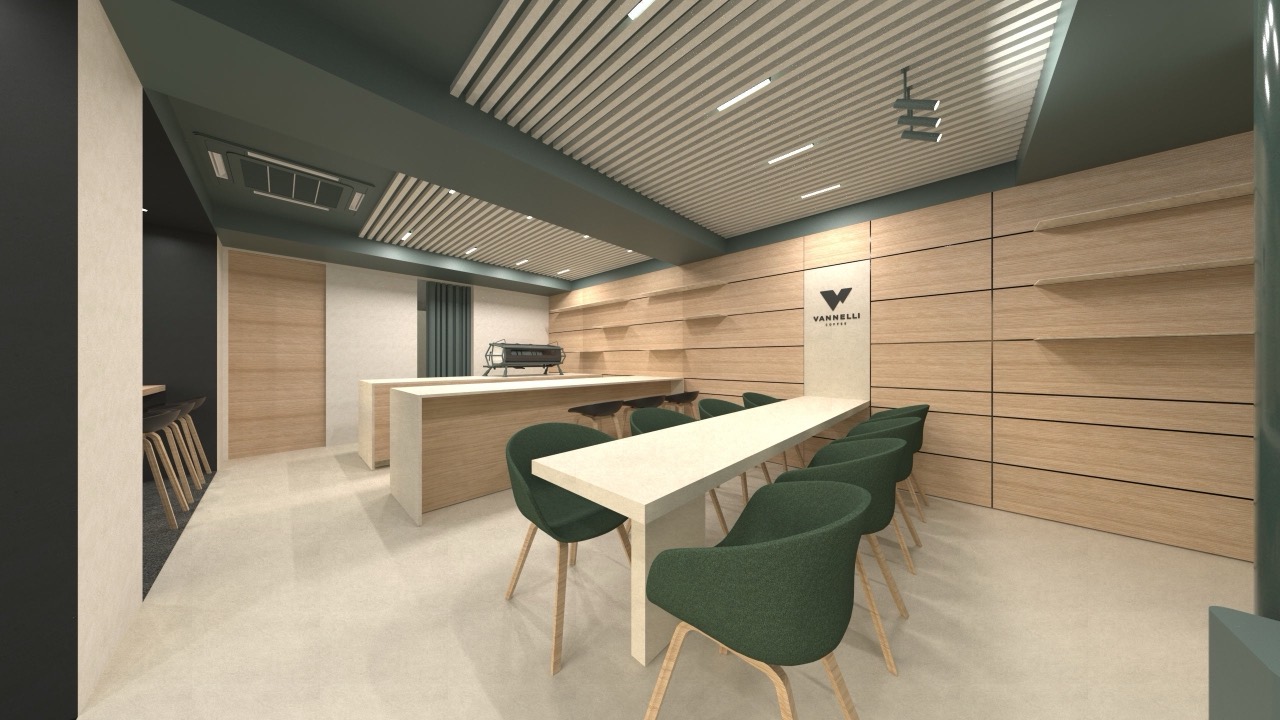
1.The facts first. On February 5, 2026, the first flagship of Vannelli Coffee in the world opened at 3-5-9 Kita-Aoyama, Minato ward, Tokyo. 244m from Omotesando station. It is 18 pyeong, with 12 seats inside and 6 on the terrace. Trading hours run eleven hours, from 8 to 19.
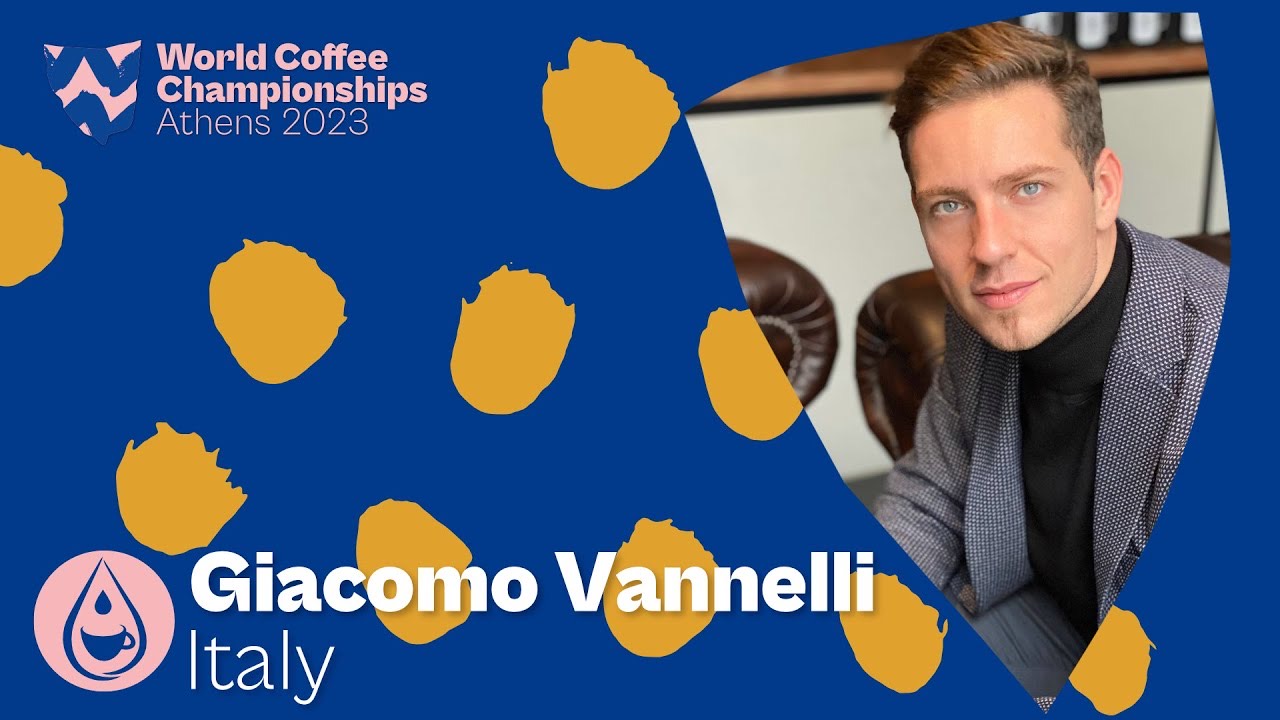
2.The owners are brothers from Cortona, Italy. The elder, Giacomo Vannelli, has competed three times at world championships for Italy (including the World Brewers Cup in 2022 and 2023) and holds the Italian roasting champion title. The younger, Pietro, became the youngest European latte art champion at 18 and now works as head roaster. Their base is a small roastery in Camucia di Cortona.
3.Something is already strange here. The first flagship in the world of an Italian brand is not in Italy. Not Milan, not Florence, not Rome, but Tokyo. The Japanese entity, Vannelli Coffee Japan, was set up back in 2023. Three years of preparation produced a first shop, in someone else's country.
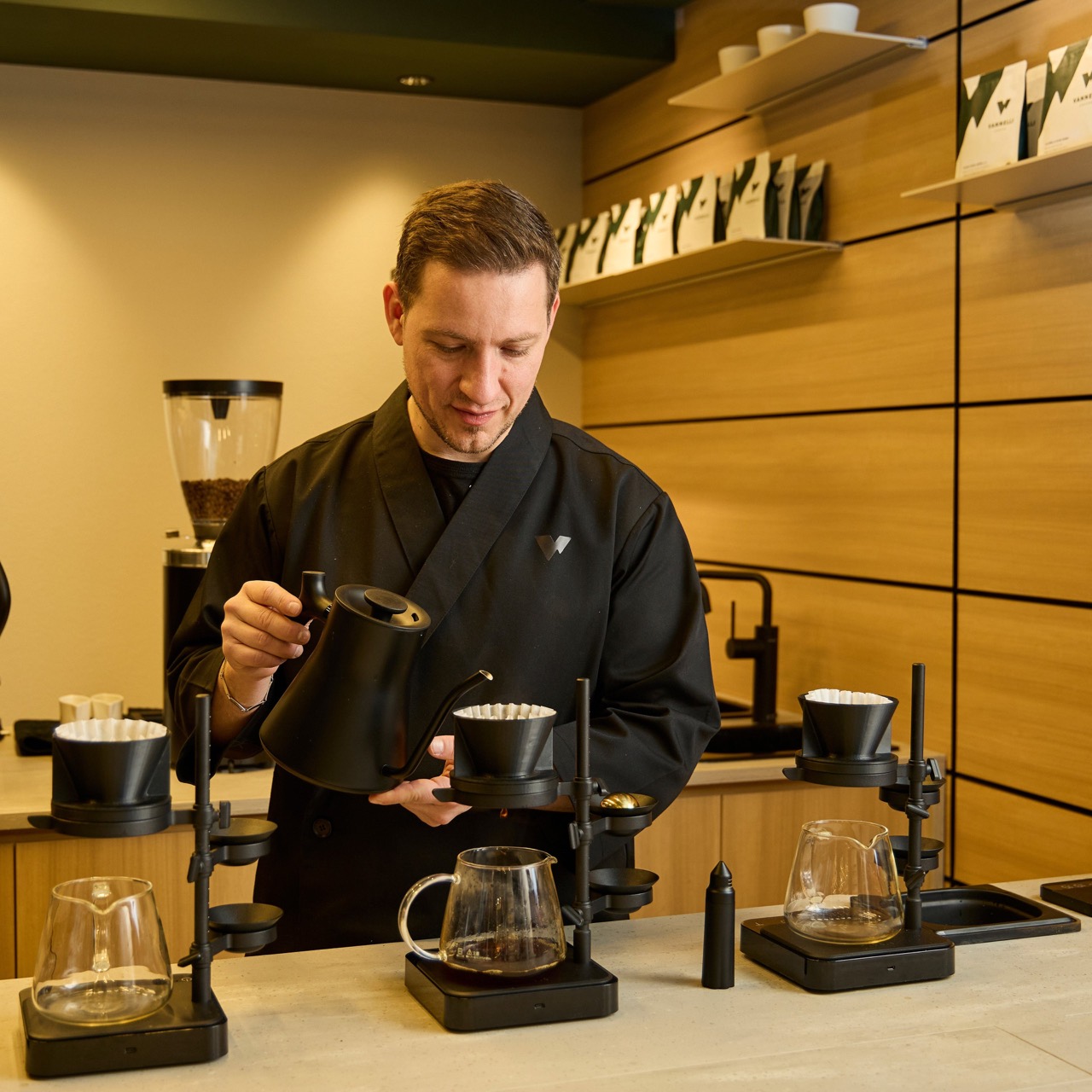
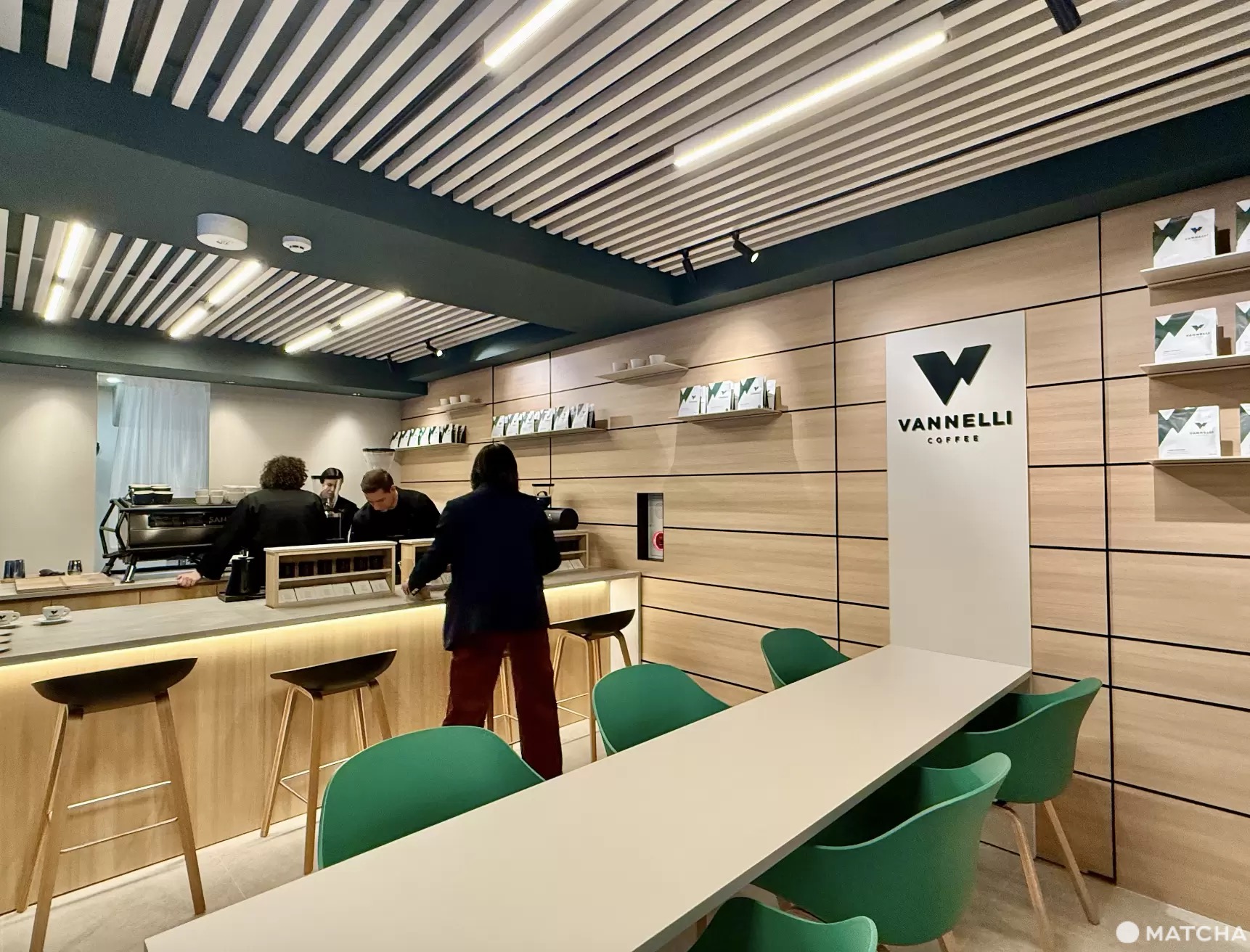
4.Start with the space. Design and fabrication went to Kobayashi Mokko, a furniture company in Hyogo prefecture. Handing the whole shop to a furniture maker rather than an interior contractor means the lead role here belongs neither to the walls nor the lighting but to the fittings. The calculation is that in an 18 pyeong box, the only place for the eye to settle is the counter.
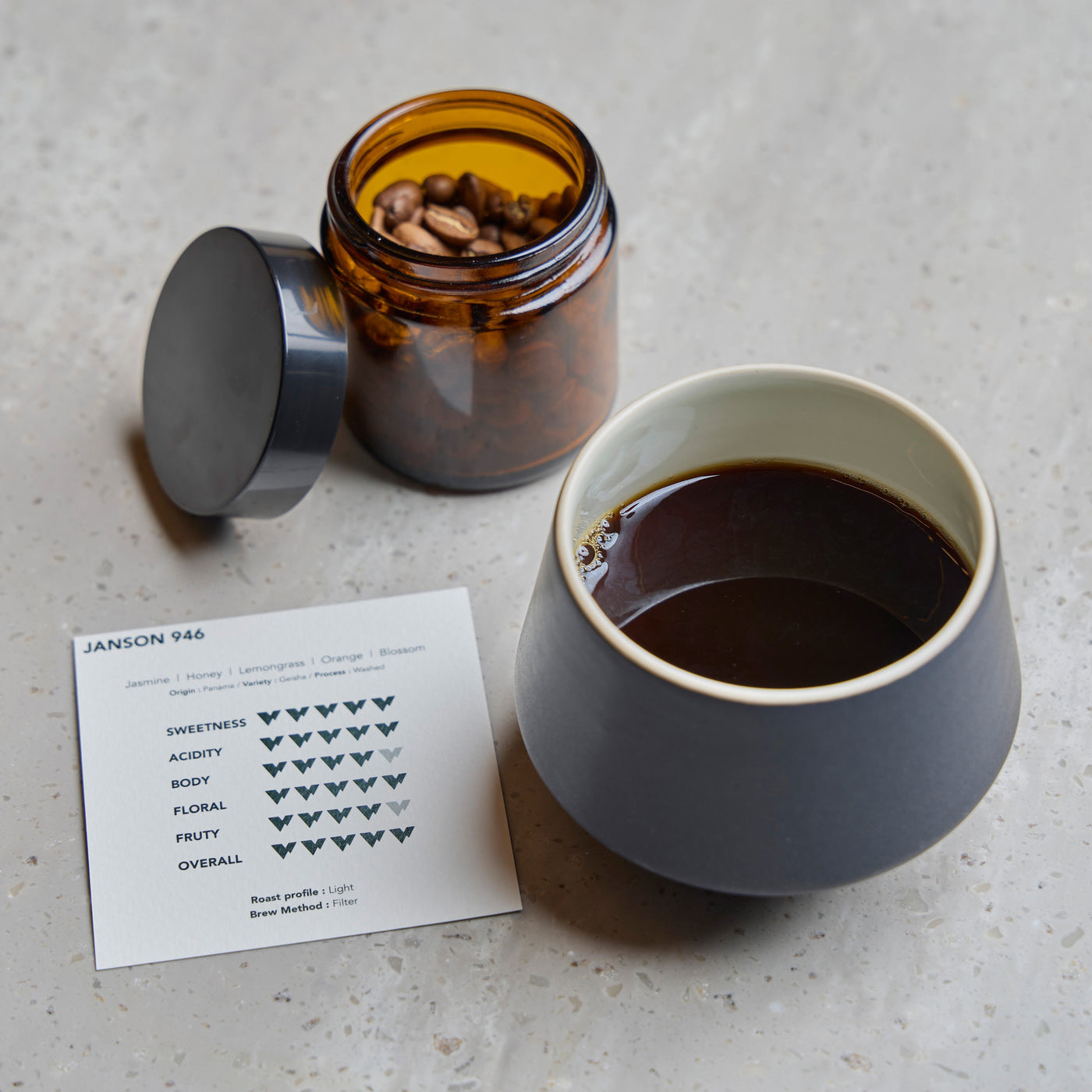
5.Inside that counter hides a moving bean showcase. Guests put their nose to the beans, read cards printed with origin, varietal and cup notes, and choose. Exactly the motion of picking up a scent strip at a perfume counter. Choosing time was planted into the circulation so that an order does not end at one americano.
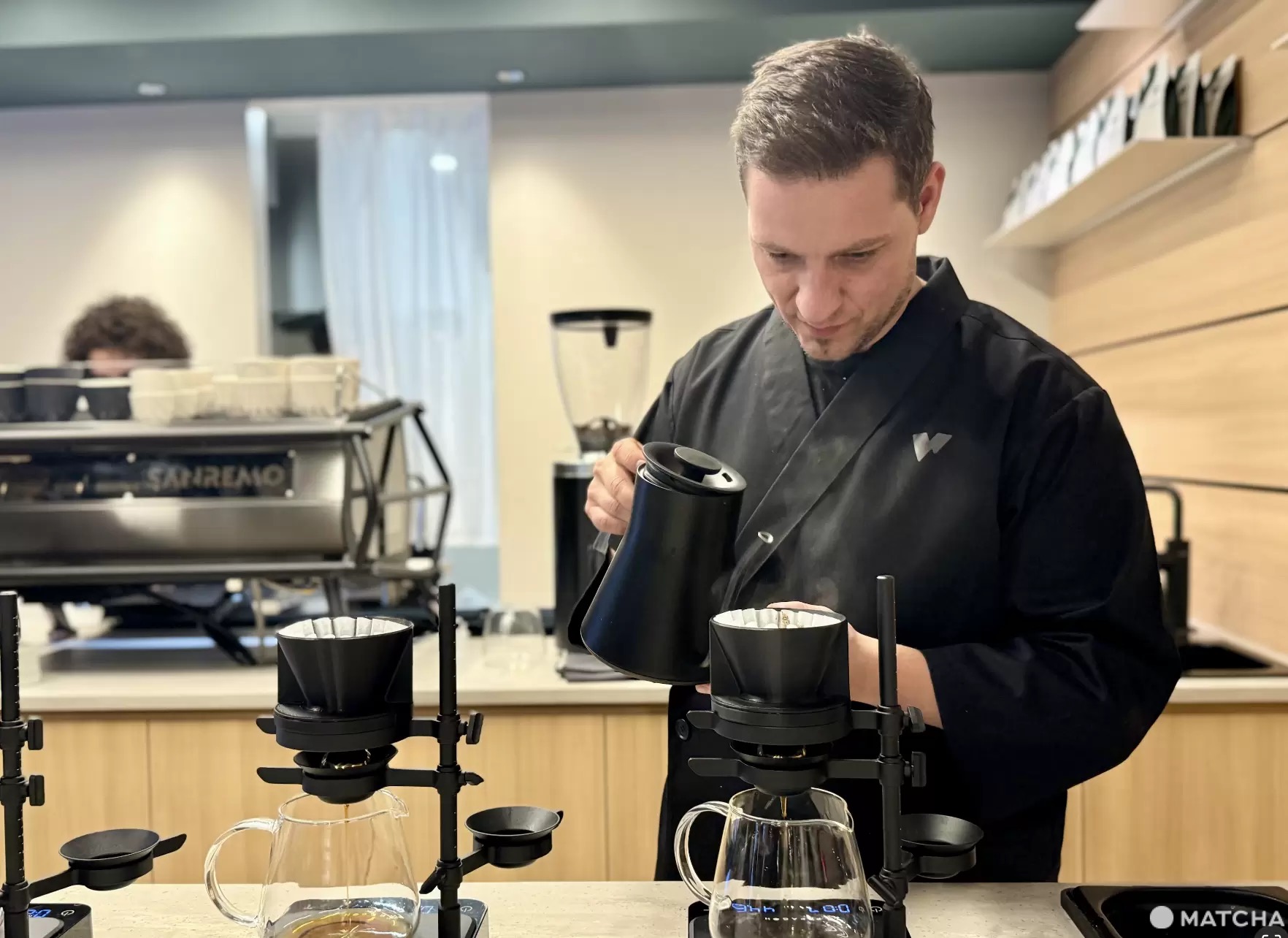
6.There is more detail. The uniforms take their shape from kimono, and the cups were made after Japanese tea utensils. An Italian brand came to Japan and put on the grammar of Japanese tea. People from a country that throws an espresso back standing up borrowed the form of a country that sits and drinks slowly.
A cafe built by a furniture companyDesign and fabrication went to Kobayashi Mokko, a furniture maker in Hyogo prefecture, rather than an interior contractor. The calculation is that in an 18 pyeong box the only place to hold the eye is the counter. Hand drip equipment lines the counter top, and bean bags sit on the shelves behind. ⓒSENLY
7.Now the menu. This is the substance. At opening, the Vannelli Japan blend espresso was 1,000 yen, cappuccino and latte on the same blend 1,400 yen, Kenya Riakiberu washed 1,400 yen, Colombia Santa Monica experimental anaerobic fermentation 1,800 yen. At the top sits Panama Janson Alpes Geisha natural, lot 1016, at 5,000 yen. Tiramisu 2,500 yen, iced matcha latte 1,800 yen.
8.Convert the numbers into Korean won. Espresso about KRW 9,400, latte about KRW 13,000, a cup of Geisha about KRW 47,000, tiramisu about KRW 23,000. Trade media put expected spend per head at 3,000 yen, about KRW 28,000. Not a coffee shop's spend per head, a restaurant lunch.
9.Note the bean lineup as well. Panama Geisha natural is the top varietal of the specialty market, and Colombia Santa Monica is an anaerobic fermentation experimental lot. Kenya Riakiberu PB is washed and orthodox. Acidity, fermentation and classic laid out on one board, a composition built to make the guest choose a preference.
Made to be chosen like perfumeBeans in glass jars and cards printed with origin, varietal and cup notes, set beside the cup. The card reads Panama Geisha, washed, jasmine, honey, lemongrass. The circulation is designed so that ordering becomes choosing time rather than one americano. ⓒSENLY
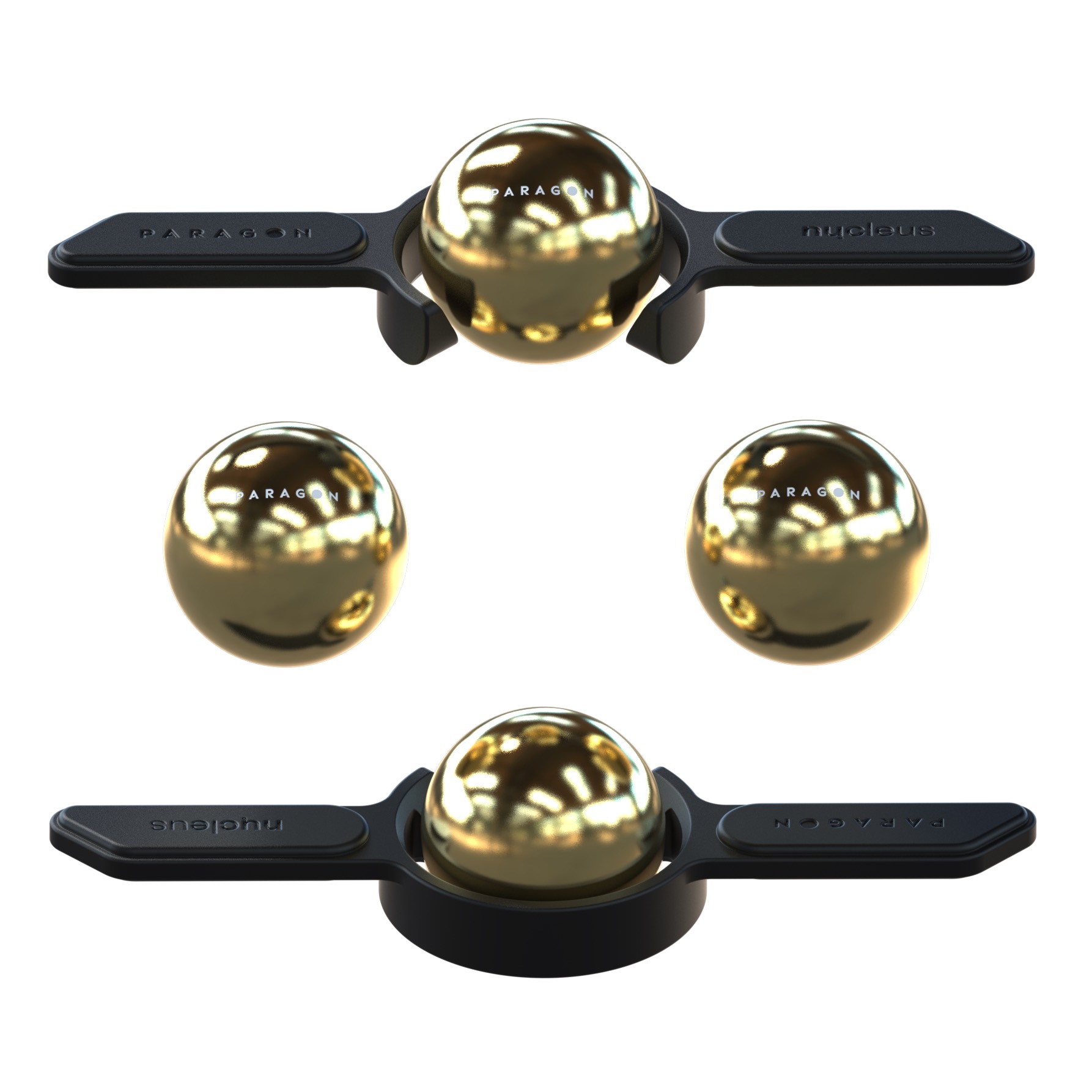
10.The brewing has its own device. What this shop puts on its sign is the Paragon method. Freshly drawn extract runs over a metal sphere frozen to minus 20 degrees, catching aroma as it tries to escape. Sasa Sestic, the Australian world barista champion, developed it with Zurich University of Applied Sciences (ZHAW), and Nucleus Coffee Tools sells it. The maker states that up to 40% more aroma compounds remain.
11.This shop is an Italian brand but not Italian grammar. The grammar of an Italian bar is standing, inside 30 seconds, done in one swallow. Vannelli Tokyo has you sit, choose, watch the equipment and drink slowly. Only the nationality is Italian, the trading method is entirely the Japanese specialty scene.
A tool that freezes aroma to catch itThe Paragon method. Extract runs over a metal sphere frozen to minus 20 degrees, chilling volatile aroma compounds so they stay. Sasa Sestic, the Australian world barista champion, developed it with Zurich University of Applied Sciences, and the maker states up to 40% more aroma compounds remain. ⓒNucleus Coffee Tools
12.First, a champion pouring it is compressed trust. The biggest weakness of specialty coffee is that guests cannot judge quality. Most people do not know why a Geisha costs 5,000 yen. But they do understand a competition record. The words national representative and champion vouch, in one stroke, for a quality no explanation would carry. What justifies the price list is not the bean, it is the résumé.
13.Second, it recycles the value of the name Italy. In coffee, Italy is the strongest national brand in the world. The words espresso, cappuccino and macchiato are Italian. Yet the specialty scene has been pulled along by Northern Europe, Japan and Australia. Vannelli fills that empty slot, Italian specialty, a combination that sounds like it should exist and did not.
What justifies the price list is the résumé, not the beanThe elder brother Giacomo Vannelli competed three times at world championships for Italy and is the Italian roasting champion. The younger, Pietro, became the youngest European latte art champion at 18. In a market where guests cannot judge quality, a competition record vouches in one stroke for a quality no explanation would carry. The photo shows Giacomo competing for Italy at the World Brewers Cup. ⓒWorld Coffee Championships
14.Third, it sold the pleasure of choosing. You smell, you read the card, you watch the equipment. Ten minutes of content attach to one cup. KRW 9,400 is expensive as a coffee price, and cheap as an entry fee to a ten-minute experience. The straight route to raising the price is not making better coffee, it is attaching time beside the coffee.
The uniform takes its shape from kimonoA black uniform with a closed collar carrying the brand mark. The cups too were made after Japanese tea utensils. A brand from a country that throws an espresso back standing in 30 seconds borrowed the form of a country that sits and drinks slowly. ⓒMATCHA
15.It is not the first. Tokyo reached four-digit yen for a cup of coffee because those before it broke the price open. In 2011 Omotesando Koffee sold coffee and custard from a small box and went out to the world, and in 2015 Blue Bottle chose Kiyosumi-Shirakawa for its first shop in Asia. That neighborhood became a coffee town.
16.The decisive precedent is Koffee Mameya and its extension, the coffee omakase format. As serving coffee in sequence like a tasting menu took hold, Tokyo guests grew used to spending several thousand yen on a single coffee sitting. Vannelli's 5,000 yen Geisha is not a price set on bare ground, it walked in under a ceiling already broken.
18 seats in 18 pyeong, one seat per pyeongThe design image released before opening. A long communal table and counter stools make up 12 seats inside, with 6 more on the terrace. A density of one seat per pyeong is less than half the customary Korean cafe figure of 2 to 2.5 seats per pyeong. It is a structure that cuts seats and raises what one person spends. ⓒVannelli Coffee Japan
17.What this shop really moved is not coffee, it is margin. Count the money. An espresso at an Italian bar is 1.20 euro (1.10 to 1.30 in most cities as of 2026). Take 7g of bean and a commercial blend at 15 euro a kilo, and the bean cost per cup is about 0.10 euro. A cost ratio of 8%, and gross profit per cup of 1.10 euro. About KRW 1,760.
18.Now Tokyo. Say a 5,000 yen Geisha uses 15g of bean, and even putting green Geisha natural in the 30,000 yen per kilo range (estimated), the bean cost per cup lands at 400 to 500 yen. The cost ratio is 8 to 10%, almost identical to Italy. Yet gross profit per cup is about 4,500 yen, KRW 42,000.
19.This is the core. The cost ratio is identical while gross profit per cup is 24 times. Even counting only the entry menu, the 1,000 yen espresso, gross profit per cup is five times Italy's. The cost ratio as a measure is completely powerless here. The same cost ratio can sit on entirely different businesses.
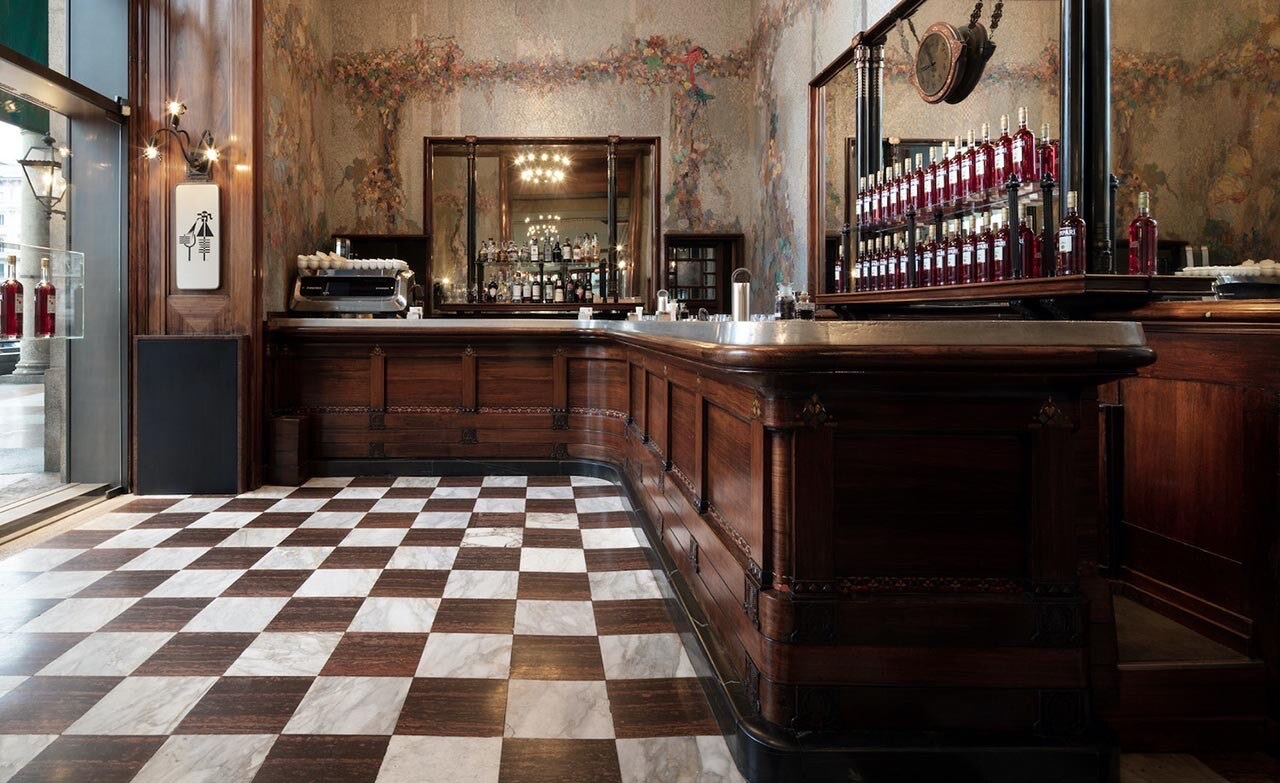
20.So the shop structures in the two countries run in opposite directions. An Italian bar keeping KRW 1,760 a cup has to sell 300 to 500 cups a day to survive, so it has you drink standing, drives turnover up and removes seats. A Tokyo shop keeping KRW 40,000 a cup needs 50 to 100 cups, so it seats you, explains and has you drink slowly. Price creates the circulation. Not the other way around.
The economics of a country that drinks standingAn espresso drunk standing at an Italian bar runs 1.10 to 1.30 euro in most cities as of 2026. Gross profit per cup of about KRW 1,760 means 300 to 500 cups a day to survive. So seats disappear and turnover is maximized. Price creates the circulation. ⓒDOMUS
21.Italy failed at moving upmarket precisely because it is the home of coffee. 1.20 euro is not a price made by cost, it is a ceiling made by culture. That it has risen more than 20% since 2021 is itself news, which shows how close a coffee price increase comes to a social event in that country. In a market where the price cannot rise however good the technique becomes, specialty cannot grow.
22.So the Italian champion's choice is arithmetic rather than sentiment. Make the best espresso in the world at home and it is KRW 1,760 a cup. Move the same skill to a market with no ceiling and it is KRW 40,000 a cup. He did not export the skill, he moved into a room where the skill gets its price.
23.Count the rent on that room too. Ground floor street-front rent in Omotesando ran 54,000 yen per pyeong a month in the second half of 2025. This shop is not on the prime street but toward Aoyama-dori, so putting it in the 30,000 to 40,000 yen per pyeong range gives 540,000 to 720,000 yen a month for 18 pyeong, about KRW 5 to 6.8 million. At 3,000 yen per head and 60 people a day, monthly revenue is about 4.5 million yen, and the rent share sits at 12 to 16%.
24.Revenue per pyeong follows. Divide 4.5 million yen a month by 18 pyeong and you get 250,000 yen per pyeong, about KRW 2.35 million. An 18-seat cafe reaching that number does so on spend per head rather than turnover. The loose density of one seat per pyeong is what holds the price up. You have to seat fewer people to sell at a higher price.
A slice of tiramisu at KRW 23,000Tiramisu 2,500 yen (cocoa, berry and matcha), iced matcha latte 1,800 yen. Trade media put expected spend per head at 3,000 yen, about KRW 28,000. Not a coffee shop's spend per head, a restaurant lunch. ⓒELLE Gourmet Japan
25.A third angle. The real risk in this model rests on a person. If what holds the price up is a champion's résumé, the price wobbles when that person is not in the shop. The brothers also run an Italian roastery, an academy and global consulting, so they cannot stand at the Tokyo counter full time. Fail to move the brand from a person to a system and the KRW 9,400 espresso loses its grounds.
26.One more. Omotesando is a trade area where tourist demand holds the price up. There is no local regular drinking a 5,000 yen Geisha every day. Footfall is the customer, which makes it sensitive to exchange rates and the tourism cycle. The paradox is here: the higher the spend per head, the more a shop rides a flow rather than its regulars.
What holds the price up is the flow, not the regulars244m from Omotesando station, six terrace seats. There is no local regular drinking a 5,000 yen Geisha every day. Tourist and passing demand hold the price up, so the higher the spend per head, the more it rides the flow. ⓒMATCHAHow the money circulatesThe same cost ratio, gross profit per cup 24 times apart. That gap splits the Italian bar into a turnover business drunk standing and the Tokyo shop into a spend-per-head business chosen sitting down. Bean cost and rent are estimates based on published market rates.
Summary
It comes to this. Vannelli Coffee, the brand of two brothers who are Italian roasting champions, opened its first flagship in the world in Kita-Aoyama, Tokyo on February 5, 2026, and hung a price list of 1,000 yen espresso, 5,000 yen Panama Geisha and expected spend per head of 3,000 yen on 18 pyeong and 18 seats. If one number survives, it is gross profit per cup. Bean cost ratios in both countries sit at almost the same 8 to 10%, while what stays in hand from one cup splits 24 times, KRW 1,760 against KRW 42,000. So the Italian bar becomes a turnover business of 300 to 500 cups a day and the Tokyo shop a spend-per-head business of 50 to 100. The cost ratio is a measure that cannot tell business models apart, and what to look at is how much stays from one cup and how many cups a day that amount has to cover fixed costs. Anyone running the same arithmetic in Korea hits not the bean but the ceiling on price. By store count, Mega MGC Coffee at 3,325, Compose Coffee at 2,649, Ediya Coffee at 2,562 and Paik's Coffee at 1,712 have made an americano at KRW 1,500 to 2,000 the standard, and even the top of Seoul specialty is realistically KRW 6,000 to 7,000 for an americano and KRW 8,000 to 15,000 for hand drip. In that market, fighting for another KRW 500 on slightly better coffee is hard to win. Raising the price means planting the grounds that hold a price up, dwell time, explanation, scarcity, into the space first, and Tokyo's four-digit yen is the result of a ceiling broken by predecessors over more than a decade together with tourist demand, not a price that can be set overnight. That the price rests in the end on a person's résumé, and that it rides tourist flow rather than regulars, remain the weak points of this model.