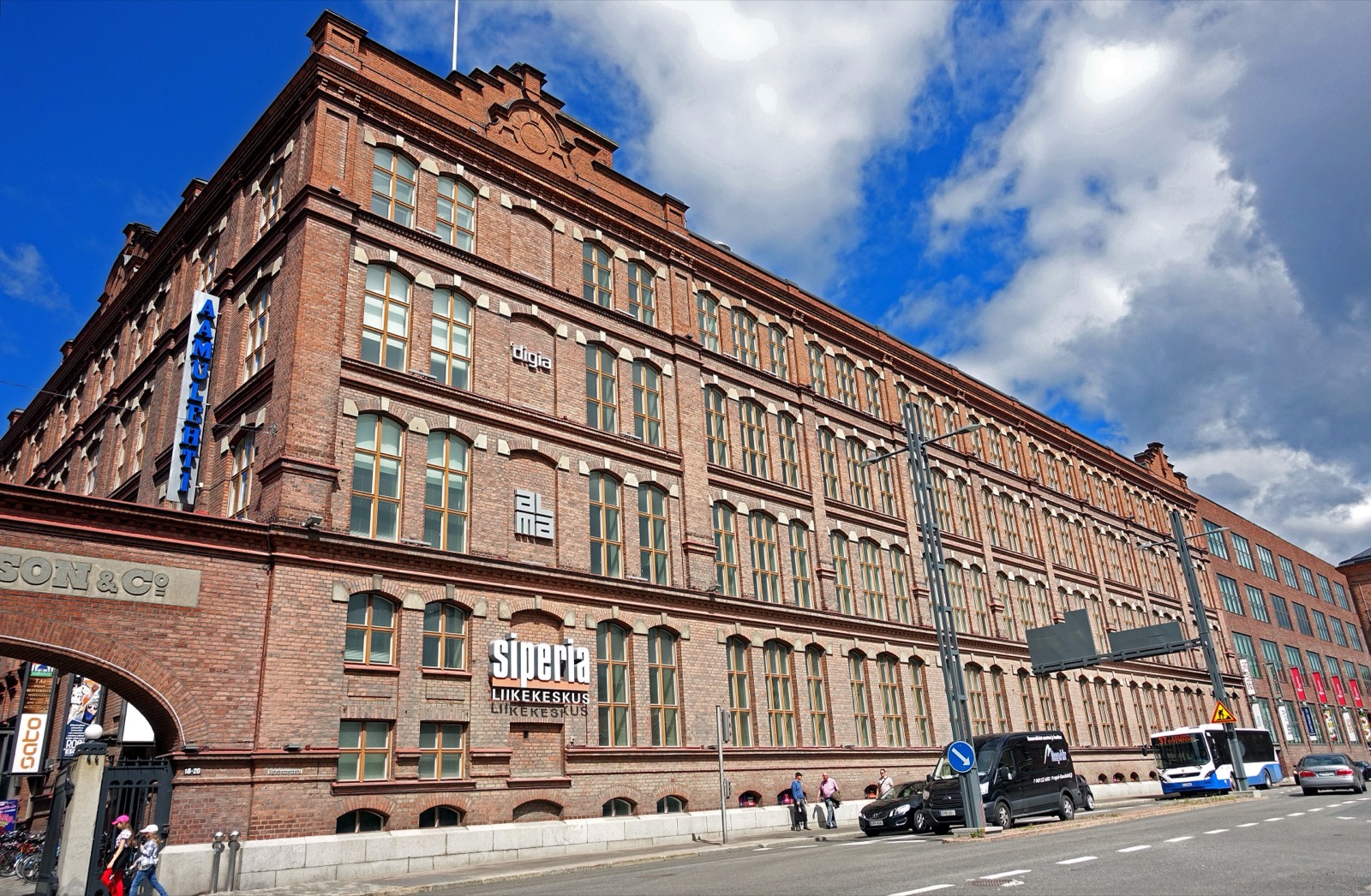
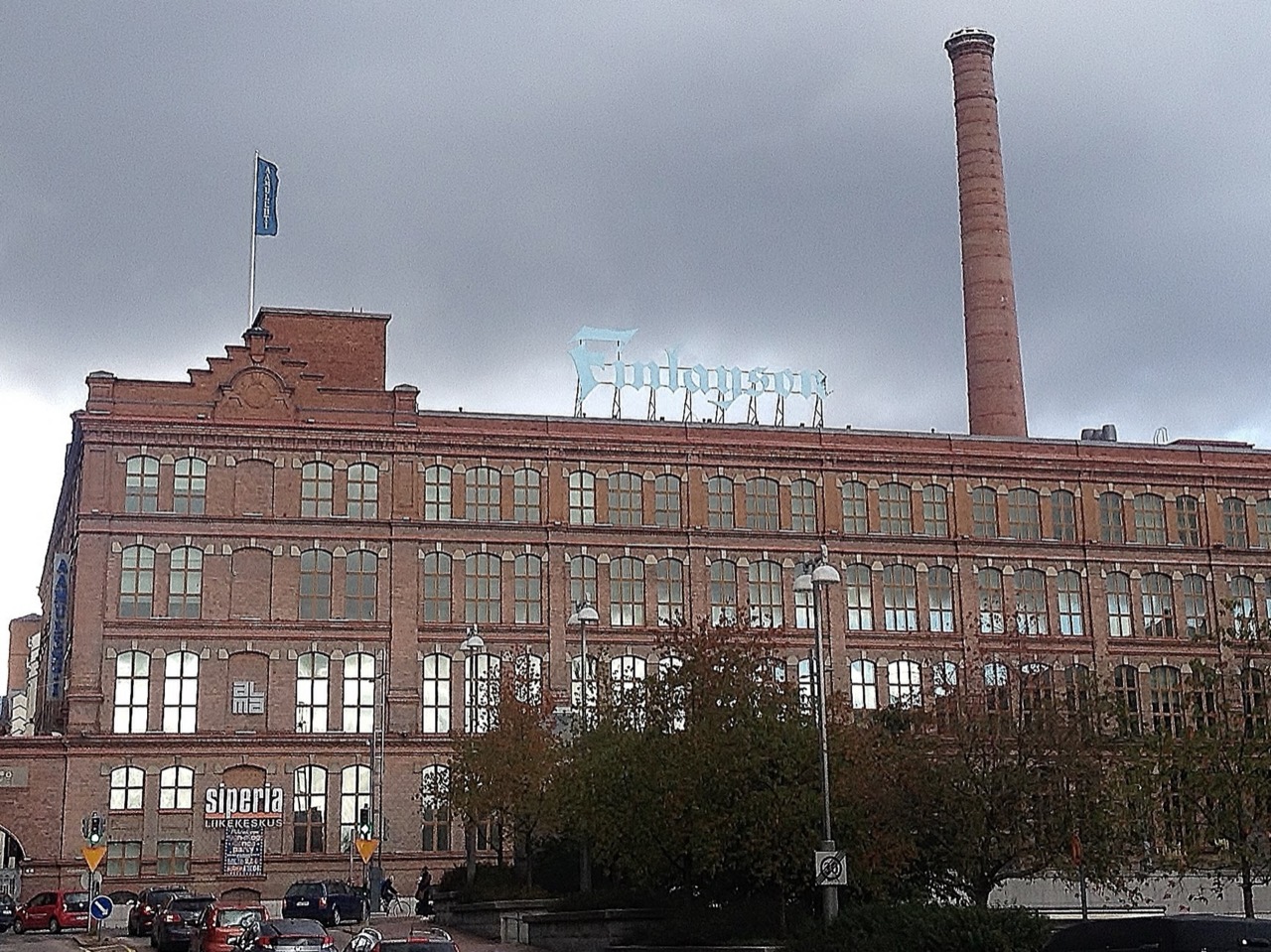
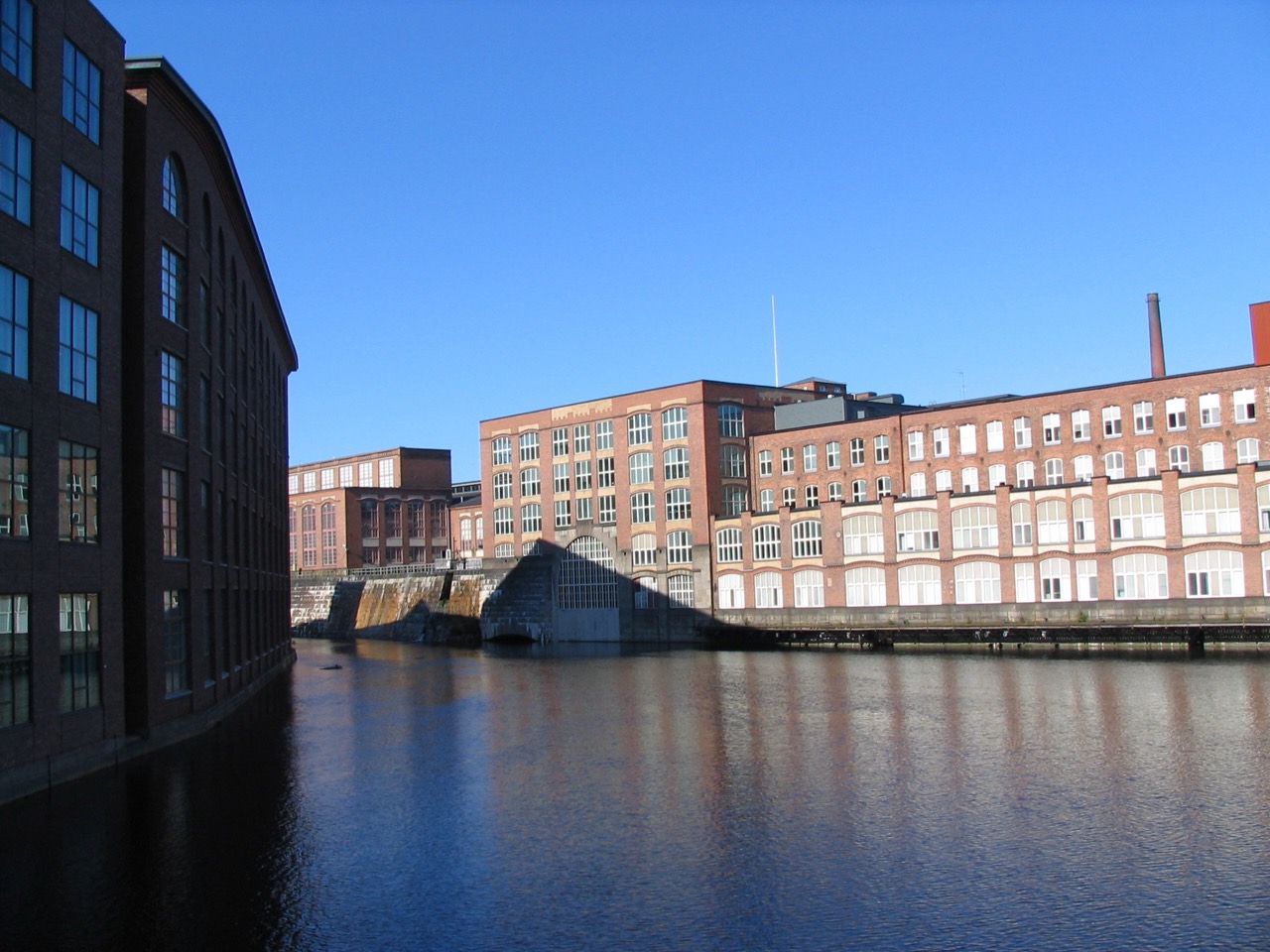
The vessel is a 200-year-old factoryThe Finlayson textile complex in Tampere. A protected industrial heritage district where red brick mill blocks line the rapids. Uumen's 99 rooms sit inside this brick shell. ⓒ Wikimedia Commons
Daily Hotel
Uumen Hotels: 39 Euros, 5㎡, No Bathroom and No Front Desk
2026.07.24
Last May a hotel charging 39 euros a night, about 57,000 won, opened in the 200-year-old textile mill district of Tampere, Finland. The room is 5㎡, and a door, a bed and storage are all of it. There is no bathroom. Locking shower and toilet booths sit in the corridor instead. There is no front desk. One wristband opens the room and the shower. Taking the bathroom out of the room and erasing the front desk are the two things that fold the whole cost structure of a 99-room budget hotel. If the prison hotel covered yesterday stood up by not buying land, this one stands up by removing the bathroom and the front desk. The same game played from the opposite end.
1.On May 14, 2025, Uumen Hotels opened in Tampere, Finland. It stands in the Finlayson textile mill district in the city center, at 5 Finlaysoninkatu. There are 99 rooms in all, in three types, single, double and four-bed. The rate starts at 39 euros a night, about 57,000 won, at 1,450 won to the euro throughout. What it claims is the cheapest hotel in the city.
2.The person who built it is Eetu Rahkola, a Tampere founder who was 30 at the time. Not a large chain, not a hotel corporation. A new brand pushed through by a small team on one clever idea. Construction started in October 2024 and it opened the following May. Seven months of preparation. For reference, the prison hotel in yesterday's piece took seven years in preparation alone.
3.The vessel is heritage. Finlayson is one of the earliest textile complexes in Europe, more than 200 years old, a protected industrial heritage district where red brick mill blocks line the Tammerkoski rapids. It is the tourism core of Tampere, packed with museums, restaurants and shops. Uumen stamped rooms out as modules and slotted them inside those protected buildings.
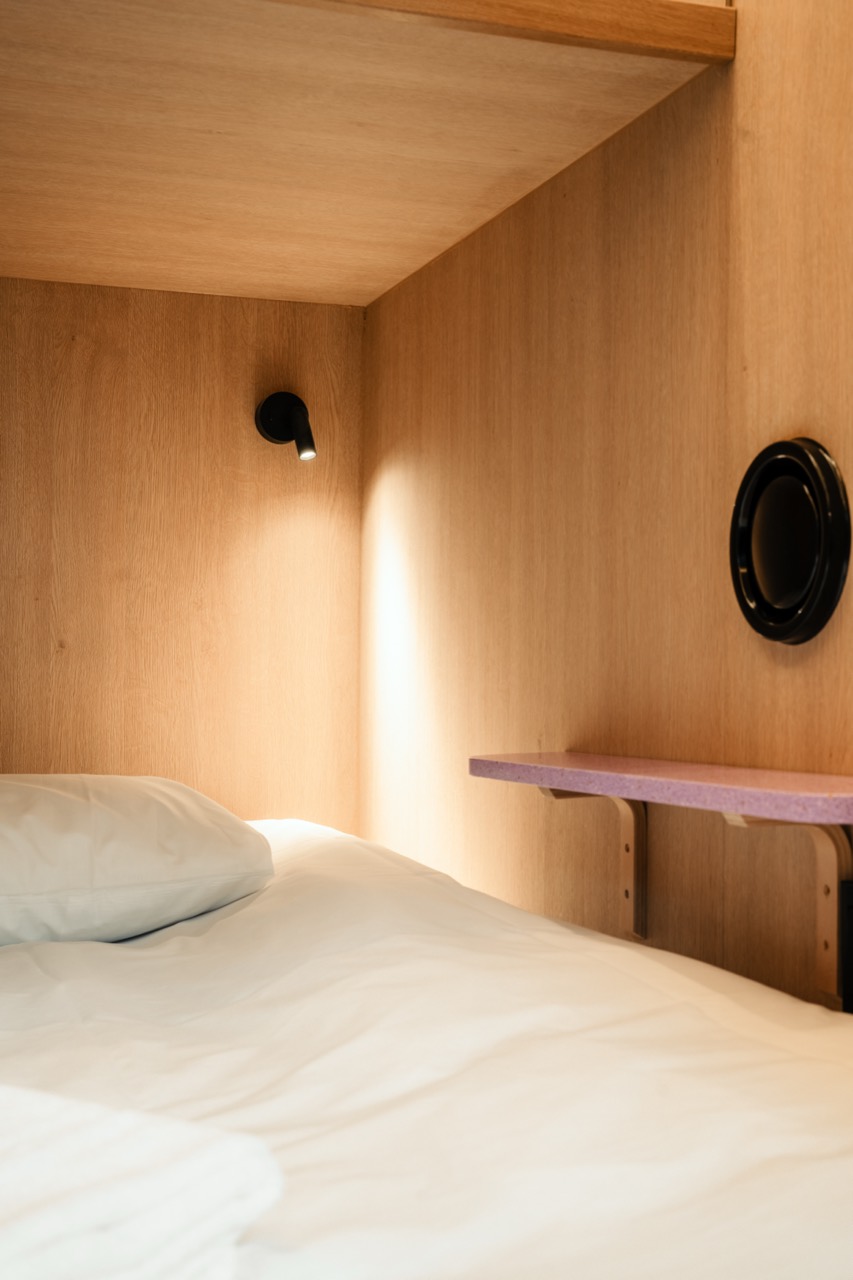
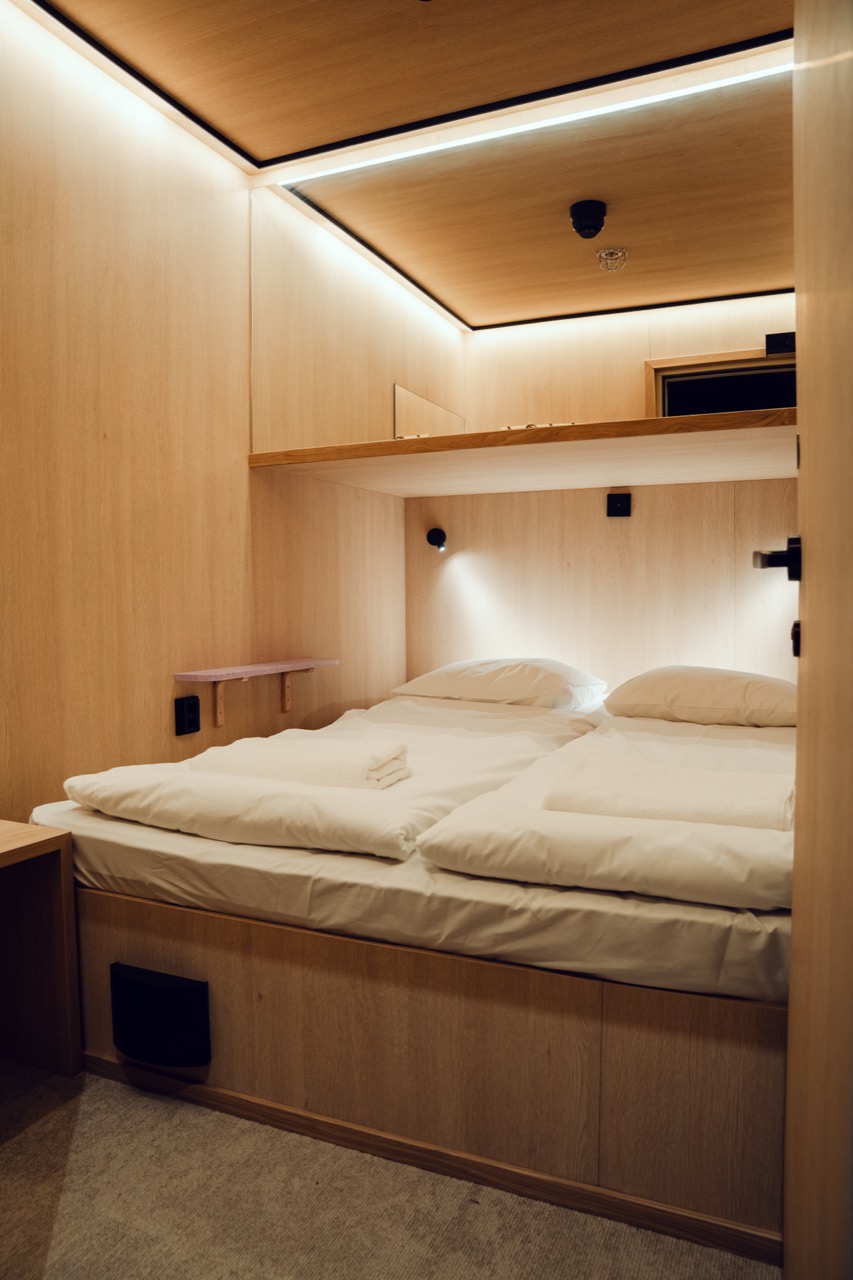
4.The concept is one line. Shrink the room and you do not have to compromise on quality. The idea came from Japanese capsule hotels, widened beyond a capsule. A microroom with a door, room to stand and a window. Not a coffin-like capsule but a very small room. That ambiguous middle ground is this hotel's product position.
5.The core of this piece is two things. There is no bathroom in the room. Showers and toilets moved to individual locking booths in the corridor. And there is no front desk. Digital check-in gives you a code, and a wristband opens the room, the shower and the common areas. A 24-hour self kiosk and remote support stand in for people. Later on both deletions get dug out in numbers to show why they are everything.
6.Take it apart, starting with the space. One microroom is about 5㎡. The composition is cold. A door, a narrow standing space, a built-in bed, storage. That is all. Sound insulation got attention instead, and only what rest requires stayed. The room is defined as a box for sleeping, and every other function was pushed outside it.
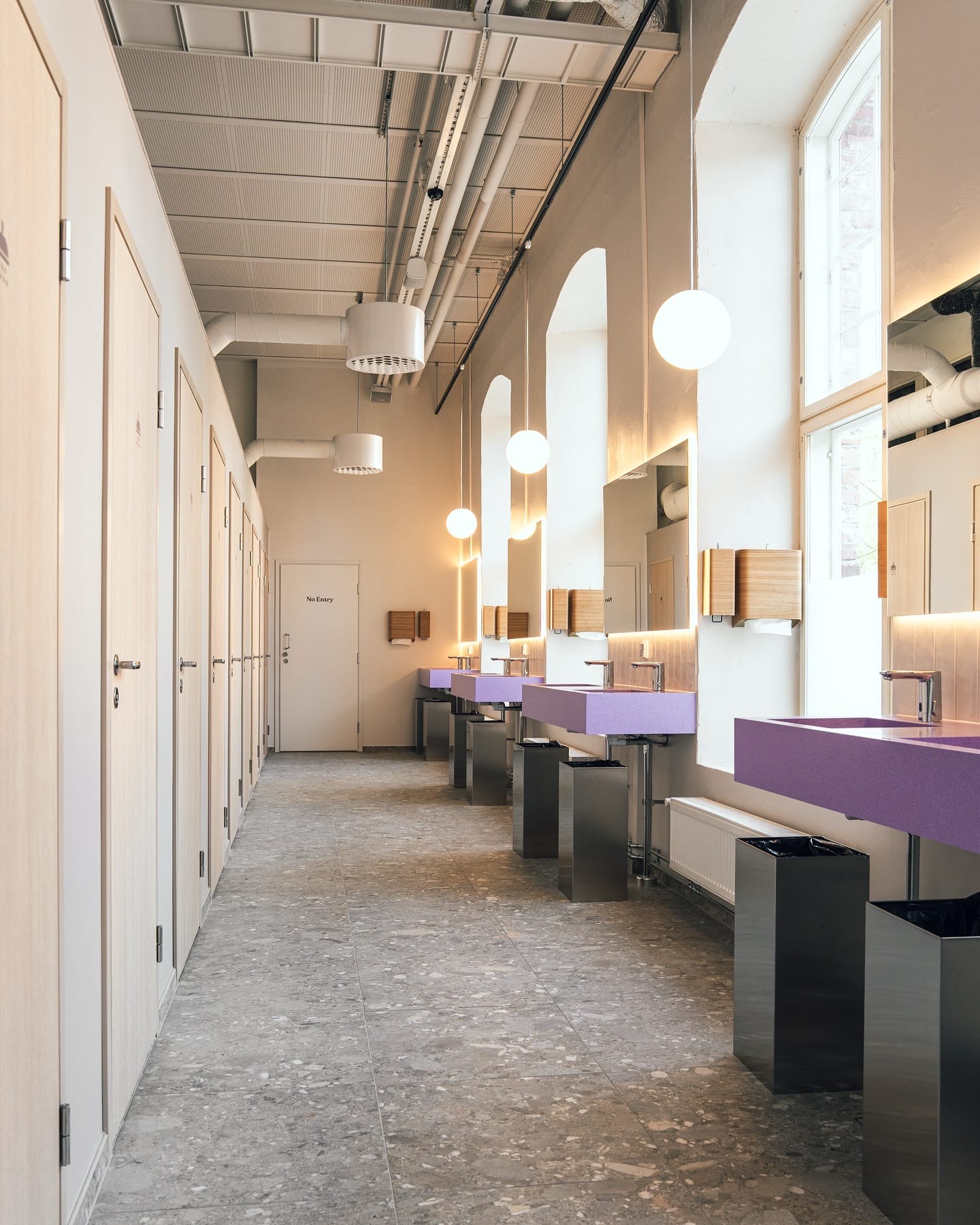
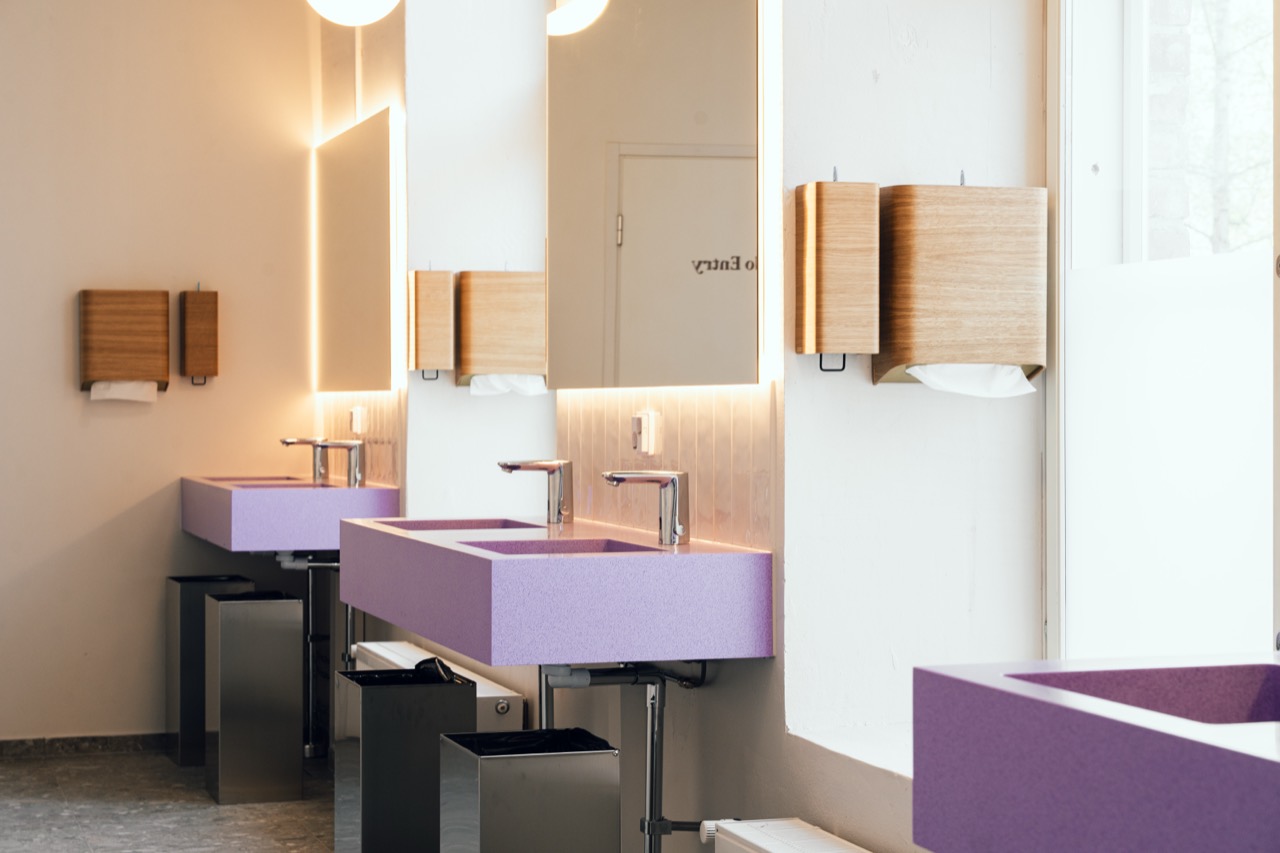
7.The decisive thing pushed out is the bathroom. Shower and toilet were separated into individually locking booths in the corridor. Single-occupancy units opened by wristband. Shared but not communal, a separation that keeps privacy. That one move folds space and cost at once.
8.A typical budget hotel room runs 14 to 16㎡ of bedroom plus a 3.5 to 4㎡ ensuite, so one room lands around 18 to 20㎡. Uumen took the bathroom out of the room and folded it to 5㎡. With the ensuite gone the room floor drops to less than half, so roughly twice as many rooms fit into the same gross floor area. The real contest in budget hotels is decided here, on density.
9.The plumbing folds with it. Put a bathroom in every room and you get as many riser stacks and waterproofing points as you have rooms. A disaster in an old brick building. Uumen gathered the wet points into one place in the corridor and concentrated the plumbing. Fewer holes in a protected building, lower construction cost, and less leak risk later.
10.Construction is modular. Rooms were made as units in a Finnish factory, transported to site and finished in early 2025. Instead of building rooms conventionally inside a brick building, finished room boxes were slotted in. The program shortens, seven months, the protected building's original fabric is touched less, and quality variance drops. A choice aiming at speed, cost and environment at once.
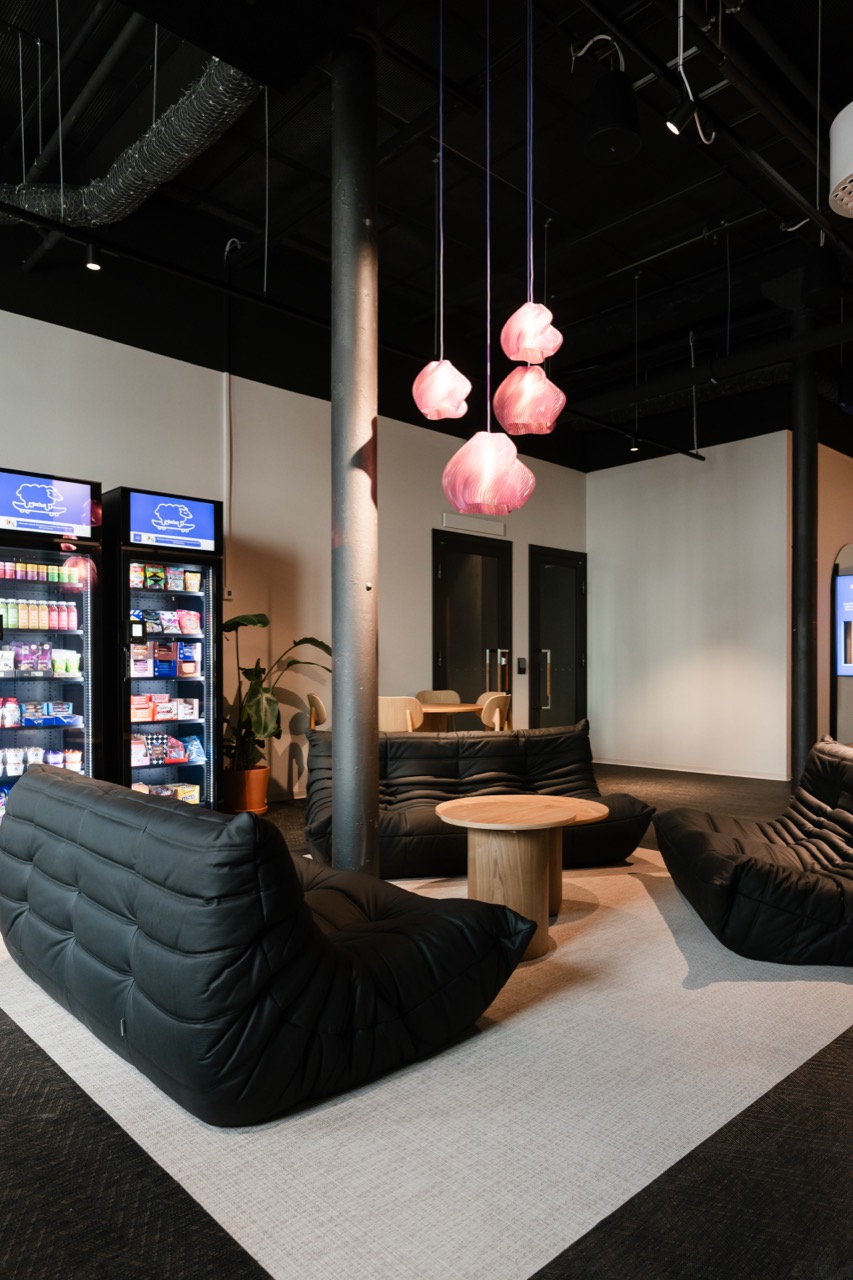
11.What compensates for the small room is the common areas. There is a lounge looking over Lake Näsijärvi, a rooftop terrace and a 24-hour self kiosk. The room is for sleeping only and time spent is designed into the common space. The sense of using the whole building rather than being shut in 5㎡ is what erases the stuffiness of a microroom.
The room is a box for sleepingA single microroom, about 5㎡. A door, standing space, a built-in bed and storage are all of it, with no bathroom. Wider than a capsule and with a door and a window, so it reads as a small room rather than a coffin. That middle ground is the product position. ⓒ Uumen Hotels
12.Into operations and revenue structure. The heart of this piece. Start with the rate. Singles from 39 euros, weekend peaks up to about 100 euros, roughly 145,000 won, with dynamic pricing moving between them. Rates jump when Nokia Arena events, visiting sports teams and the start of term stack up demand.
13.Occupancy and actual ADR are not published. What follows is an estimate. With a 39 euro floor on singles, higher doubles and four-beds, and a dynamic structure peaking at 100 euros on weekends, annual blended ADR looks like about 55 to 65 euros. The midpoint of 60 euros, about 87,000 won, is used here.
14.For occupancy, given a city center location, the lowest price position and event demand, assume the high turnover typical of budget and take 65 to 70% a year. At 68%, RevPAR, revenue per available room, comes to about 40 euros, roughly 58,000 won. Luxury earns on ADR, this side earns on occupancy.
15.Converted to revenue per key, 60 × 0.68 × 365 gives about 14,900 euros a key, roughly 21.6 million won, and multiplying by 99 rooms gives room revenue alone of about 1.48 million euros a year, roughly 2.1 billion won, by estimate. The real KPI in micro lodging, though, is not revenue per key. It is revenue per square meter. With twice the rooms on the same floor, one square meter of floor earns double what it does in an ordinary hotel. That is the number that justifies 39 euros.
16.Cost lever one, the erased bathroom. Removing the ensuite did not only fold area. Waterproofing and plumbing work per room disappeared, which lowers capital cost, and cleaning shifts from wiping a bathroom in every room to managing corridor booths centrally, which cuts housekeeping routes and time in operating cost. In a budget hotel the room bathroom is the most expensive and most labor-hungry part. It was taken out whole.
17.Cost lever two, the erased front desk. The largest item in budget hotel operating cost is labor, and within it the 24-hour front desk. Uumen removed the staffed desk with digital check-in, wristbands and 24-hour remote support. What remains is effectively housekeeping and light operations. The 39 euro rate could not stand up at all without that compression of labor cost.
Where a person used to standA floor Uumen presents as common use space. With no staffed desk and everything running on self check-in and wristbands, the spot where labor cost was heaviest turns into facility. ⓒ Uumen Hotels
18.Cost lever three, the erased conventional build. Modular cut the program to seven months. Program is financing cost and pre-opening fixed cost. The shorter the time from groundbreaking to revenue, the faster the capital comes back. Building rooms conventionally inside an old protected building would have multiplied both the program and the cost several times. Modules are the key to the speed problem in heritage conversion.
19.Channels and ancillaries. A new budget brand leans heavily on OTAs, Booking.com and the like, early on. The problem is that 15 to 18% commission on a 39 euro room leaks 6 or 7 euros, which is fatal on thin budget margins. So Uumen is pushing direct share up through the Uumen Village loyalty program and digital-native direct booking. Food and drink were outsourced to a partnership breakfast with a nearby bakery plus vending machines. With zero kitchen and food staff the margin is low and the risk is nil.
39 euros dissectedLuxury earns on ADR and budget earns on density. Pushing the bathroom out of the room fits about twice the rooms onto the same floor, and unstaffing the front desk erases the largest labor cost. Areas, occupancy and revenue are the writer's estimates laid on published facts.
20.First, price. Hotels in Nordic cities are expensive. Throwing a floor in the 57,000 won range into the middle of that is a powerful wedge on its own. It lands exactly on price-sensitive demand that does not spend long in the room, backpackers, students, visiting sports teams, groups of friends.
21.Second, the capsule stigma was erased. Capsule hotels are cheap and carry the psychological resistance of sleeping in a coffin. Uumen crossed that with a microroom that has a door, a window and room to stand. As dense as a capsule while selling as a small room, aimed exactly at the empty slot between capsule and hotel.
22.Third, the halo of design. Put a cheap product inside a heritage shell of 200-year-old brick mills and budget becomes tasteful thrift rather than shabbiness. The same 5㎡ inside a bleak new box or inside red brick industrial heritage divides willingness to pay. The space raises the grade of the product.
The same 5㎡, a different gradeThe district between the Finlayson mill blocks. This shell, with the red brick left as it is, lifts the grade of a 39 euro room. ⓒ Wikimedia CommonsWater built the factoryThe Finlayson and Tampella factory districts face each other across the Tammerkoski rapids. Two hundred years ago this current turned the looms, and tourists now walk between the brick. ⓒ Wikimedia Commons
23.Fourth, the social layer of the common areas. The lake-view lounge and rooftop turn a narrow room into a stay rich in amenity. For solo travellers, digital nomads and younger guests, the lounge matters more than the room. This allocation, shrinking the room and enlarging the common space, matches the grain of small lodging demand now.
Time is spent hereThe room shrank and the common areas grew. The lake-view lounge and rooftop absorb the stuffiness of a narrow room. For solo travellers and nomads this common space is the center of the stay rather than the room. ⓒ Uumen Hotels
24.This is not the first. The source of the microroom is Japanese capsule and pod hotels, nine hours and First Cabin. The current that put privacy and sound insulation into a narrow unit and pulled it away from cheapness. Uumen widened that capsule one step into a room with a door and a window.
25.Europe has its own. citizenM, Yotel, Zoku, Moxy and Ruby have already been running the micro and lifestyle formula of shrinking the room and enlarging the common space. That grammar of 15 to 18㎡ rooms with a lobby used as a living room. Being Finland's first microroom, turned over, also means being a late arrival onto a proven playbook.
26.Uumen's real cleverness lies in combining the three. Capsule density plus hostel shared bathrooms plus hotel privacy, a door and a window, plus unstaffed operating technology. None is new on its own, and the combination of those four in one product makes the 39 euro price. The contest of ideas was won on the combination rather than on the ingredients.
27.A mirror of yesterday's piece. Yesterday's prison hotel erased the largest capital items, land and building, from the books to make 48 keys on 100,000㎡ of extreme low-density luxury stand up. Uumen is the exact opposite. It erases the most expensive costs, the bathroom and the front desk, to make 99 keys of extreme high-density budget stand up. One low-density luxury, one high-density budget. Opposite poles, and the way of winning is identical. Delete the largest cost.
28.The weakness stated honestly. A 39 euro, 5㎡ structure rides entirely on occupancy. With thin margin per room it only stands up when high density and high occupancy run together. If demand cools, if maintenance costs on an old brick building spike, or if OTA commission does not shift to direct booking, a thin margin flips into the red in no time. Budget is a business that forgives no mistakes.
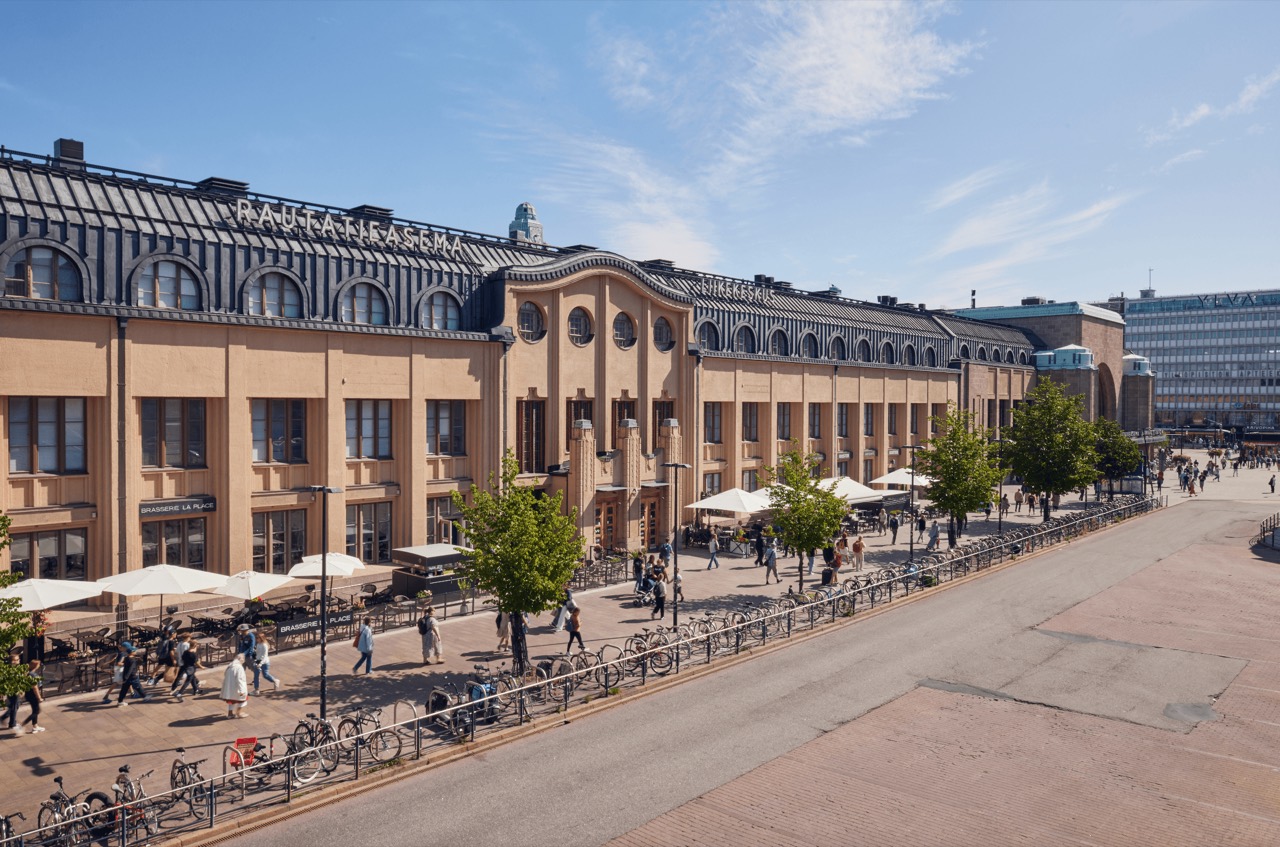
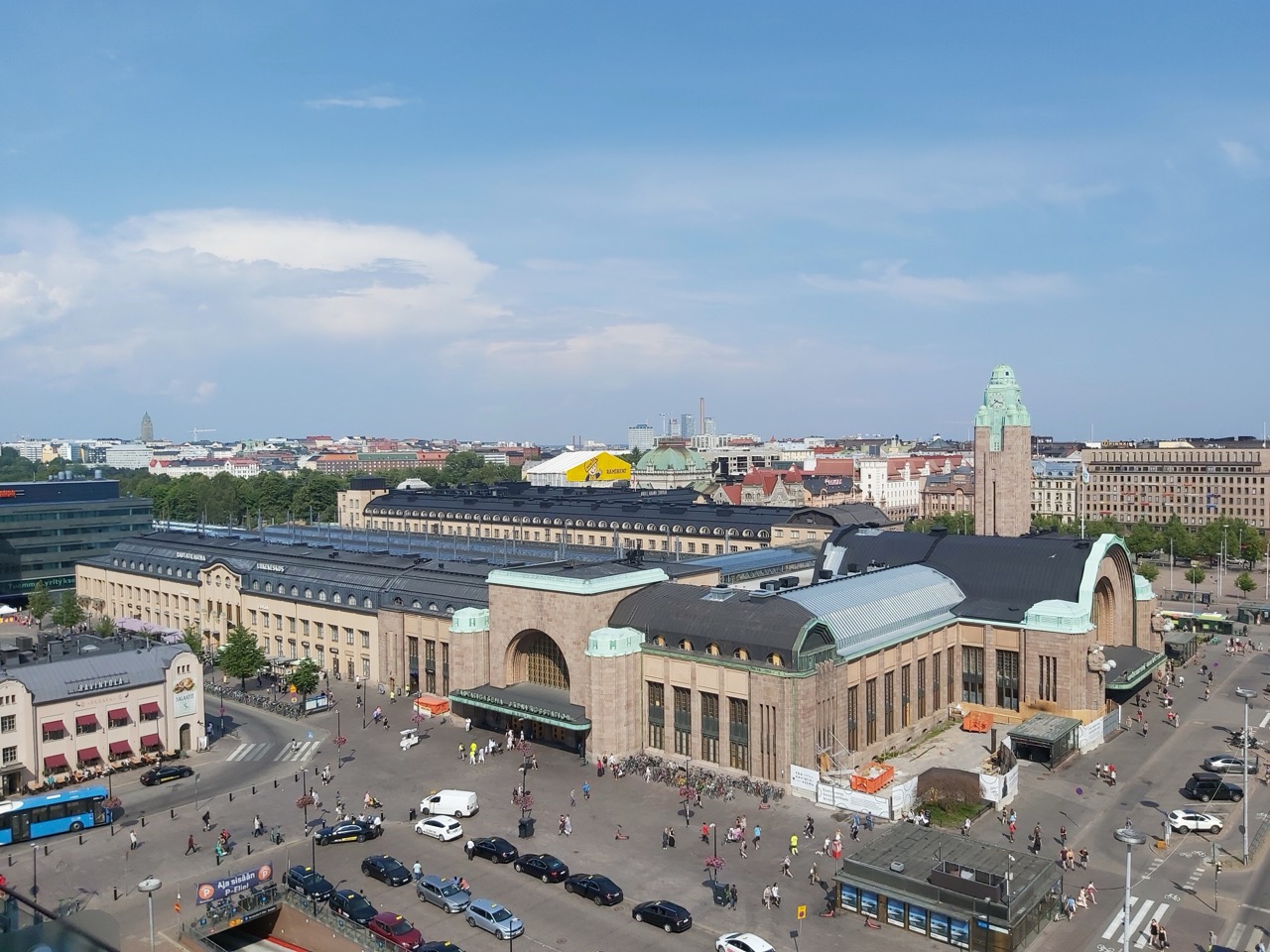
29.So the decisive signal is this. Uumen is already building a second site. In spring 2027, 150 rooms open at Elielinaukio in front of Helsinki Central Station. Micro hotel economics only really profit when brand, systems and modular design spread across several sites. One property barely breaks even, and as a chain the fixed cost folds. The body of this business is not one hotel, it is the rollout.
Helsinki is nextThe image Uumen released announcing its second site in Helsinki. When 150 rooms open at Elielinaukio in spring 2027, it will be 1.5 times the 99 rooms in Tampere. ⓒ Uumen HotelsWhy in front of the stationHelsinki Central Station. Elielinaukio, where the second site will go, is the plaza in front of it. Demand that does not spend long in the room is decided by walking distance from the station. ⓒ Wikimedia Commons
30.This is not a story about selling cheap, it is a story about redesigning cost so it can be sold cheap. Move the bathroom to the corridor, swap the front desk for a wristband, stamp the rooms out in a factory, and fill the missing sense of stay with common areas. Every decision points the same way. Lower cost per room, raise density, and let that density carry a low rate. Small lodging with a good idea is always threaded on one line of logic like this.
Same module, different capacityA double microroom. On the same ultra-small module logic as the single, only capacity changes, taking couples, friends, families and visiting teams. A way of holding density and flexibility at once. ⓒ Uumen Hotels
Summary
Uumen, a 99-room micro hotel, opened in May 2025 in the 200-year-old textile mill district of Tampere, Finland. The room is about 5㎡ with only a door, bed and storage, the bathroom moved to locking corridor booths and the front desk replaced by wristbands and unstaffed operation. Pushing the ensuite out of the room fits about twice the rooms into the same gross floor area, and the thin figures of an estimated 60 euro ADR, 68% occupancy and 40 euro RevPAR just about hold on top of that density. If yesterday's prison hotel made low-density luxury stand up by erasing land and building, Uumen makes high-density budget stand up by erasing the bathroom and the front desk. Opposite poles on the same principle. Anyone moving this to Korea gets stopped at the window first. Using a 5㎡ room as a habitable room requires daylight openings of at least a tenth of the floor area under the Building Act, so Uumen choosing a microroom with a window was no accident. Unstaffed operation has to carry guest identity verification and youth protection equipment, and using an old factory as the vessel brings change of use, fire safety and parking, three gates that arrive before the window.
Not compromising on qualityThe room is small and the finish was kept restrained but real. What reduces stuffiness in a narrow area is the detail of material and lighting, and that is exactly where capsule and microroom part. ⓒ Uumen Hotels