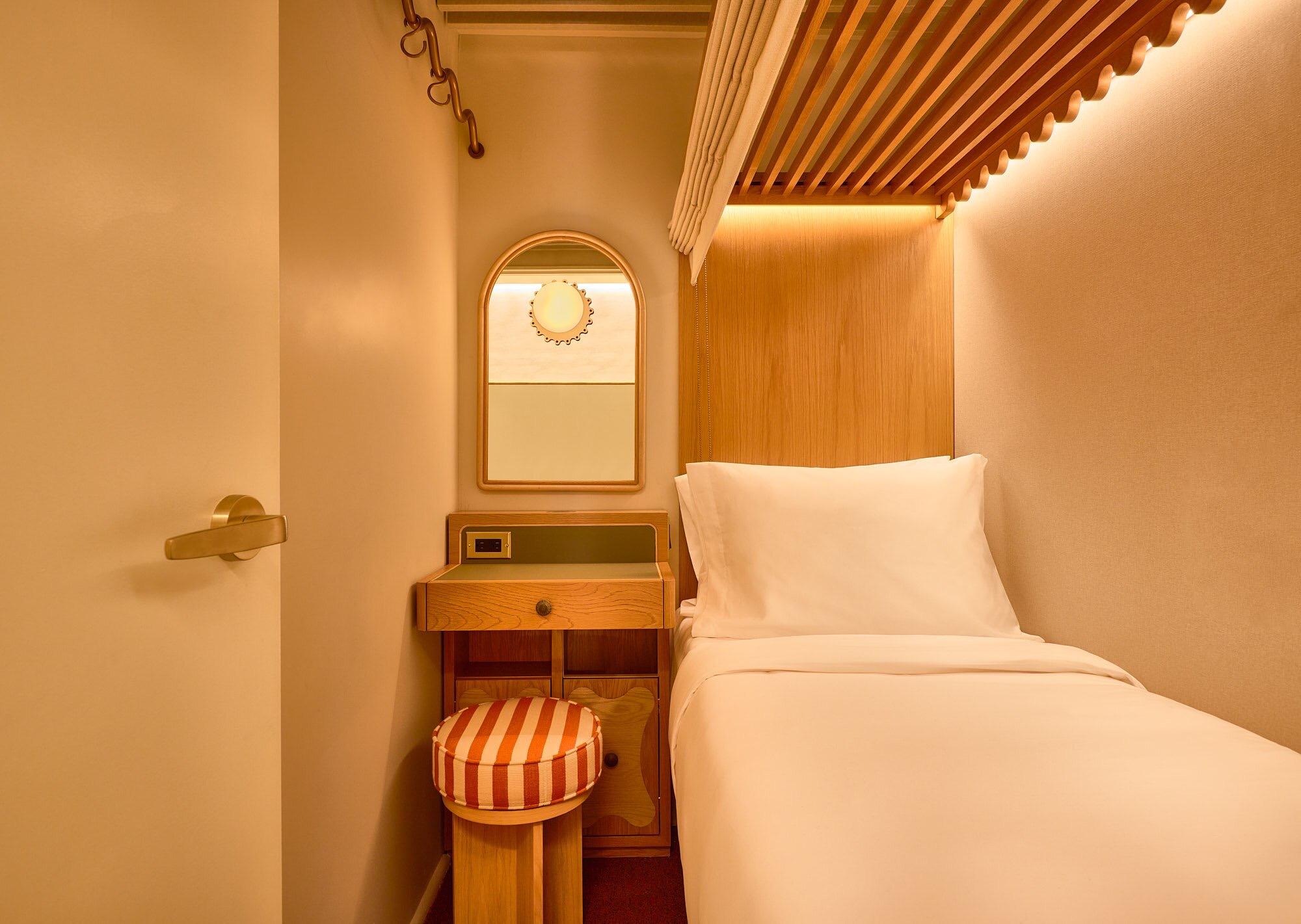
A room in the middle of Manhattan measures 2.97㎡. There is no window and the bathroom is shared by the floor, and at 125,000 won a night it earns 3.5 times what an average Manhattan hotel earns per unit of area. A hundred years ago this building was a flophouse.
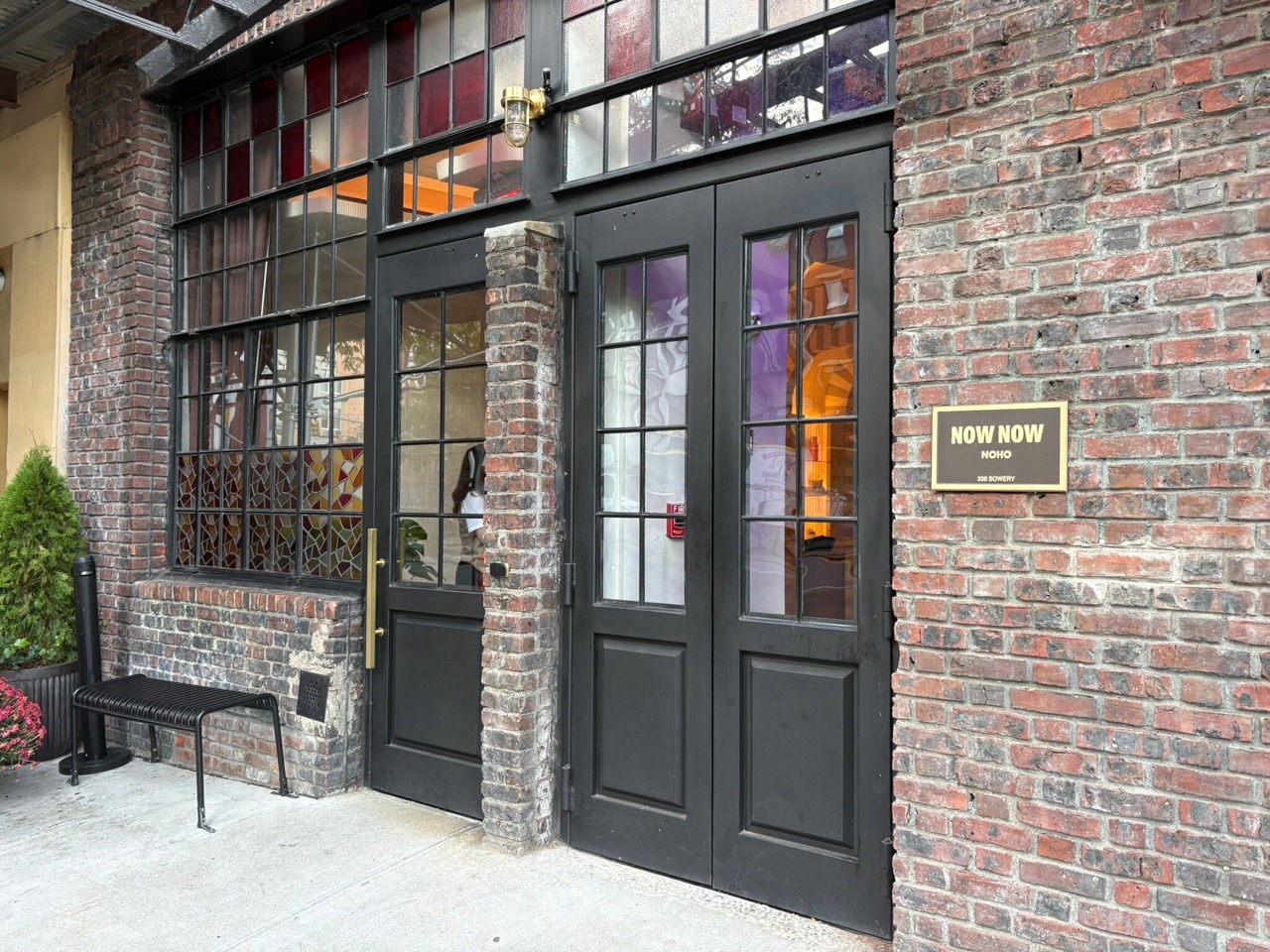
1.Now Now NoHo opened on April 2, 2025 at 338 Bowery in Manhattan, New York, inside the NoHo historic district. What it calls itself is unusual, neither a hotel nor a hostel but a sleeper cabin hotel.
2.There are 180 cabins, 177 by the operator's own count. The base Cozy cabin measures 32 square feet, about 2.97㎡, and inside it go a 74-inch (188cm) single bed, storage above and below the bed, a desk, a vanity mirror and a door that locks. Rates start at $125 a night. Actual bookings drop to around $118.
3.One step up is the Now or Never cabin. At 53.8 square feet, about 5㎡, it is 1.7 times the base. Only ten of them exist, each with a mural by a local artist, and the premium is $30 a night. The area is 1.7 times and the rate is only 24% more.
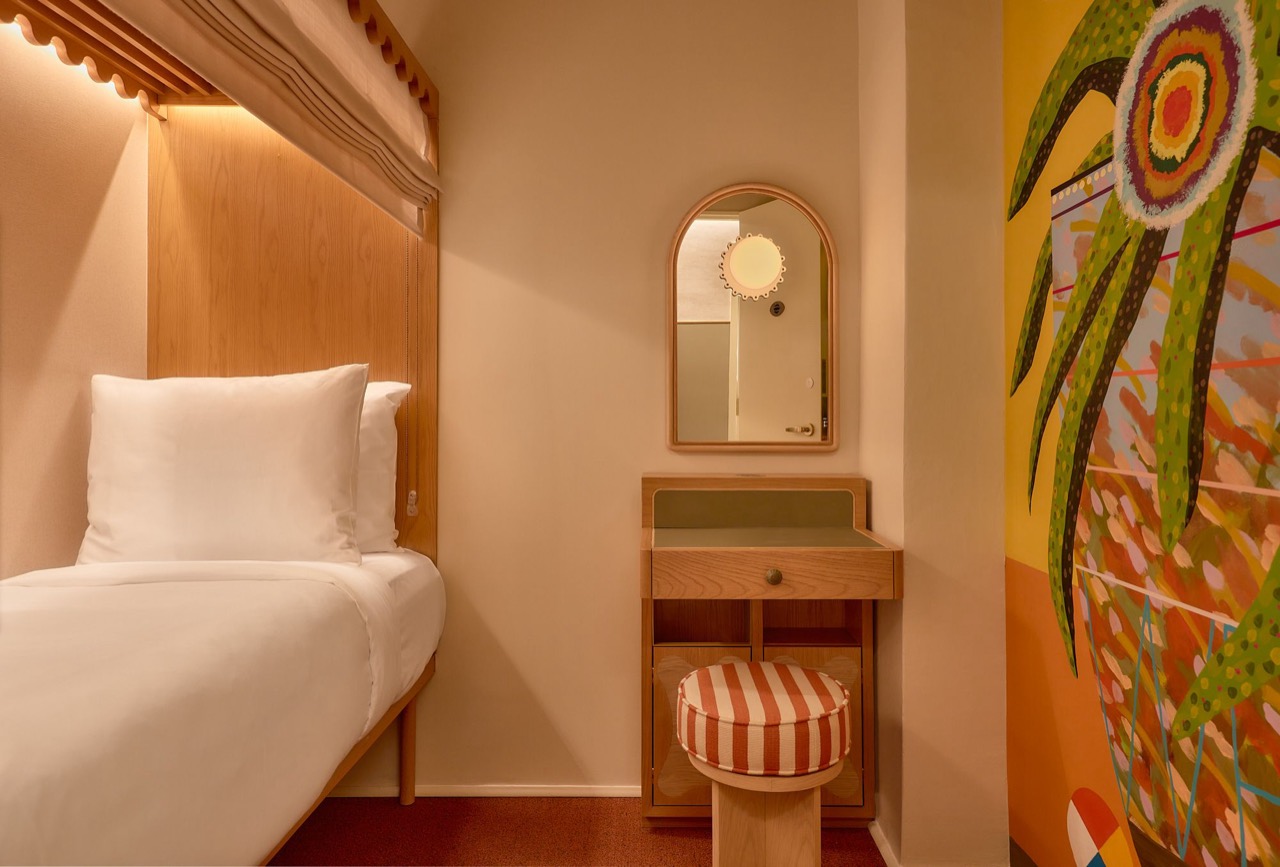
4.The operator is Dovetail + Co, a boutique group running hotels and bars in Hawaii, California, Rhode Island and Bermuda, and this is its seventh hotel. Design is by Islyn Studio of New York. The concept is stated outright: the efficiency of a Japanese capsule hotel, the romance of a European sleeper train, the sociability of a hostel.
5.The building's own record is the main story. It was a lodging house from 1899, the Bellevue Hotel, and in 1917 the Italian immigrant Eusebio Gerardi opened it as the White House Hotel. In 1929 it swallowed the neighboring lot at 338. At its peak in 1950 it had 234 rooms. The word used then was cubicle.
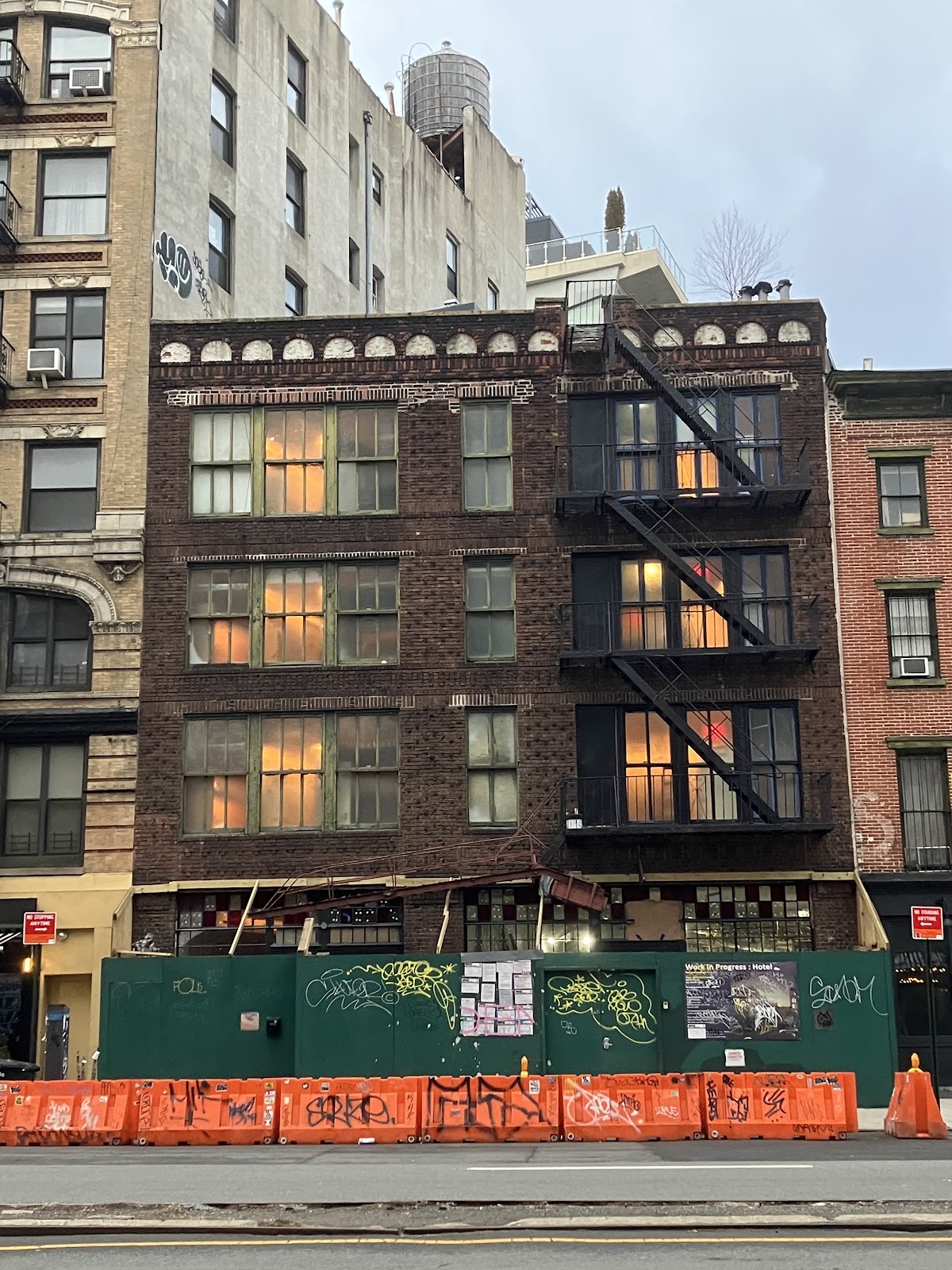
6.Take it apart. How do you fit a hotel into 2.97㎡. The answer is subtraction. No window. No bathroom. No wardrobe, no television. Three things stay, the bed, the storage and the lock. Everything else was pushed out into the building's common areas.
7.The key detail is the ceiling. Cabin ceilings are not closed up to the slab, they are finished with an acoustic baffle grid so air passes between rooms. The principle is identical to the wire mesh ceilings of the cubicles a hundred years ago, and the only difference is the noise treatment.
8.Close the ceiling and each compartment becomes an independent room, which brings daylight, ventilation, air conditioning and sprinklers per room. Leave it open and it is treated closer to a partition unit of furniture. Fitting 180 cabins into a four-story former lodging house came from that one move, not from the design.
9.Bolder still is the absence of an elevator. Guests climb four floors by stair, and accessibility is handled by putting accessible cabins on the ground floor. A new elevator is one of the most expensive line items in an old-building conversion, and it was cut out whole.
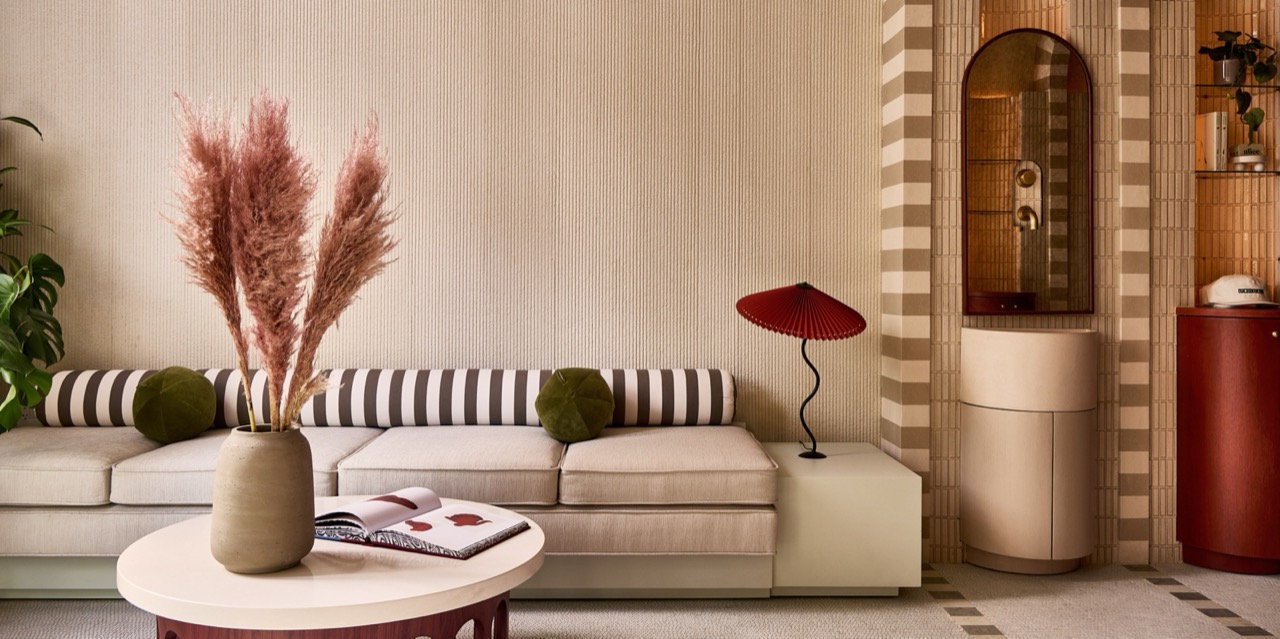
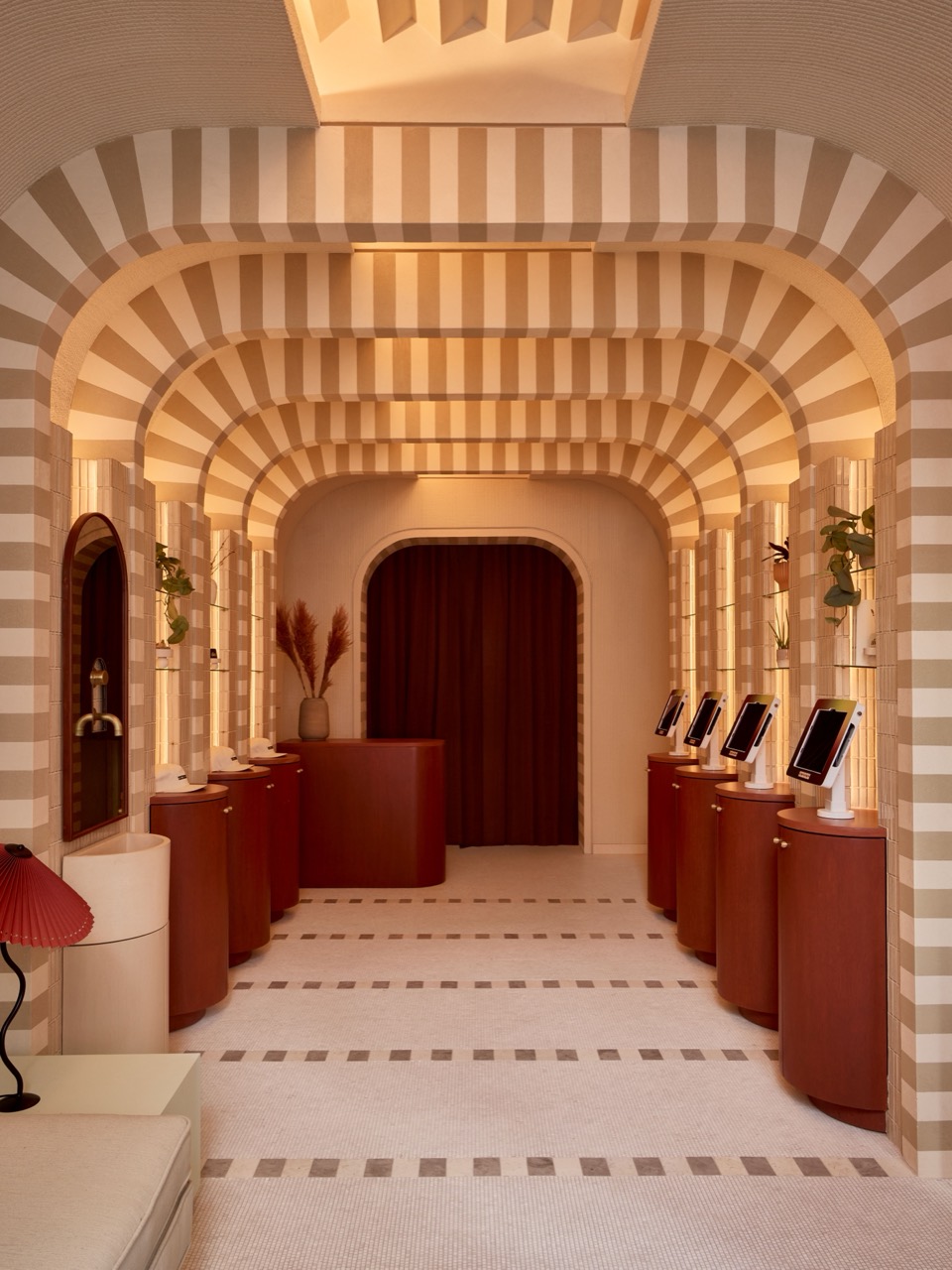
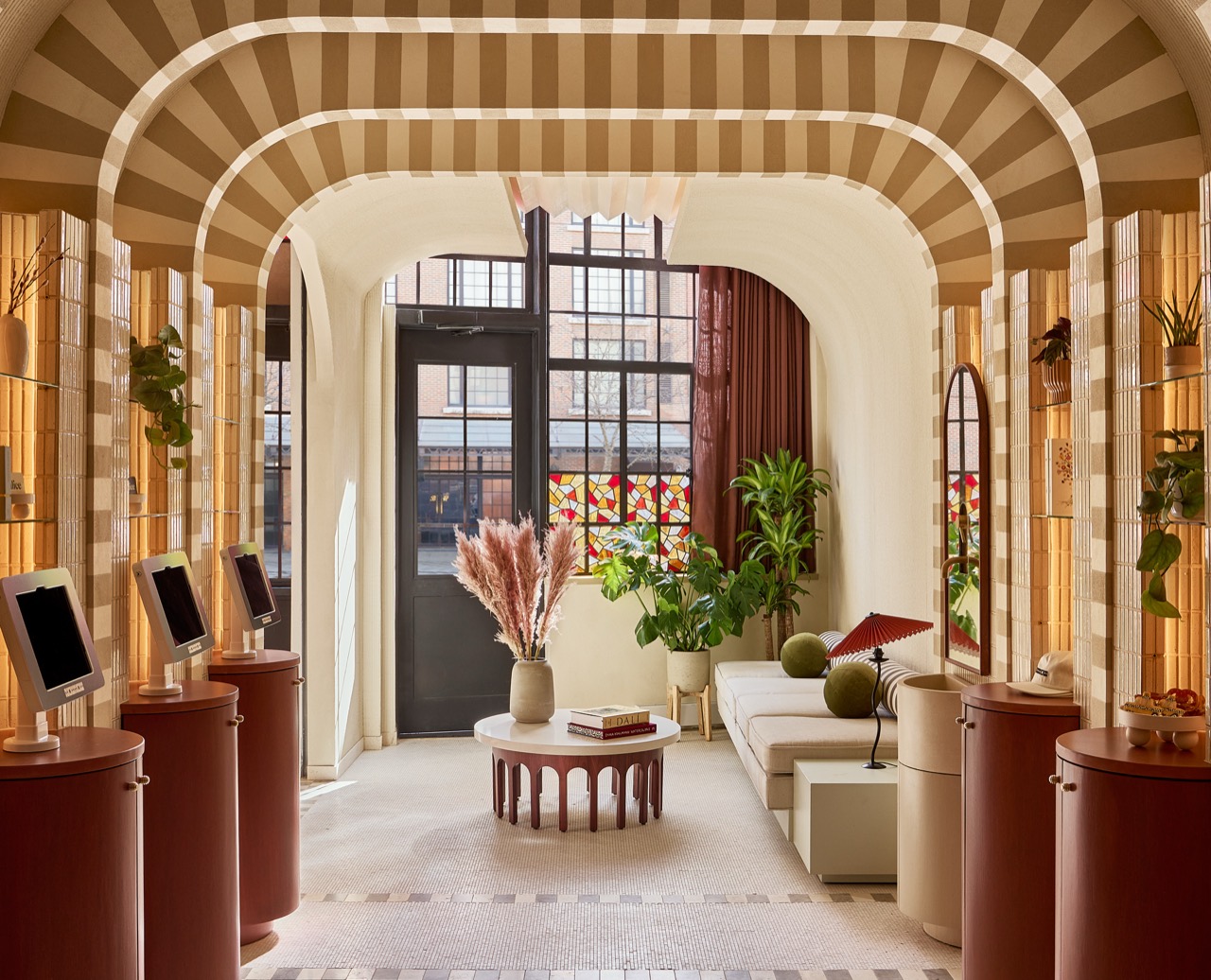
10.Bathrooms are shared by floor, though not in an open dormitory format. Showers and toilets are individual booths that each lock. The finish is art deco green and purple. Money saved in the rooms goes to the corridors, the bathrooms and the lobby.
11.Inside the room too, money goes to surfaces rather than to area. Wright mattresses, Garnier-Thiebaut linen, Brooklinen robes, Grown Alchemist amenities, a white noise machine, earplugs, an eye mask, wireless charging. Everything within reach was upgraded. In 2.97㎡, what is within reach is everything.
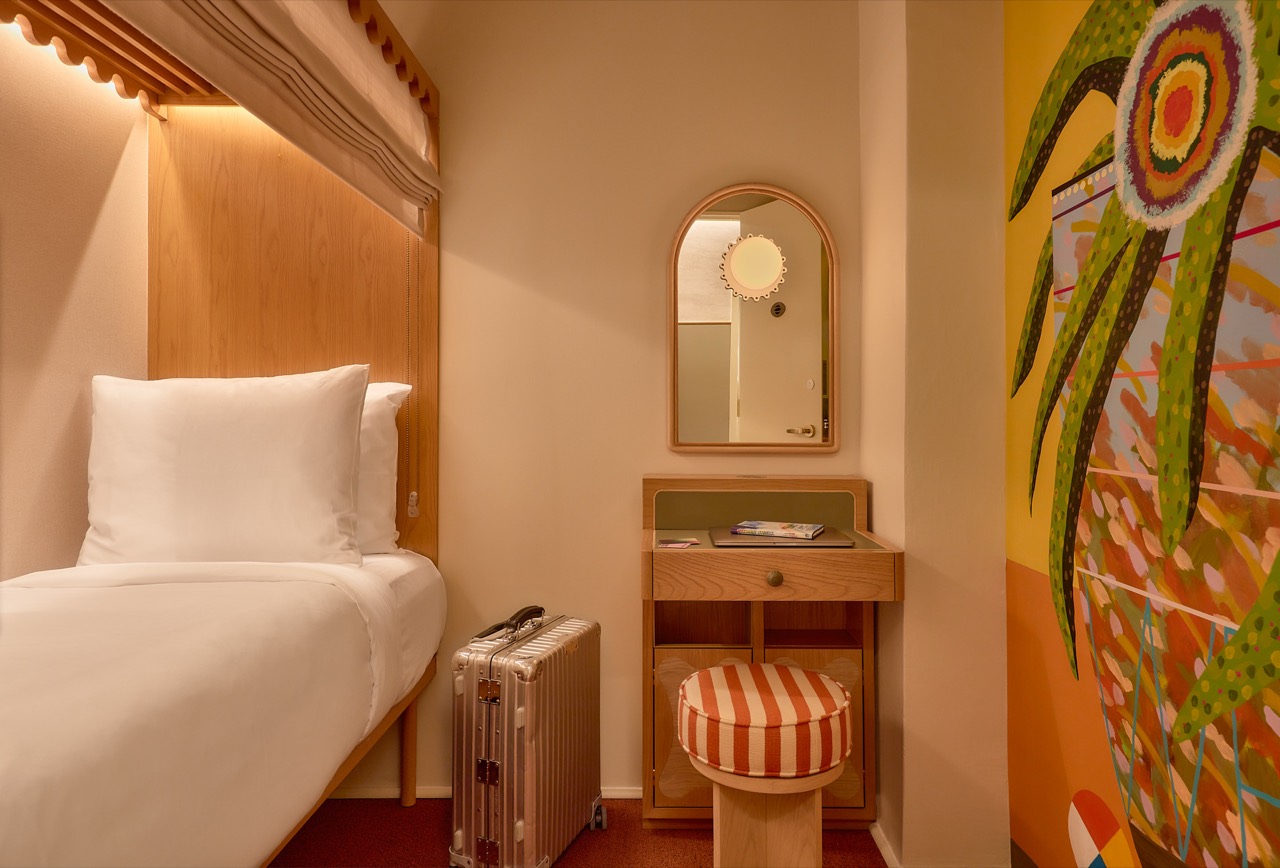
12.First, what this place sells is not area, it is a door that locks. A hostel dormitory has no door, only a curtain. Even at 2.97㎡, a locking door makes it your room, and the moment privacy comes loose from area the price is set again.
13.Second, it hit the gap exactly. The average daily rate for New York hotels in 2025 was $333.71, an all-time high, and at the other end sits a bed in a dormitory. Between them, the $100 to $150 band had no private room. Now Now did not create new demand, it drove a product into an empty price band.
14.Third, safety became a product. The Women+ floor, reachable by key card only, is for women and non-binary guests. The first reason women traveling alone avoid budget accommodation is safety, and that barrier came off with a single floor. It is a product made from an operating rule rather than from equipment, so it costs almost nothing.
15.Fourth, the name. The same building with rooms of almost the same size charged $45 in 2011 when they were called cubicles, and calling them sleeper cabins makes it $125. One word borrowed from the sleeper train moved narrowness from deprivation to adventure. Branding earned 2.8 times.
16.Fifth, subscription. Membership runs $99 a month or $999 a year. Annual members get one free night a month, twelve a year, plus 25% off further stays and early check-in. It turns a city hotel into a season ticket, sells off-season vacancy in advance, and sets a floor under occupancy.
17.This is not the first. The source is Capsule Inn Osaka from 1979, designed by the architect Kisho Kurokawa. It was the moment Metabolism, the architectural idea of repeating and plugging in small units, broke out into the lodging trade.
18.First Cabin reorganized that capsule into product grades. Founded in 2006, first branch in Namba, Osaka in 2009. The grammar came from aircraft. Business class at 2.5㎡ for around 4,000 yen, first class at 4.4㎡ in the 6,000 yen range. The point was making it an independent compartment with a high ceiling rather than a capsule, and the two-tier Cozy and Now or Never structure at Now Now carries that method over exactly.
19.In the United States The Pod Hotels came first. It started with Pod 39 in New York in 2007 and now runs four sites in New York alone, with rooms around 175 square feet. Now Now cut that to a fifth. The same line of descent, an order of magnitude apart in density.
20.The true source, though, is this building itself. The White House had 234 cubicles in 1950 and there are 180 cabins now. Seventy-five years on, the same building does the same thing again, and what changed is the grade of mattress, the name and the price. Not an invention, a rediscovery.
21.This is not a budget product. $125 divided by 32 square feet is $3.91 per square foot, while an average Manhattan room, about 300 square feet at an ADR of $333.71, is $1.11. That is 3.5 times per unit of area. The guest sleeps cheaply and the landlord sells far more expensively.
22.Developers are already running this arithmetic. A 22-story, 62m mass timber pod hotel at 948 Howe Street in Vancouver is going through permitting, with public consultation in May 2026. The scale is startling. The site is 3,000 square feet, a knife-thin lot with a 9m frontage.
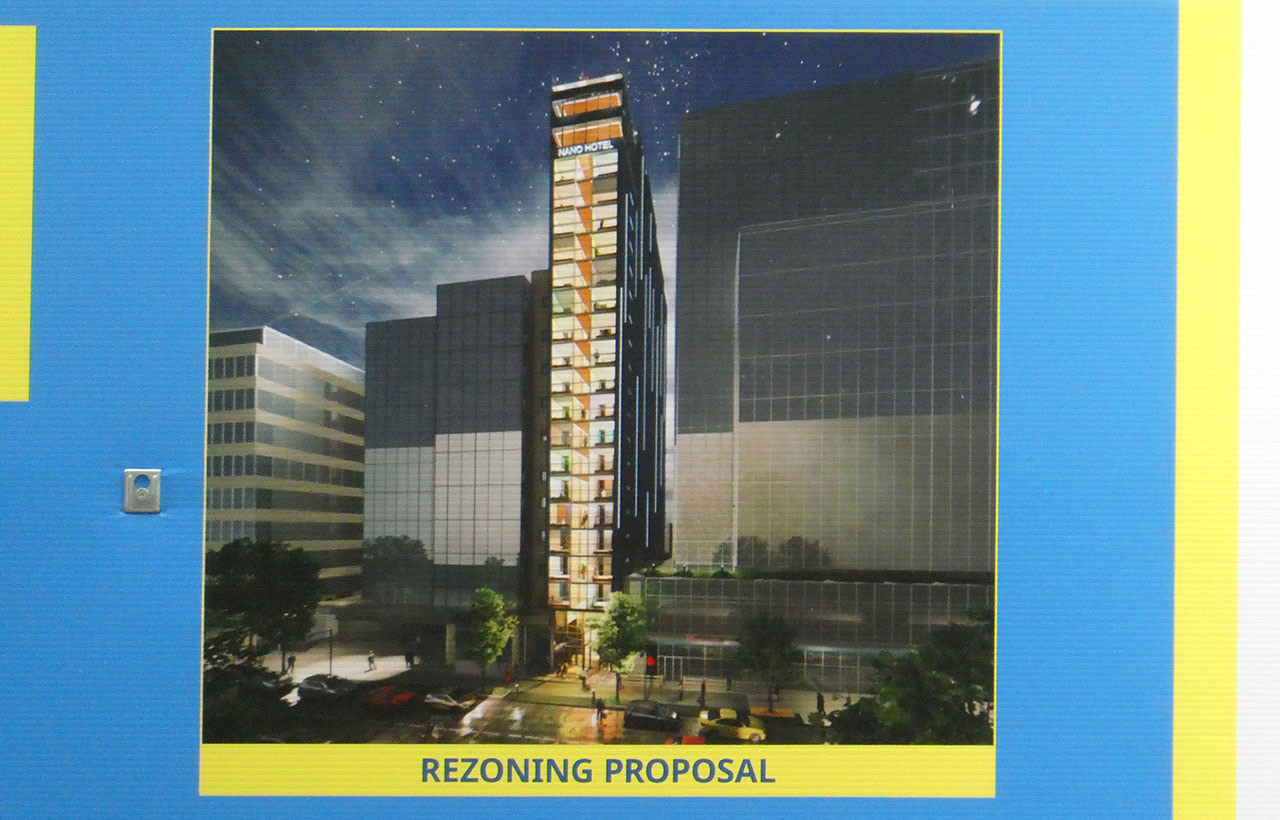
23.That site holds 408 rooms. 361 nano pods at 33 square feet and 47 nano rooms at 105 square feet, with about 56,000 square feet of gross floor area, which comes to roughly 12.9㎡ of gross floor area per room. A full-service hotel normally uses 43 to 56㎡ per room, so land efficiency runs three to four times higher. Seventeen floors are rooms and three are amenities, a gym on the second floor, a lounge on the twentieth, a bar on the twenty-first and a rooftop sky bar on the twenty-second.
24.One shadow gets written down honestly. The price of this conversion was people, and long-term residents who had lived in the White House for decades were pushed out through buyout offers and relocation. Rooms of the same form and the same size were resold to a different class at three times the price, and that is what this business actually is. Excellent as a product, contested as a piece of the city. Both are true.
25.A 1917 lodging house came back as 180 cabins of 2.97㎡, and what made that density is one move, leaving the ceiling open to the slab. The number that stays is $3.91 per square foot, 3.5 times the Manhattan average room. This is a land efficiency product rather than budget lodging, so the fight moves too. Rather than wrestling with drawings to win back a third of a square meter of floor, burning the same budget on mattress grade and sound insulation lands harder in the reviews, because the top complaint in a small room is the sound from next door and not the width. The name is a variable of the same order, and between $45 as a cubicle and $125 as a sleeper cabin there is almost no difference in equipment. One thing has to be cleared to move this to Korea, though. A four-story lodging facility with no elevator is effectively impossible here, and the standards for lifts, escape stairs and accessibility are far tighter than in an American old-building conversion, so the elevator portion of this project's capital saving cannot be stolen. Take the logic of the ceiling and the unit, and put vertical circulation into the budget from the start.