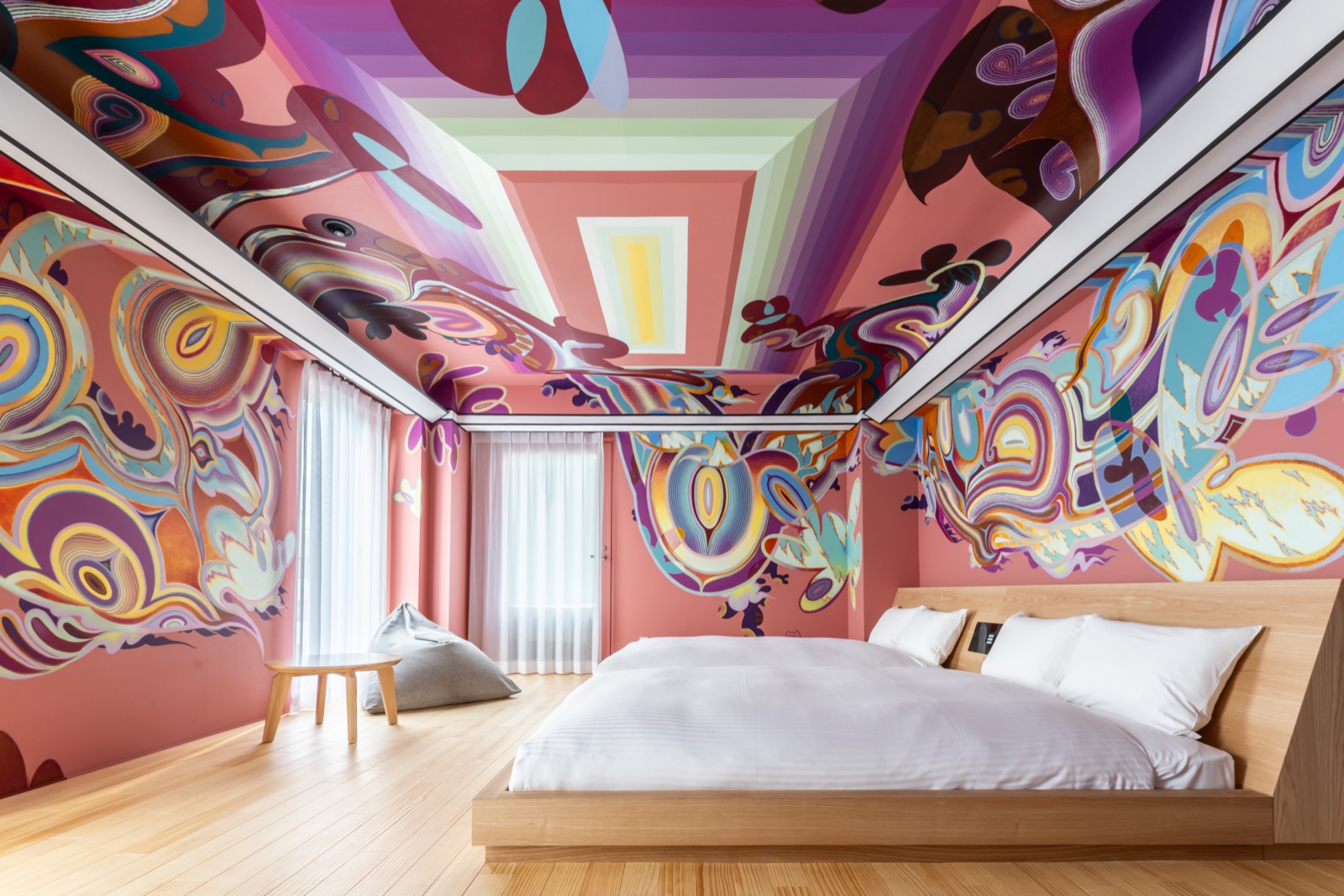
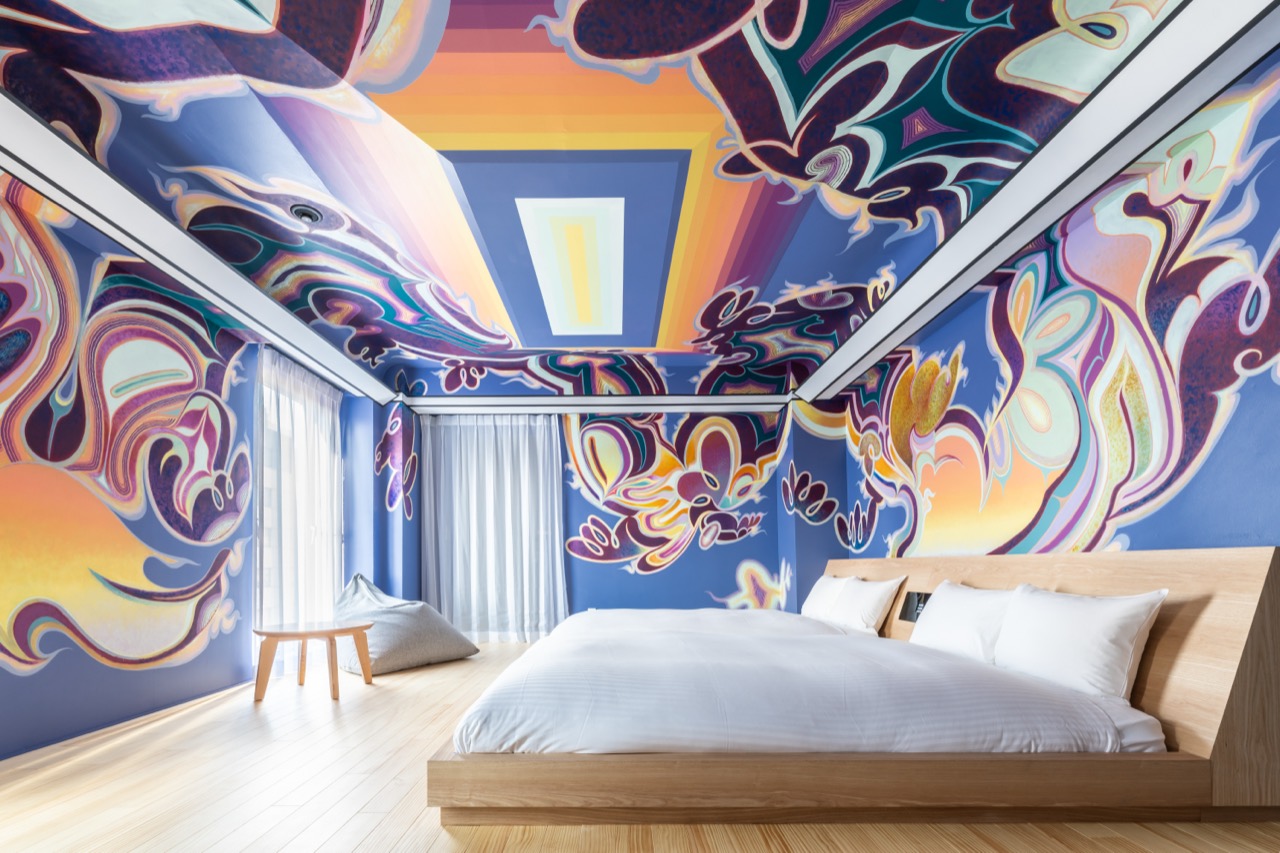
Mon Koutaro Ooyama's roomOne of this year's new works. Walls and ceiling are covered by a single painting. ⓒColumbia Works
Daily Hotel
31 rooms handed to 16 artists, and a share of every night goes back to them
2026.09.19
BnA Alter Museum, a ten-storey art hotel in Kyoto's Shijo-Kawaramachi district, has swapped ten of its rooms for new works seven years after opening. Every room keeps sending a share of its room revenue to the artist who made it.
1.One block off Kawaramachi, on a Takatsuji corner, stands a narrow ten-storey building. BnA Alter Museum opened here on May 17, 2019. It has 31 rooms, each made by an artist as a work of its own. Sixteen artists took part at opening, grouped under nine art directors. On April 1 this year, ten rooms came back to market either as new works or reworked ones.
2.Three companies split the job. The developer that bought the land and put up the building is Columbia Works, a Tokyo-listed property company; its subsidiary Columbia Hotel & Resorts runs the hotel; and BnA, a Tokyo art-hotel company, recruited the artists and planned the rooms. BnA set one condition. Each time an artist's room sells, part of the room charge goes to that artist, for as long as the room is sold.
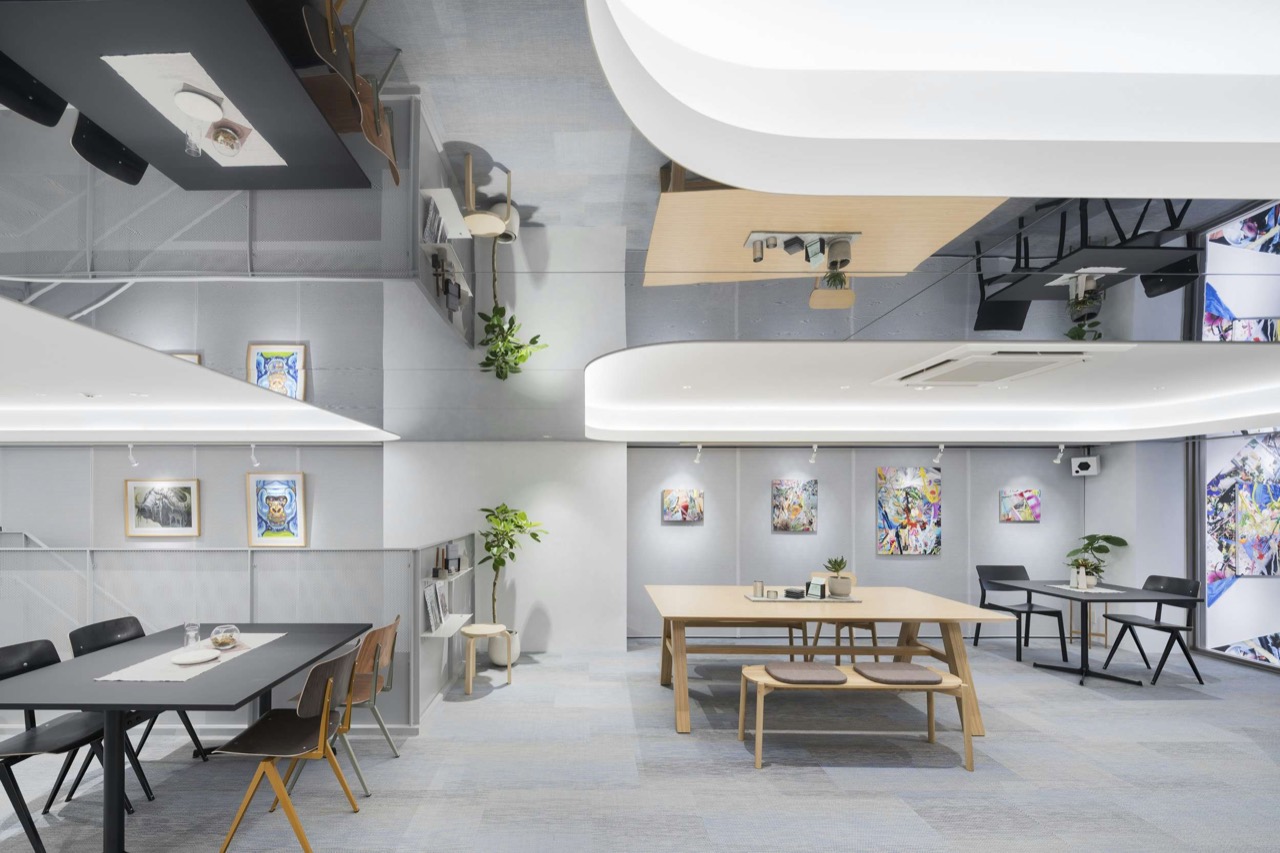
Second-floor cafe and galleryThe wall beside the dining tables doubles as an exhibition wall. The cafe opens from noon to 6 p.m. ⓒBijutsu Techo
3.The site is 237㎡, under 72 pyeong. A steel frame rises ten floors on it for 1,675㎡ of floor area, so each floor plate is a little over 167㎡. The ground floor holds reception and the bar, the second floor a cafe and gallery, and the eight floors from the third to the tenth are rooms. It is a pencil of a building, about four rooms per floor, and every room reworked this year is a 30㎡ quad.
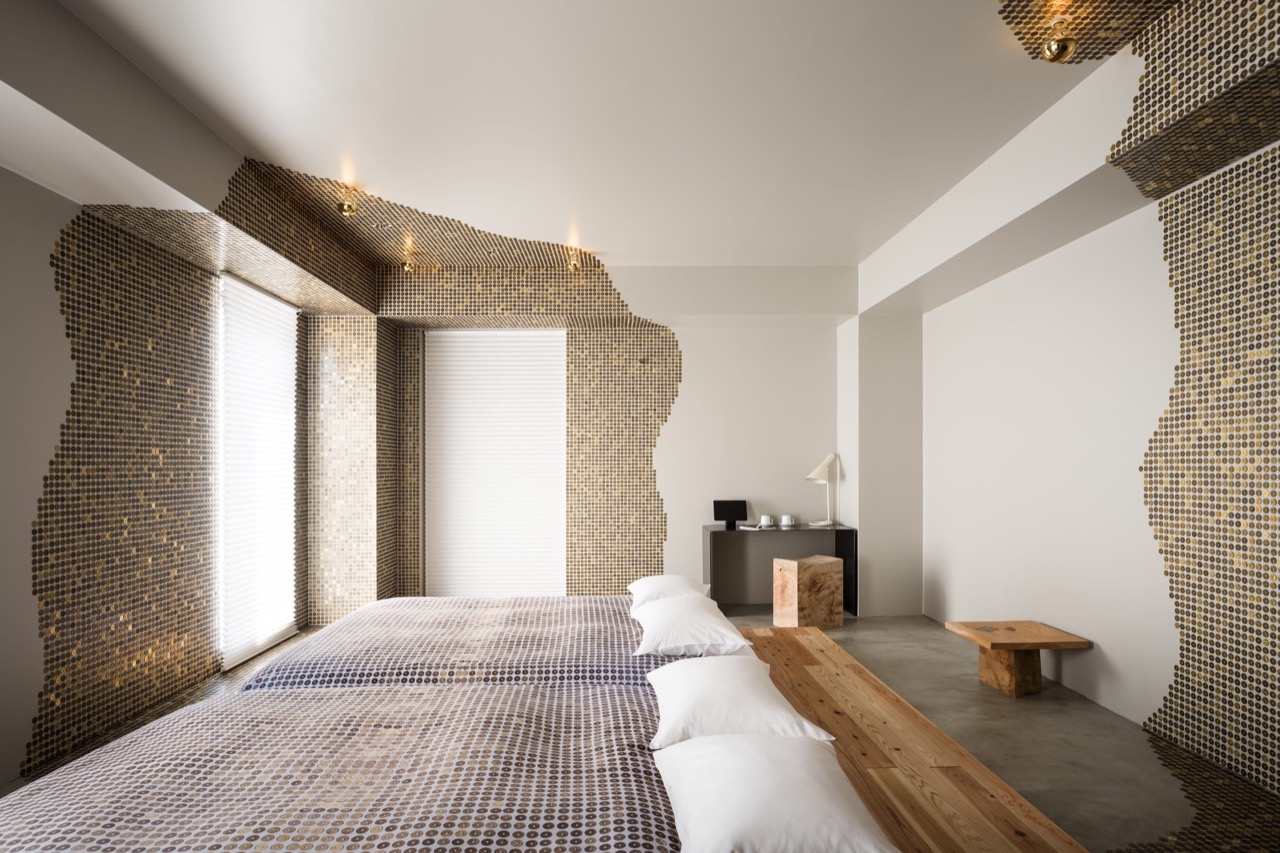
A room from opening daySmall gold pieces cover the walls and window surrounds, and the beds sit low to the floor. ⓒColumbia Hotel & Resorts
4.On a tight lot, the stair is the most expensive waste of floor area. This building turned its stairwell into a gallery. Called the Staircase Gallery, it climbs 30 metres from the ground floor to the top with exhibition spaces stacked along the way. From 11 a.m. to 6 p.m. anyone can walk in without staying. An escape route that could never be left empty anyway was turned into a shop window facing the street.
Use by floorEight guest floors. The stairwell, the least productive space, became a gallery, and one whole face of the building became a display window.
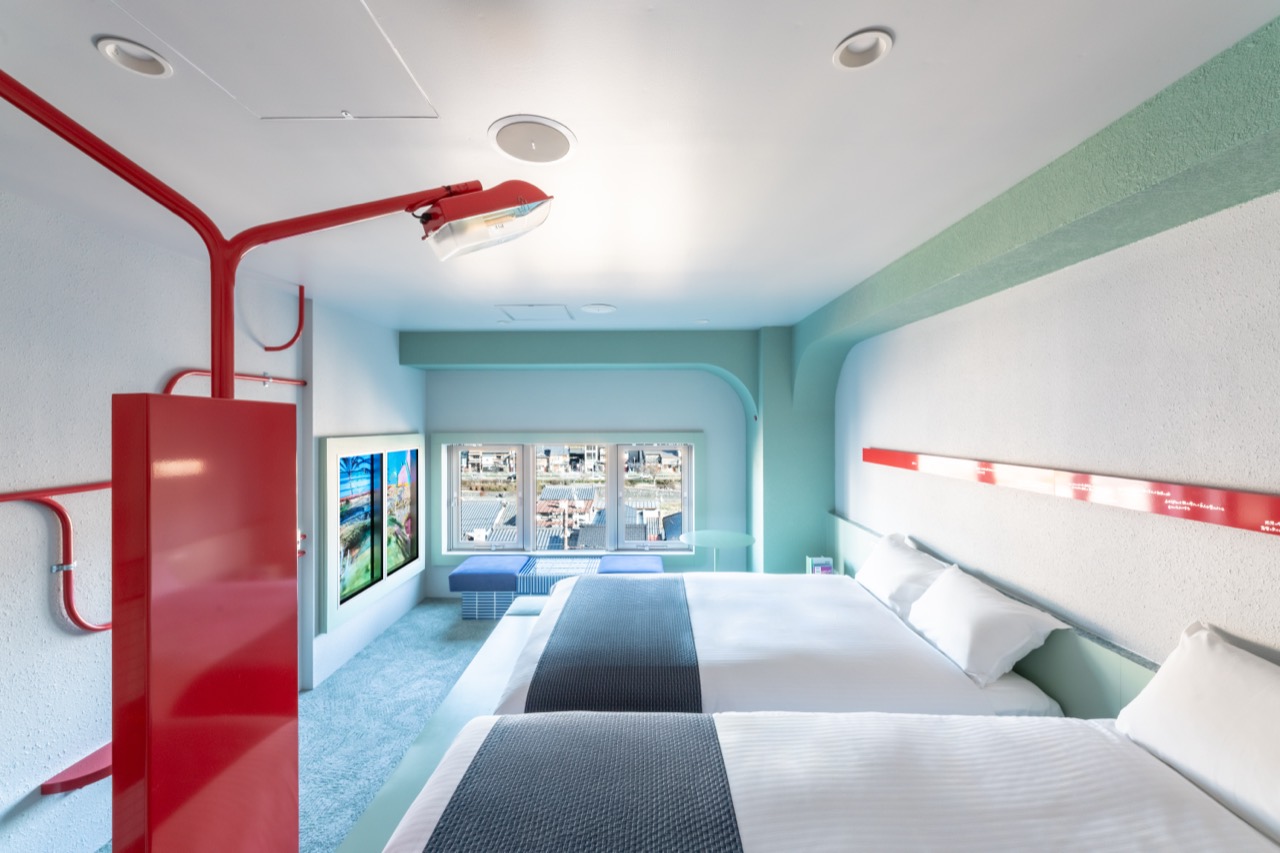
5.Thirty-one rooms do not mean thirty-one works. The official room listing shows roughly 17 works, and one work repeats across floors. Asako Fujikura's new room this year went into 304, 404, 504 and 604, the same position on four floors. Because services and structure line up floor to floor, the artist designs once and the builders install four times. The artwork follows the hotel's standard room plan.
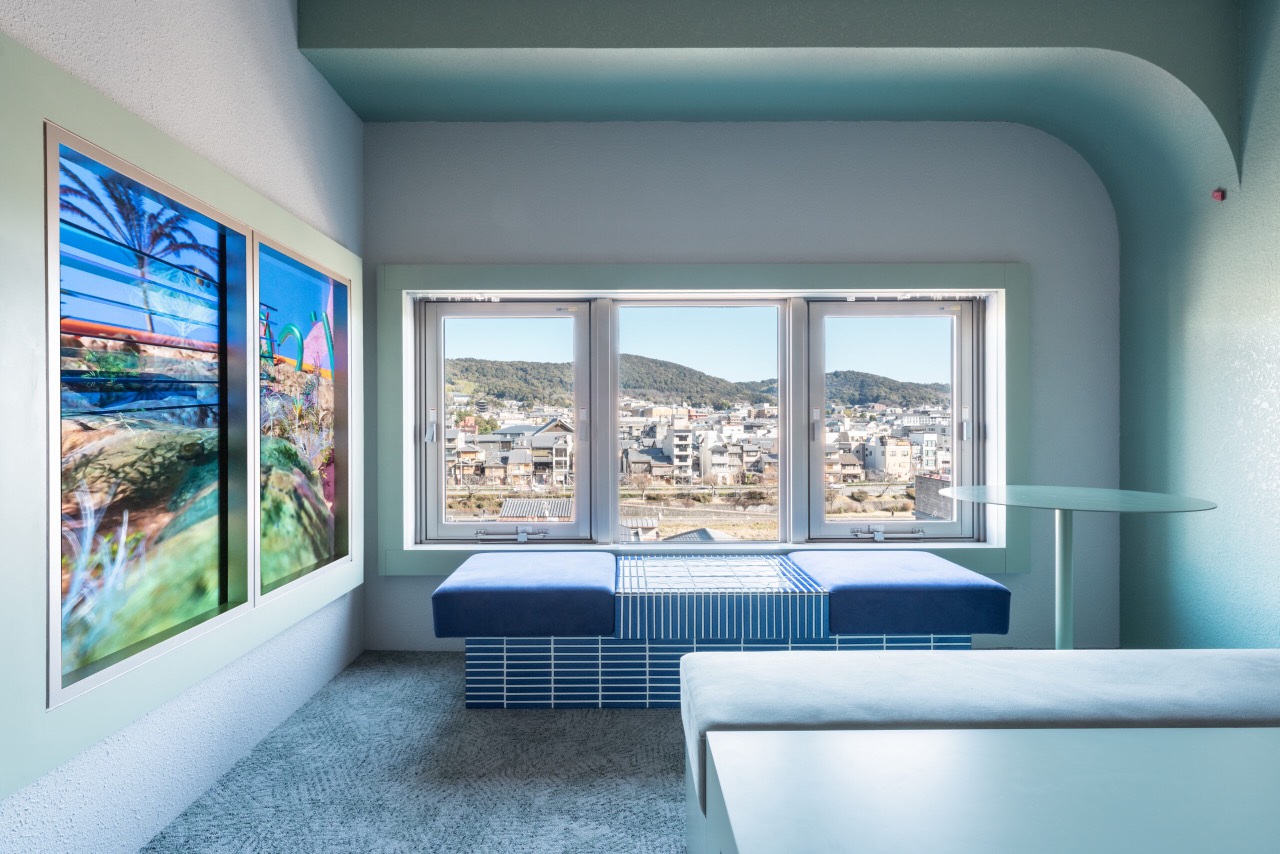
Asako Fujikura's roomDigitally drawn landscapes hang like windows beside the real one. This room faces the river. ⓒColumbia WorksThe same work, another angleThe red piping is deliberately exposed. The same room repeats on four floors, one above another. ⓒColumbia Works
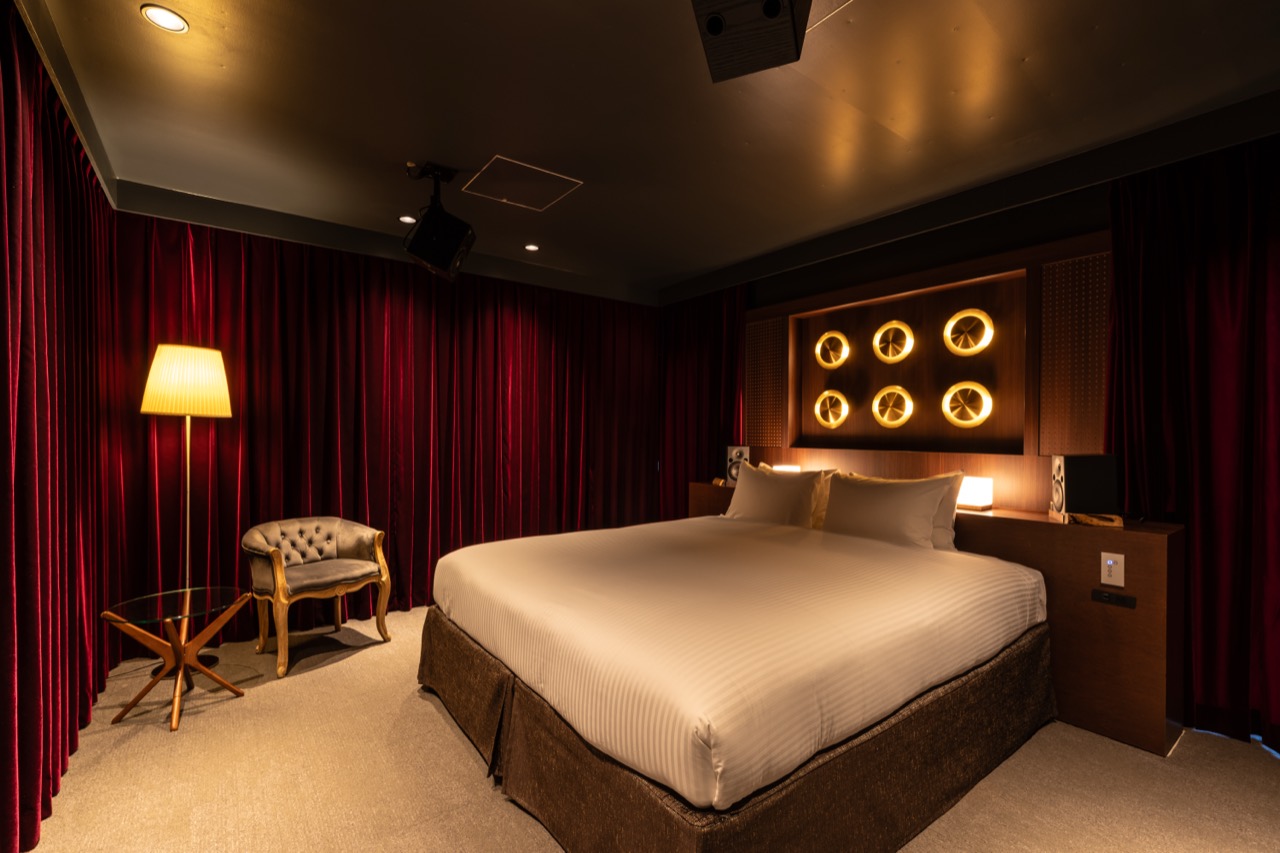
6.One room on the ninth and tenth floors was reworked by musician AOKI takamasa. Red velvet curtains wrap every wall, and six round speakers are set into a panel above the bed. It is called the Audiophile Listening Room, subtitled TRAVELING ROOM. Switch off the lights and the curtains swallow what is left, leaving only the rims of the speakers. The room sells a night of unpacking and listening to one record all the way through, and no other hotel room can stand in for that night.
AOKI takamasa's TRAVELING ROOMThe six circles above the bed are speakers. A room rebuilt for listening. ⓒColumbia Works
7.Revenue is not disclosed. According to the Kyoto City Tourism Association, hotels in the city averaged a daily rate of 21,286 yen in 2025, with revenue per available room (RevPAR) of 17,156 yen. Divide one by the other and occupancy comes to about 81%. Booking sites list this hotel from 12,000 to 13,000 yen per night for two, but the 30㎡ quads sell higher. At an average rate of 20,000 yen and 80% occupancy, 31 rooms earn about 181 million yen a year (estimate). At 930 won to 100 yen, that is close to 1.7 billion won.
8.Spread across the floor area, that is about 360,000 yen per pyeong per year (estimate). The general manager wrote on the company blog that the team is about 14 people, full-time and part-time combined. That is one person for every 2.2 rooms, and the front desk is staffed 24 hours. Guests are mostly couples from their late twenties to forties, from the US, Australia and the UK, while Japanese guests rise in the off-season to 10-20% of the total. It is a hotel where the person at reception has to be able to explain the art in English.
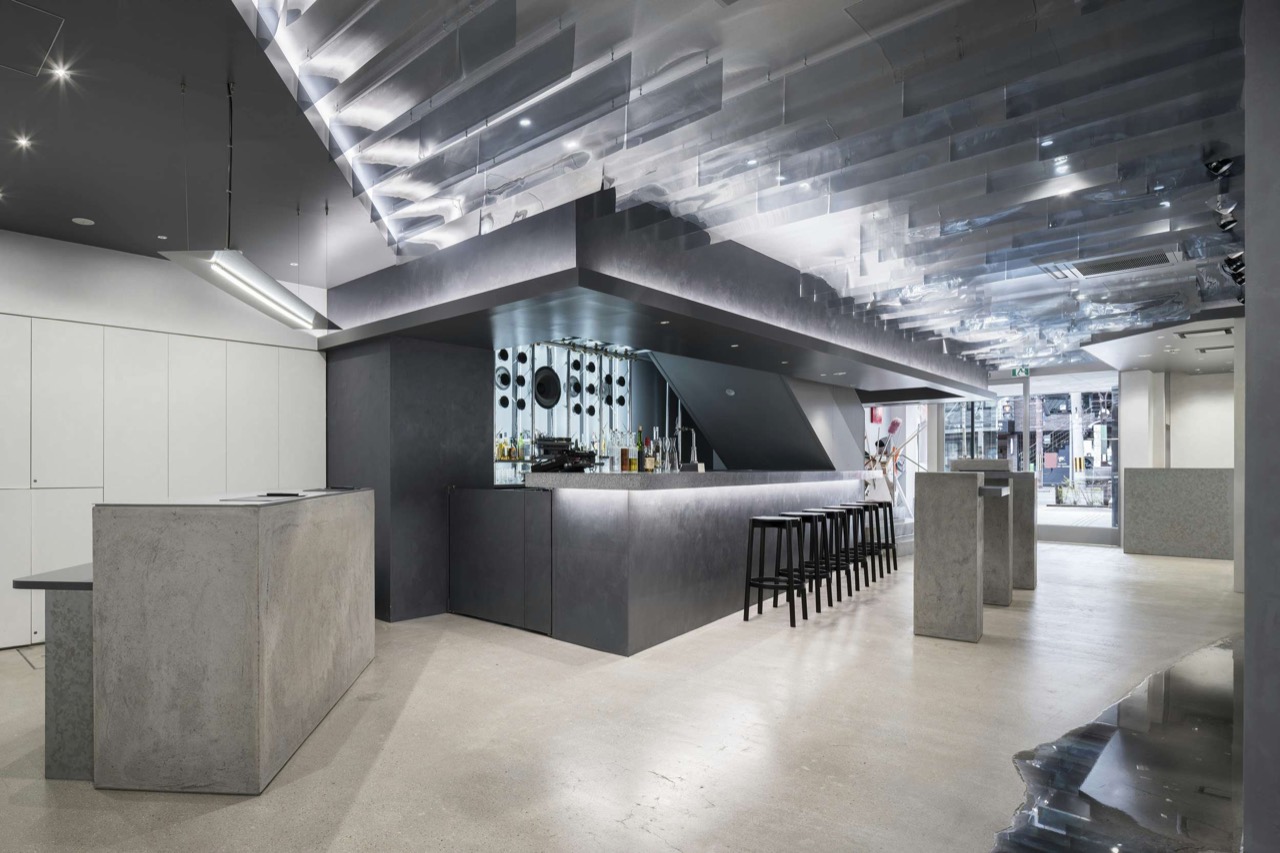
Ground-floor reception and barThe bar counter sits right next to the check-in desk. The bar opens from 6 p.m. to 2 a.m. ⓒBijutsu Techo
9.The artists' share is published nowhere. Apply 3%, 5% and 10% to the estimated revenue above and you get 5.43 million, 9.05 million and 18.1 million yen a year. Divided among the roughly 17 works in the official listing, that is 320,000 to 1.06 million yen per work per year (estimate). Not much for any one artist. So why do artists take on a room? Because the money does not stop while the room sells, and over seven years it can outgrow a one-off commission fee.
Art fees tied to revenueWhatever the rate, the artist's share rises and falls with occupancy. For the hotel, part of the cost of the art moves from fixed to variable.
10.At a star-rated hotel, most of this money would have gone out up front as construction cost. The room fit-out is ordered from an interior contractor in one package and paid off at completion, and revenue outside the rooms comes from restaurants and banquet halls. Here, part of the cost of the art in each room is tied to revenue and paid out slowly. In a slow month, the artists' share shrinks too. The banquet hall's job is taken by the ground-floor bar and the free Staircase Gallery, and both work more as advertising than as revenue.
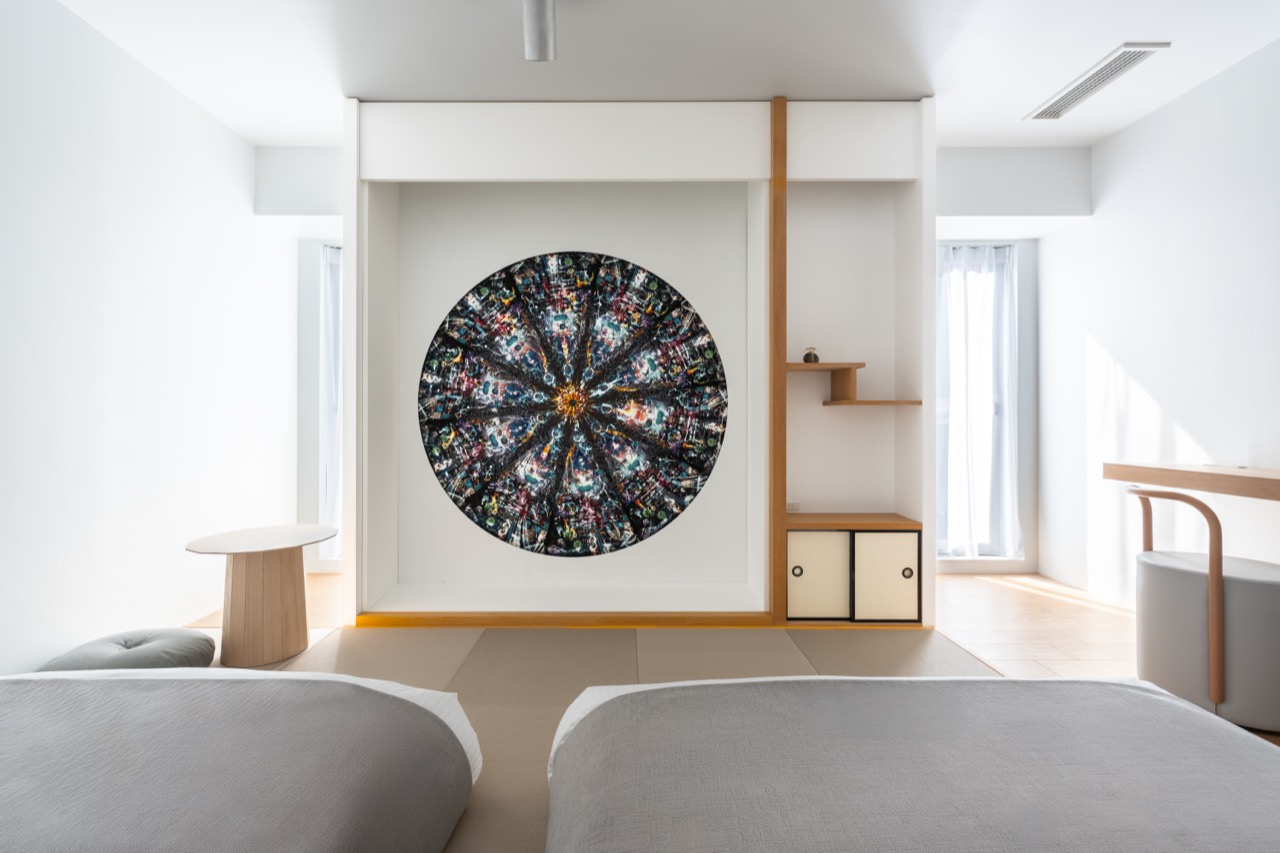
11.This renovation shows that artworks have a lifespan too. Two new works (six rooms) and two heavily reworked ones (four rooms) mean ten of 31 rooms, about 32%, changed in seven years. Another artist's room opened last April as well. Where an ordinary hotel renovates its rooms on a 10-15 year cycle, this one does it every few years, a few rooms at a time. Each renovation doubles as a new exhibition and a new set of photographs.
A room reworked this yearA single round work hangs on a white wall. Even within one renovation, the density of each artist's room differs completely. ⓒColumbia WorksSame artist, different colourThe same work as the top photo, redone in blues for another floor. ⓒColumbia Works
12.People pay for these rooms because they cannot be compared. On an OTA screen, hotels around Kawaramachi line up by minutes to the station and square metres, but a room with six speakers in the wall does not join that line. Guests choose a work rather than a room, and post photos of it on their own accounts. The artists promote their rooms too. The hotel gains a crowd of promoters without paying for advertising.
13.BnA began in 2016 with a two-room guesthouse in Koenji, Tokyo. In 2021 it opened the 26-room BnA_WALL in Nihonbashi and had a different artist repaint the ground-floor mural every season. This month it has announced an opening inside an art centre in Maebashi, Gunma, where a single art room comes with a theatre, a bar, a gallery and artists' lodgings. The direction is not more rooms but more places for artists to stay.
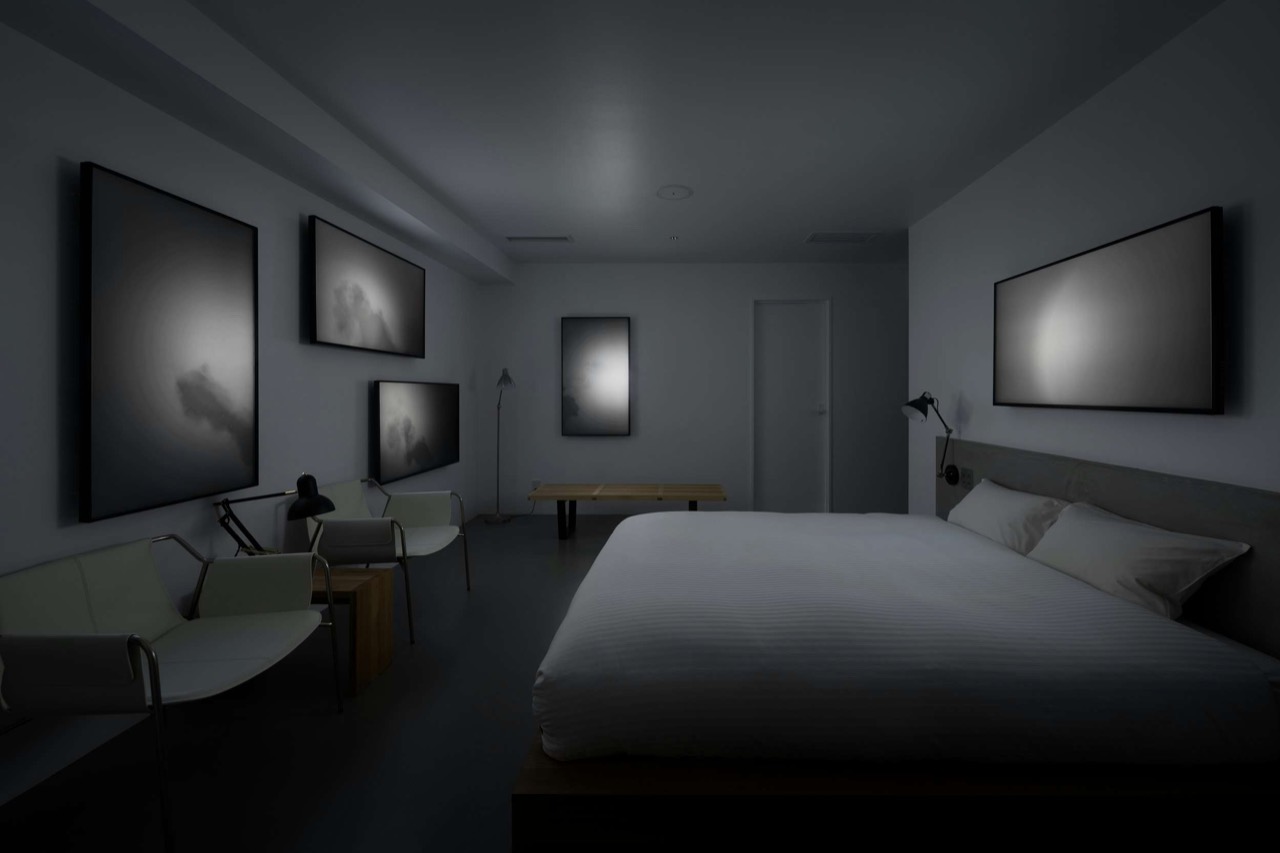
An art room shown at openingGlowing screens hang on dark-painted walls. A photo released when the hotel opened in 2019. ⓒBijutsu Techo
14.The risk is that the art ages faster than the room. A renovation is not a building job but a new contract with an artist, and the moment a work comes down, that artist's share stops. There are problems inside the room as well. Guest reviews keep mentioning that the art takes up wall and floor space and makes rooms feel cramped. Sleeping four in 30㎡ while giving one wall to art only works as long as the rate stays above a business hotel of the same size.
On a 72-pyeong lot in Kyoto, 16 artists made 31 rooms in a ten-storey building, and seven years on, ten of them have been replaced by new works. If the artists' share is 5% of an estimated 181 million yen in room revenue, 9.05 million yen a year goes to them. Build the same rooms in Korea and the walls become the first problem. Lodging facilities fall under flame-retardancy rules in Korea's fire safety laws, so interior finishes such as wallpaper, plywood and timber must pass flame-retardant performance standards, and the Building Act separately restricts interior finish materials in lodging facilities. Panels an artist fixes to a wall and installations hung from a ceiling are caught by both, so the first check, before choosing materials, is whether they can be treated to meet those standards.