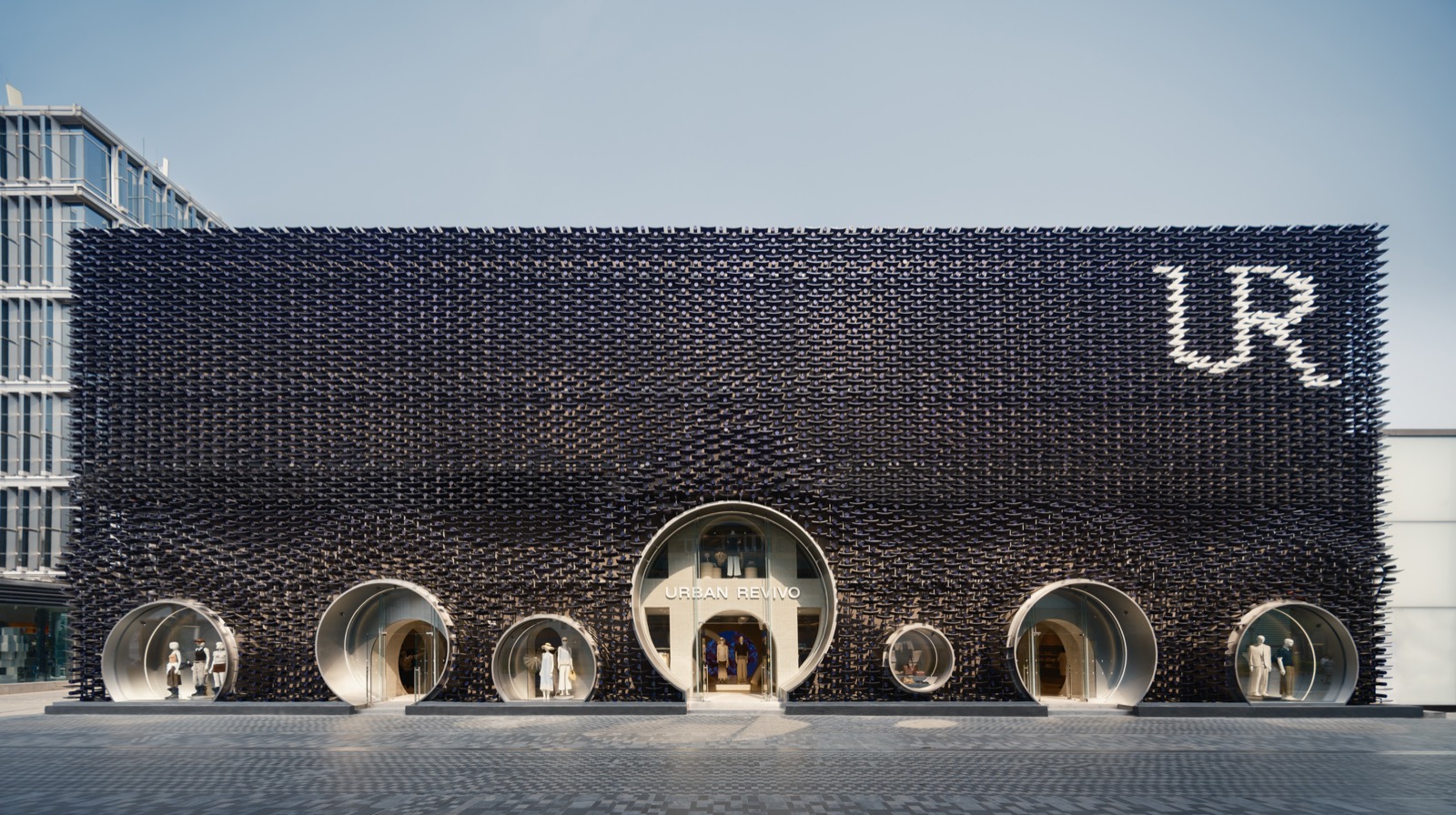
A 1,246 pyeong clothing store has opened on the Sanlitun pedestrian street in Beijing. What it sells is a dress in the 50,000 won range. Yet tens of thousands of aluminium tiles hang on the outer wall, sliding from purple to blue as the angle changes. A company that goes from plan to shelf in seven days spent two years on a skin.
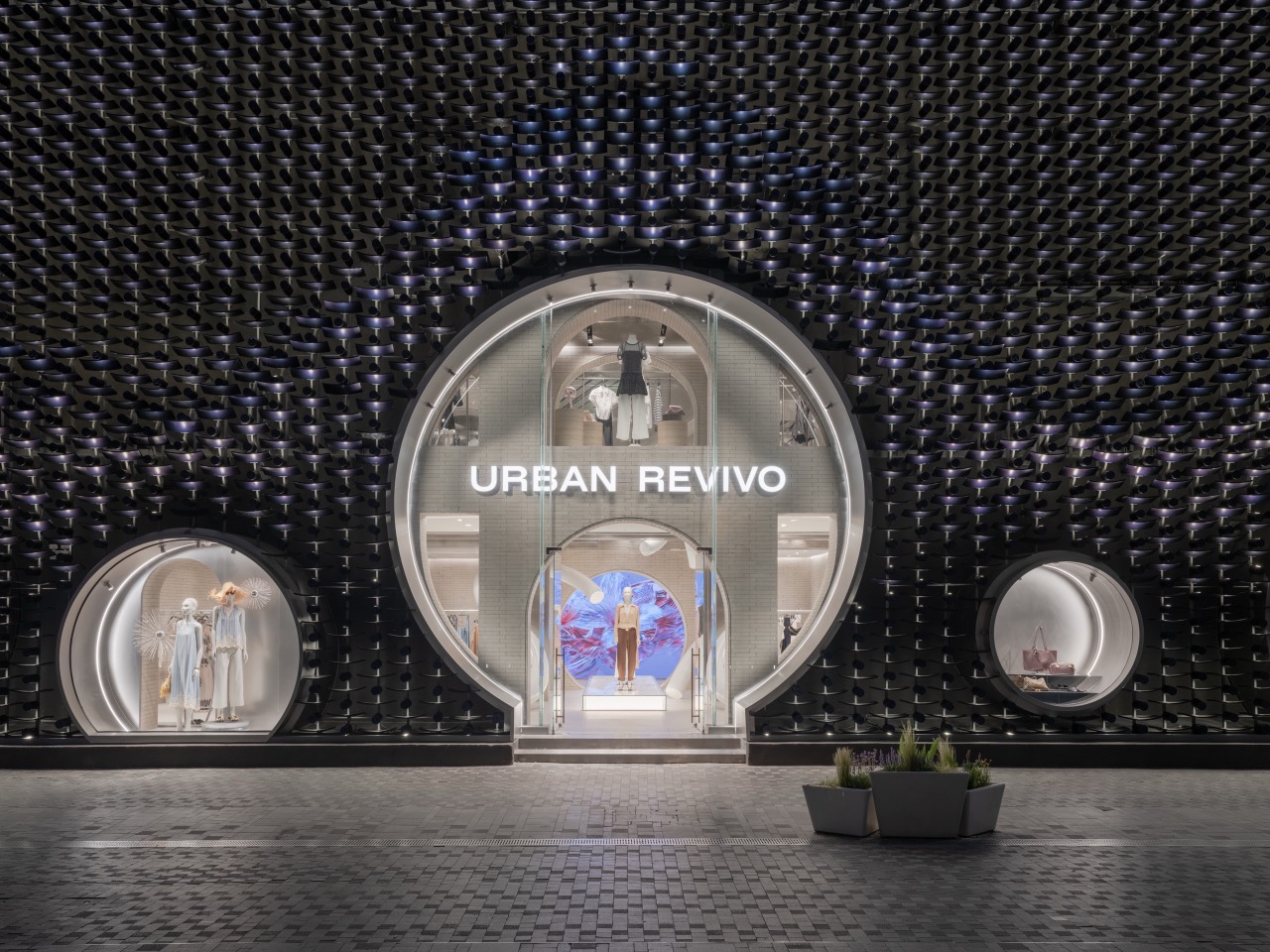
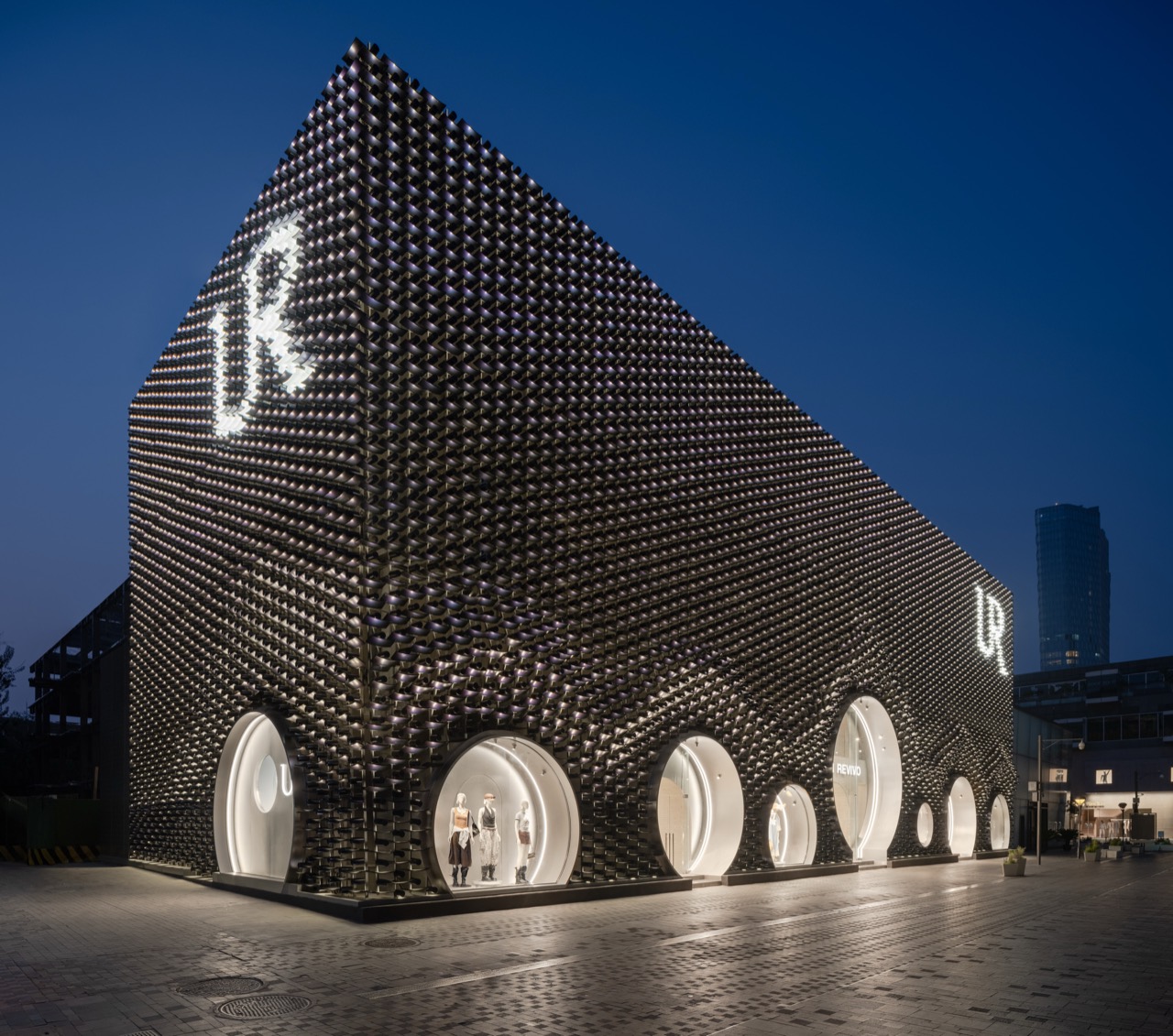
1.On 3 August, URBAN REVIVO opened a new flagship on the west side of Sanlitun in Beijing. The site is the Yisheng Building in the middle of the pedestrian street that links the north and south blocks of Taikoo Li. Floor area 4,120 square metres, 1,246 pyeong, spread across four levels. MVRDV of the Netherlands designed it.
2.The clothes this company sells run about 50,000 won for a dress and 90,000 for a jacket. It takes seven days from plan to shelf, and new pieces land twice a week. A company that fast spent 2025 and 2026 on this building. A company that rose on speed put money into something speed cannot make.
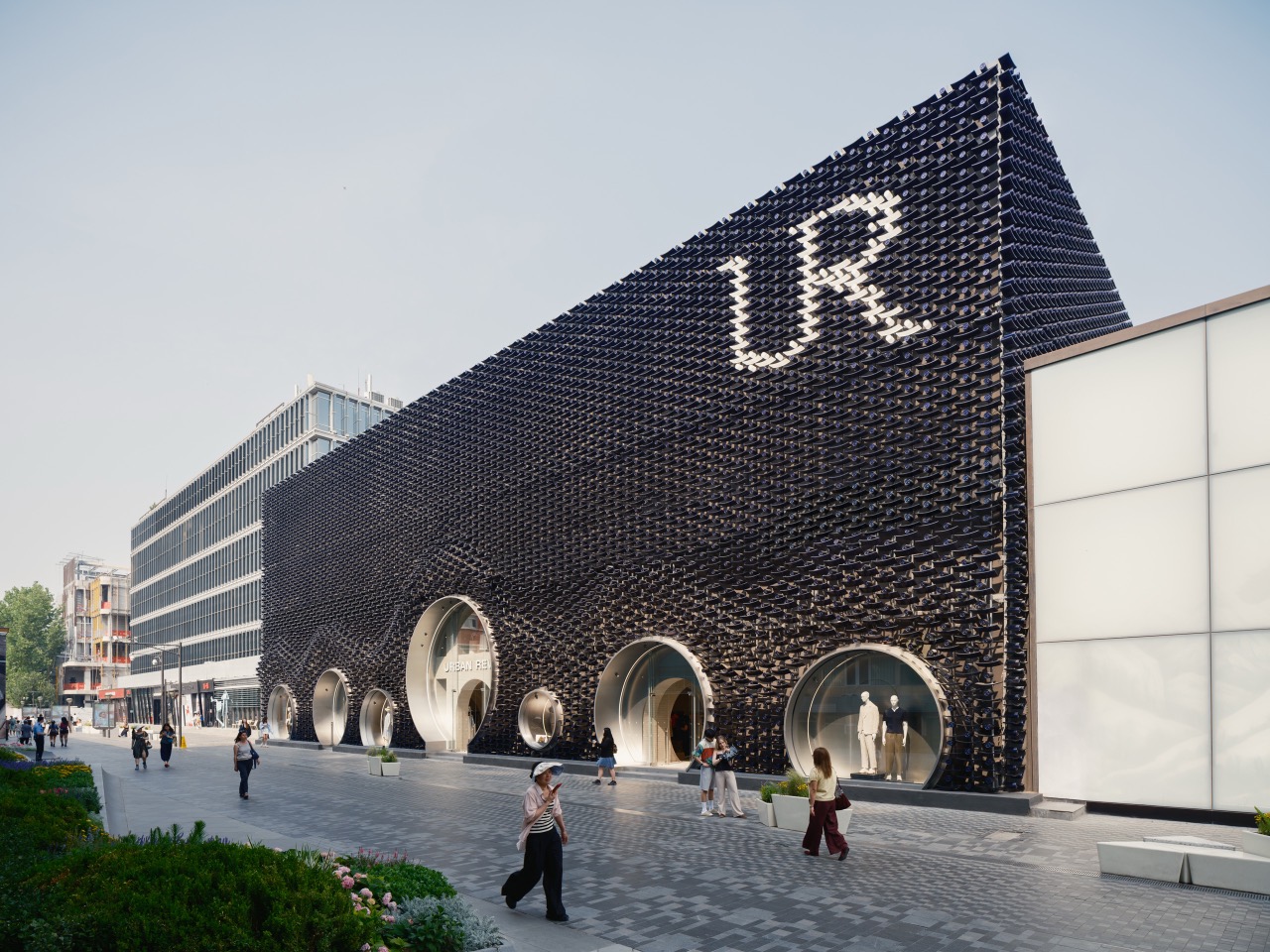
3.Aluminium tiles and tubes hang on the facade finished in deep navy, with a coating over it that splits colour by viewing angle. Purple head on, blue from the side. In daylight it sinks to black, and as the sun drops each tile stands up by peeling off its own shadow. Even the logo is not painted but set in bright tiles like pixels.
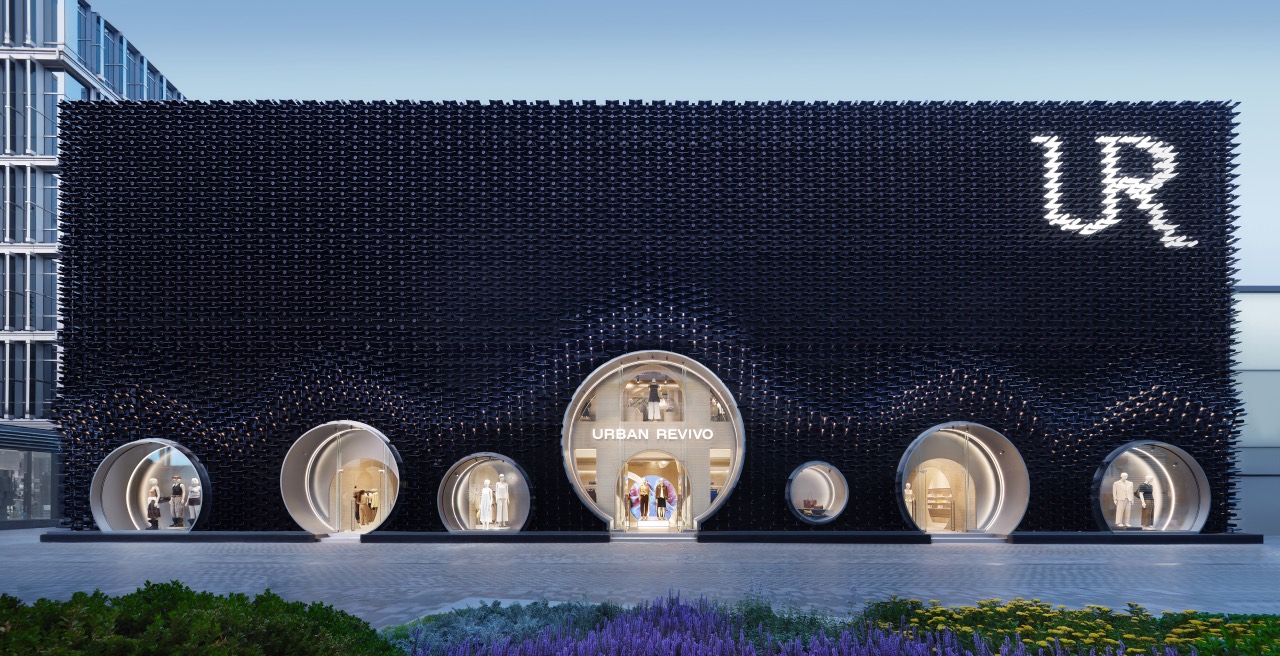
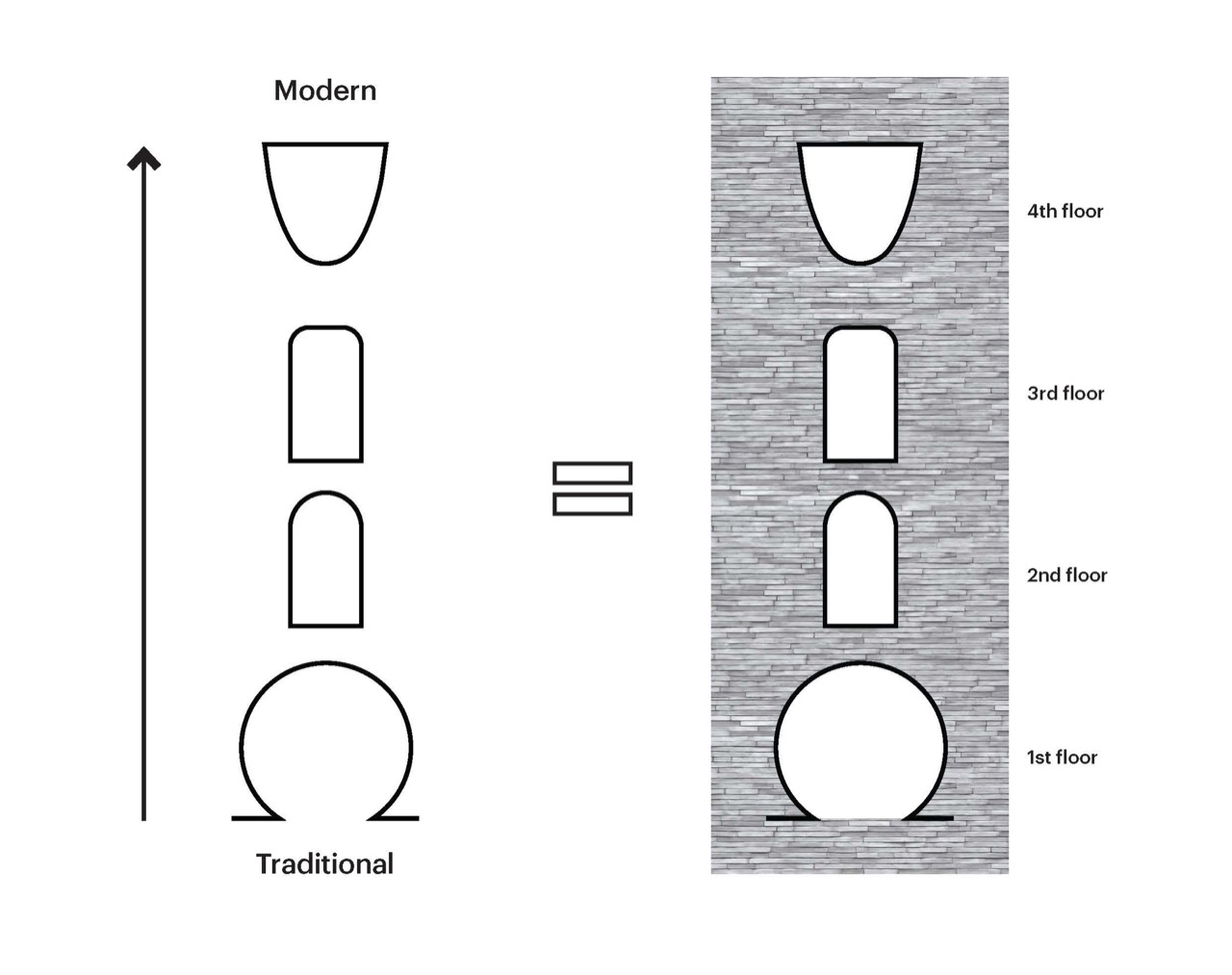
4.Seven openings are cut into the wall. The circle comes from the moon gate of Chinese gardens, the largest one in the middle is the entrance and the other six are windows. The shape of the opening changes one step at a time going up. Level one is a full circle, level two an arch, level three a square with the corners taken off, level four an inverted curve. An order built to start in tradition and cross into the present floor by floor.
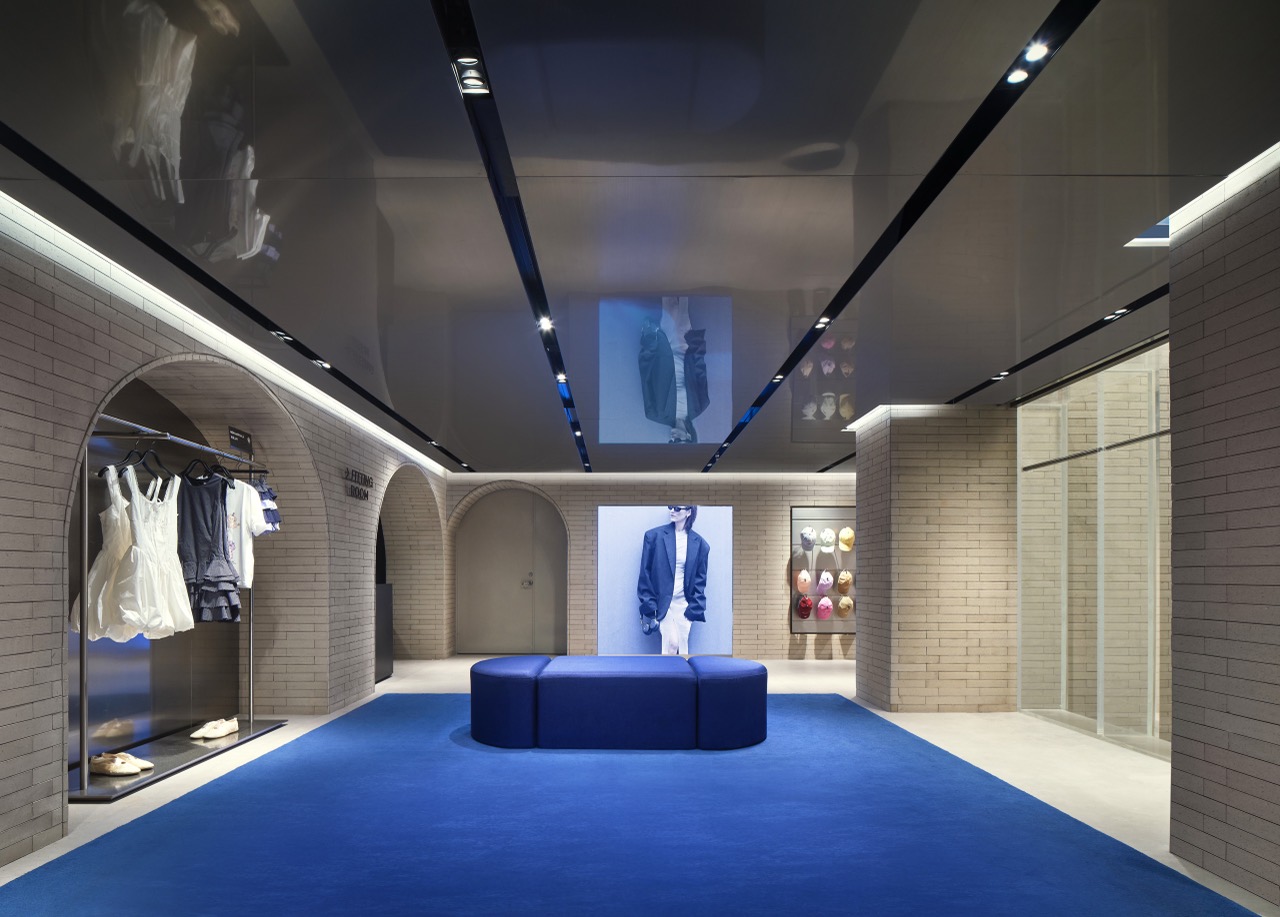
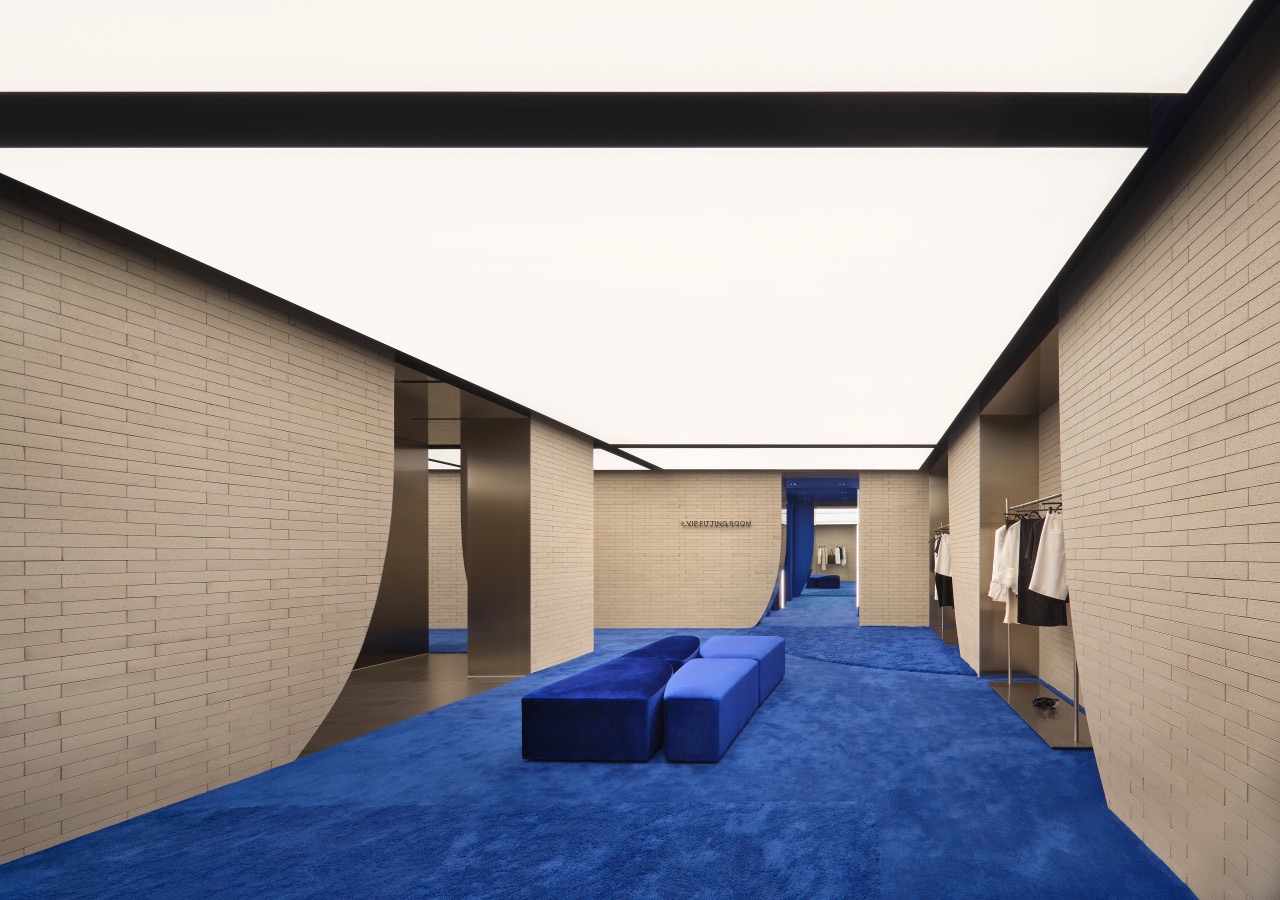
5.Inside it is grey brick. The explanation is that hutong walls were pulled indoors, and brick arches stand in layers along the corridor with rails hung between them. A rough face where the joints catch the back of a hand. Materials change as the floors rise: level two takes reflective surfaces and blue furniture, level three dark heavy finishes, level four velvet and cobalt blue.
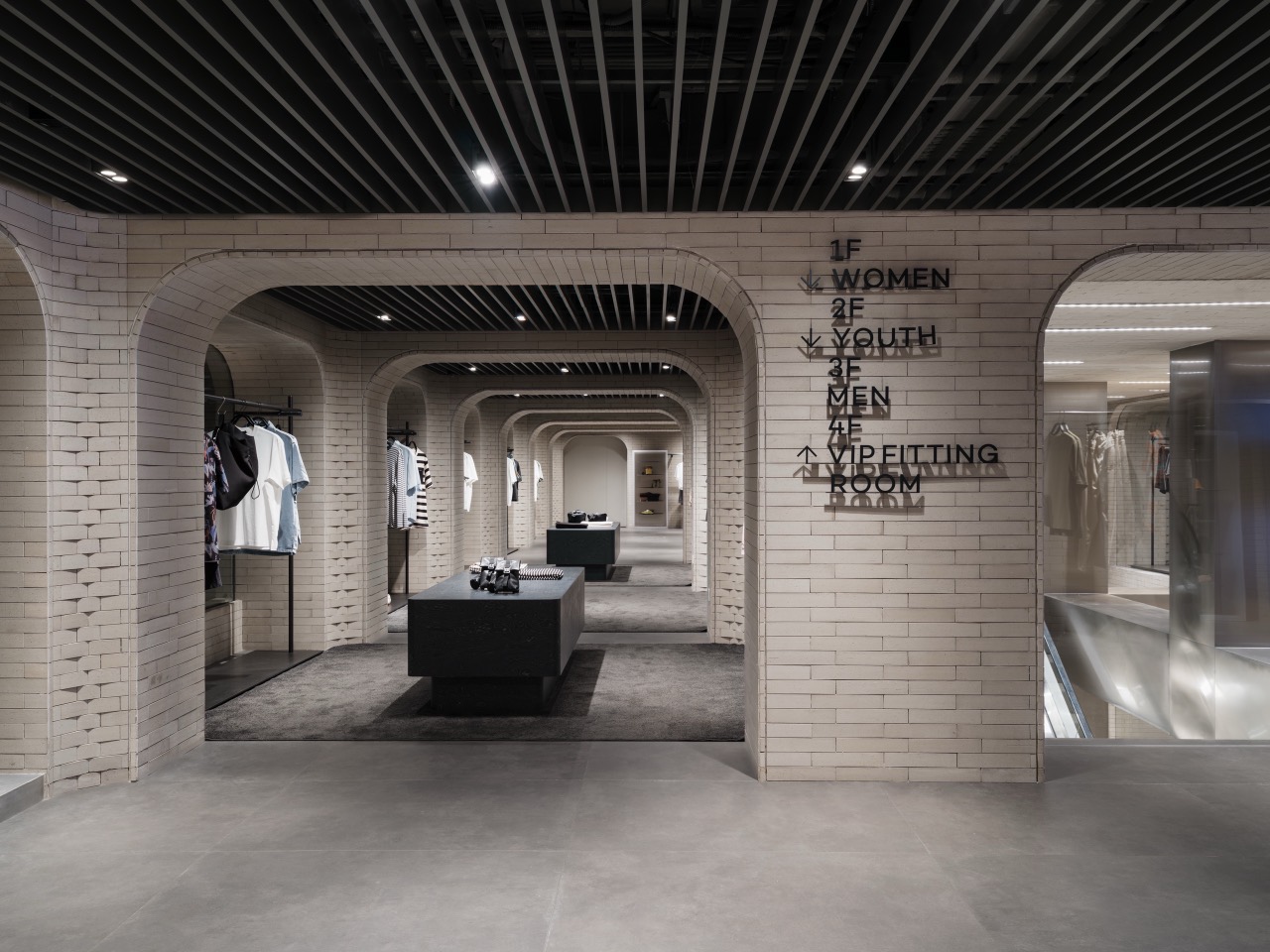
6.The floor directory shows what this store is. Womenswear on one, youth on two, menswear on three, and VIP fitting rooms on four. One floor that sells nothing sits on top of three that do. Deep blue carpet goes down with velvet benches on it. Six rooms called Bold Rooms are scattered across the floors as well, among them a room wrapped in fabric, a room stacked with blocks of recycled textile, and a room holding only glass cases.
7.The weapon this company held has already gone blunt. UR's strength was a seven-day lead time and new stock twice a week, a number that halved Zara's fifteen days. SHEIN has taken that ground now. In a market where an opponent has appeared that cannot be beaten on speed, the only difference left is what can be touched.
8.The phrase founder Li Mingguang put up is kuaishe shishang, fast light luxury. Fast fashion prices carrying material closer to light luxury. Anyone can write that sentence, and it can only be proven in a store. Swiping through ten photos of a 57,000 won dress on a screen is not the same as passing through a moon gate and checking the seam allowance of that same dress under a brick arch.
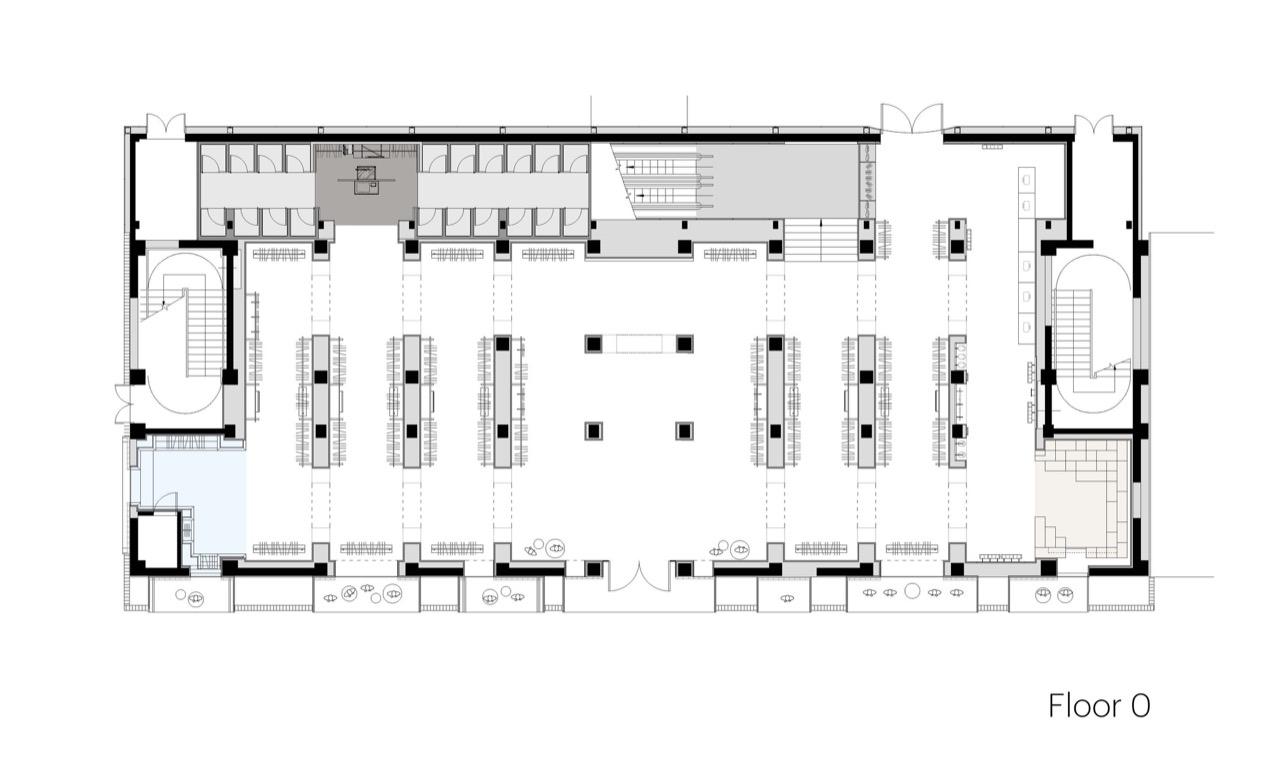
9.Advertising budget is folded in here too. This facade is the most conspicuous object on the Sanlitun pedestrian street, and photographs of it spread without media spend. Part of the money booked as construction cost actually moved over from the advertising line. The published ground floor plan shows the whole back wall given to a row of fitting rooms, with stair cores at either end leaving the middle open.
10.UR is an SPA company. It has production bases in Guangzhou and Dongguan and holds planning, production, logistics and sales itself. It runs more than 10,000 styles a year in small batches and reorders only what responds, which cuts inventory risk and forces the back of house to keep shrinking. Filling in small batches at high frequency to shrink the stockroom and grow the selling floor is the strategy the company has published.
11.Small units at Taikoo Li are reported trading at RMB 120 to 250 per square metre a day. Applying that rate to 4,120 square metres does not add up. A large anchor usually goes in on roughly a tenth of that as fixed rent with a turnover-linked layer on top. Assume RMB 20 per square metre a day and annual rent is RMB 30.08 million, KRW 5.86 billion. Put rent at 15 percent of sales and annual revenue of KRW 39.1 billion is needed, which comes to KRW 2.61 million per pyeong a month. This is an estimate built to gauge scale.
12.Group revenue is reported at RMB 6 billion, around KRW 1.17 trillion, and recently approaching USD 1 billion. More than 380 stores, about 20 of them outside China. The target is 200 overseas within five years, adding around 20 a year and raising that to 50 a year over the longer term.
13.Li Mingguang offered to take Zara's China franchise, was turned down, and founded his own company in 2006. Twenty years on, that company stepped sideways instead of chasing. In February 2025 it opened 2,787 square metres at 515 Broadway in SoHo, New York, then 492 square metres on Neal Street in Covent Garden, London, and after that Westfield Stratford City.
14.One number does not line up. April 2025 coverage wrote that stores worldwide had passed 400, and the August 2026 coverage of this opening writes more than 380. If both are right, the store count fell over the past year. Area grows and count falls. The other side of a big-store strategy is that the sum you cannot recover when one store misses grows with it.
15.One more risk attaches. This company has repeatedly drawn accusations of copying luxury design along with quality complaints, and the Chinese fast fashion market itself grew from RMB 206.3 billion in 2018 to RMB 300.9 billion in 2023 before growth softened. A large store reflects such disputes more brightly. In a store that talks about material through brick and velvet, if the material of the clothes does not follow, the same store is also where that gap shows best.
16.A company that swaps its clothes every seven days put money into a skin that took two years, and that skin is now this company's advertisement and its claim about quality. KRW 2.61 million per pyeong a month is the line 1,246 pyeong has to clear under the middle assumption. Using a whole facade as a brand device in Korea catches on rules before construction cost. It has to pass the area limit on wall signage and the non-combustible performance standard for exterior finishes, and a leased store has to carve the scope of reinstatement out of the contract in advance. Moving an advertising budget onto a skin means putting how many years that skin can be used into the calculation first.