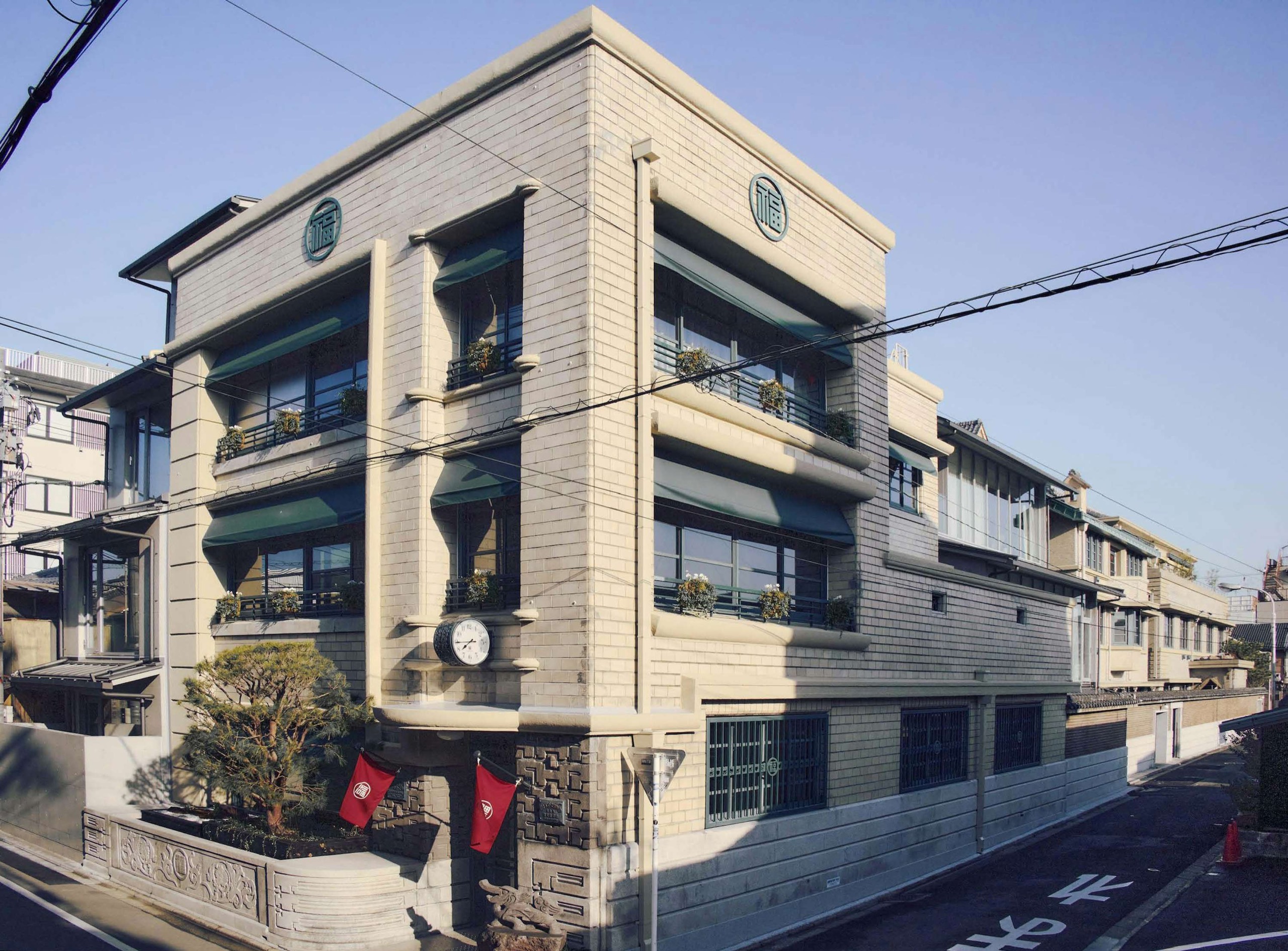
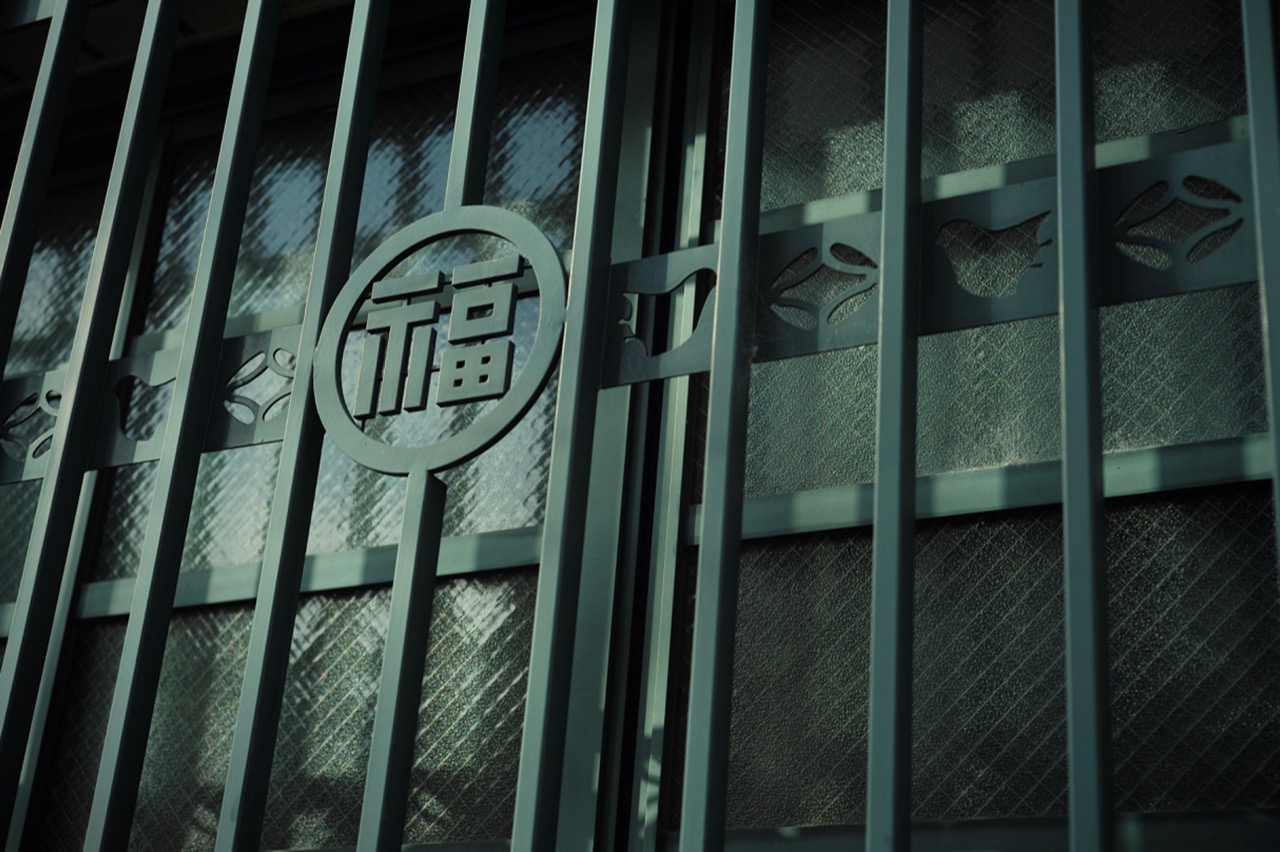
A noren instead of a signThe old 1930 office building was left as it was. The circular ornament high on the wall and the red noren at the door carry the mark of the old trading name Marufuku. ⓒMarufukuro / Bijutsu Techo
Daily Hotel
Marufukuro: a hotel that sold one room for three and a half years
2026.08.01
Three office buildings from 1930 with one new building attached became a hotel of eighteen rooms. More than half of the 519 pyeong of floor area is not a room sold to guests. The lobby and the library are for guests only, and the restaurant took outside diners only a few days a month. For three and a half years there was one thing to sell, a room, and that room cost three times the market average.
1.On 1 April 2022, a three-storey building on Shomen-dori in Shimogyo-ku, Kyoto, opened as an eighteen-room hotel called Marufukuro. Six minutes on foot from Shichijo station on the Keihan line and fifteen from Kyoto station. Built in 1930, its original use was an office, and its owners were the Yamauchi family.
2.The company that family started in 1889 making hanafuda cards is Nintendo. The hotel's name comes from Marufuku, the trading name used when it incorporated in 1947. The family that founded the company still holds the building, and Plan Do See operates it. Design supervision for the renovation went to Tadao Ando, detailed design to Tadao Ando Architect & Associates and Nom Architectural Design Studio, and construction to Obayashi.
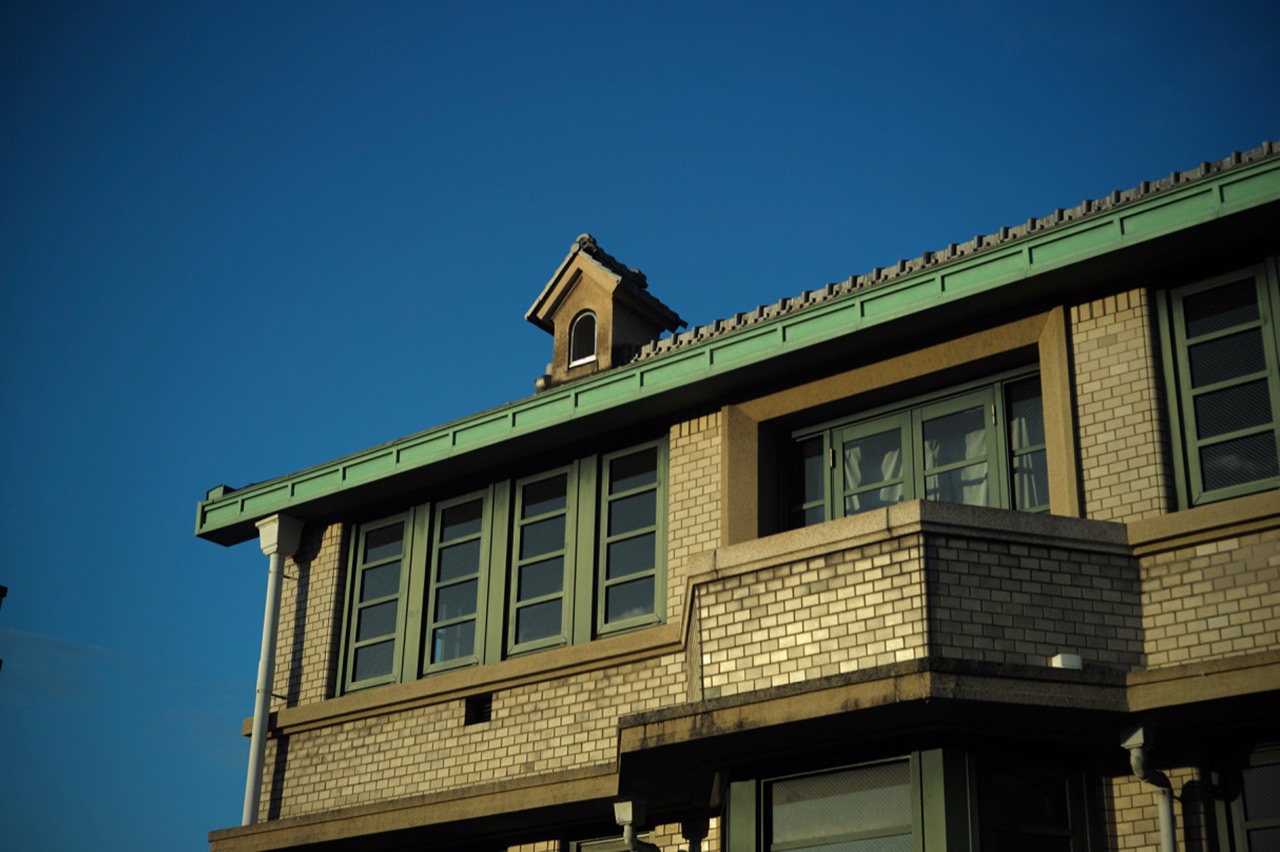
What was not erasedScratch tile, green window frames and even the small lantern on the roof remain in their 1930 form. ⓒMarufukuro / Dezeen
3.The site is 802 sqm with a floor area of 1,716.08 sqm, 519 pyeong in Korean units. The old office, residence and warehouse buildings were kept and one new building slotted in for four in total, each named Spade, Heart, Club and Diamond. Name tags left by a house that made playing cards.
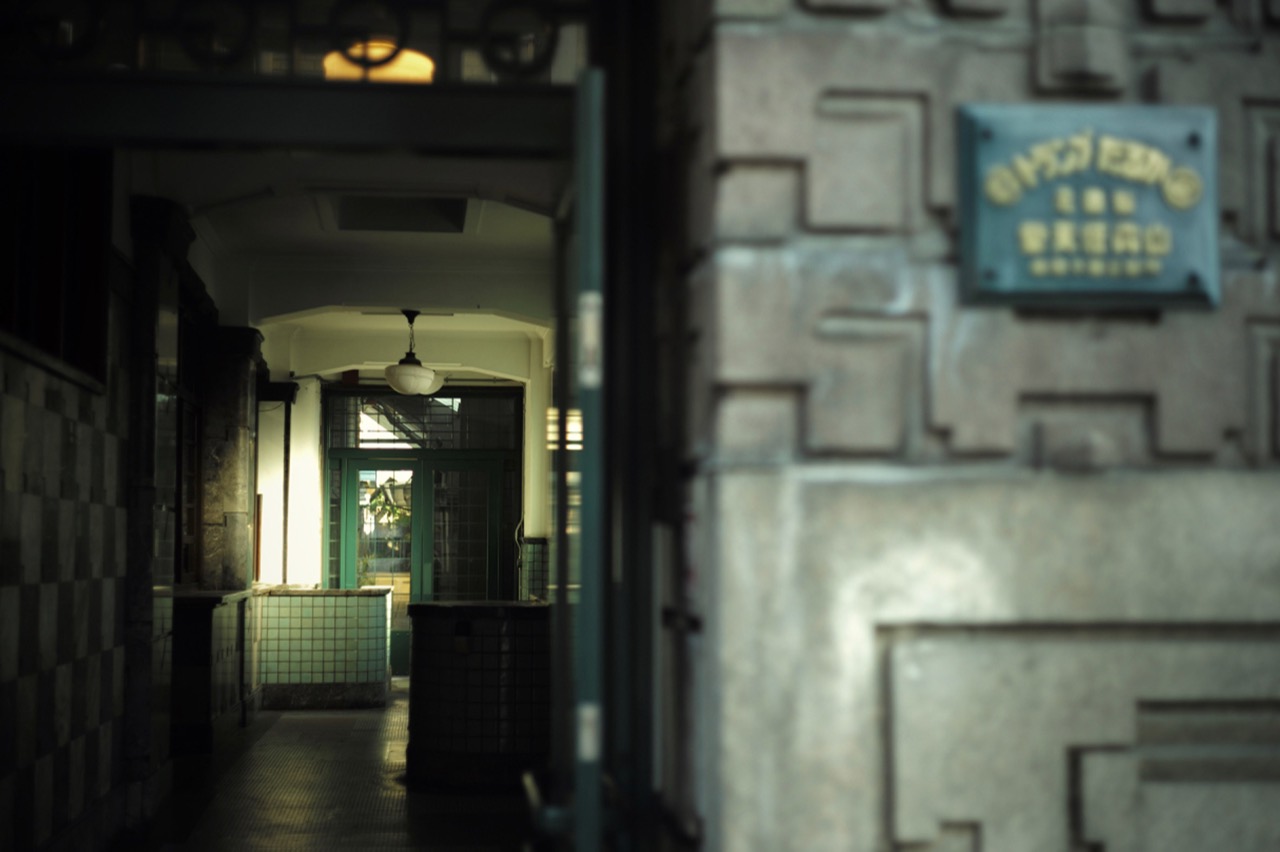
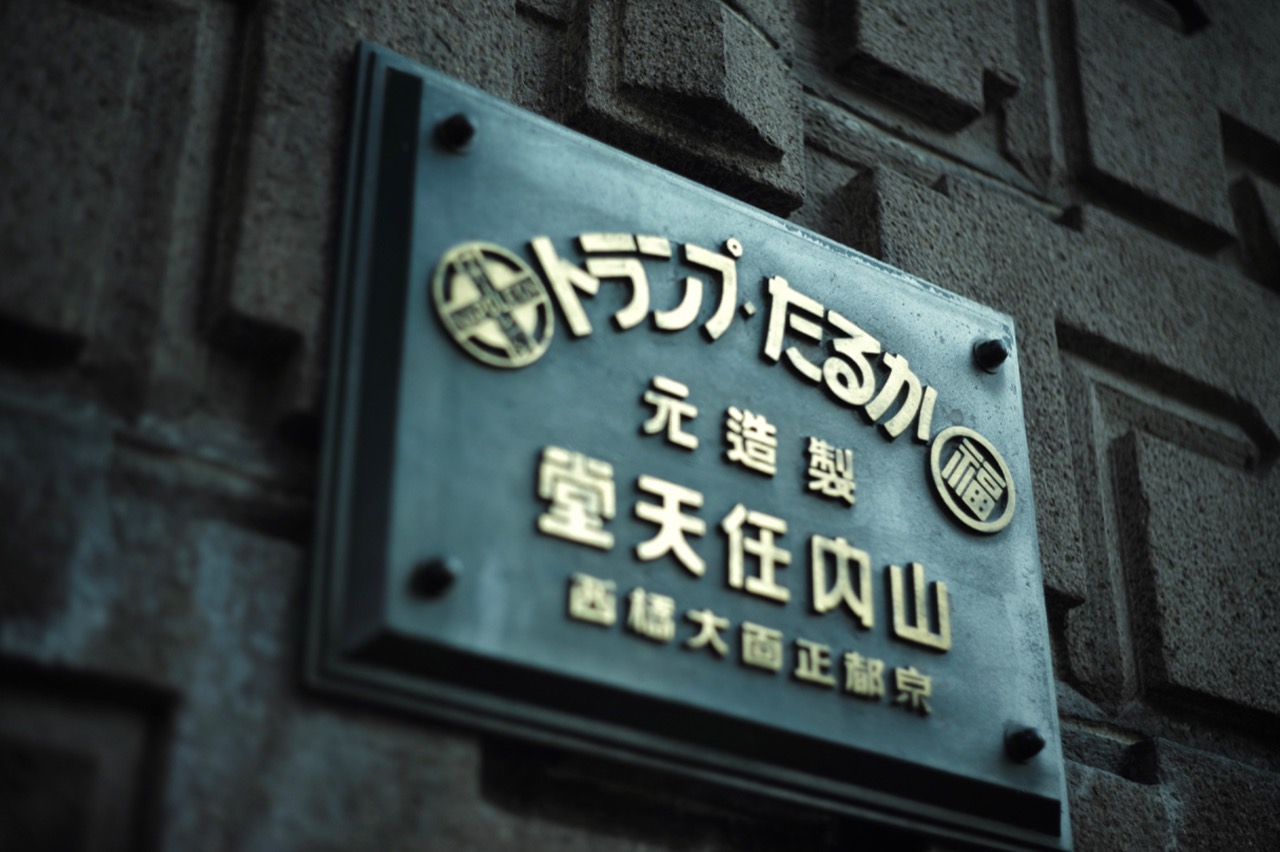
The way in is narrowA tiled passage runs from the gate to the entrance, with the old nameplate still fixed to the wall on the right. ⓒMarufukuro / Dezeen
4.Rooms come in twelve types between 33 sqm and 79 sqm, seven of them suites. Even generously counted by type, the total net room area comes to around 810 sqm (estimate), just 47 percent of the floor area. The remaining half and more goes to two lounges, a library, a restaurant, stairs and corridors. Against the usual 65 to 75 percent net ratio in a city hotel, the public areas here are twice as thick.
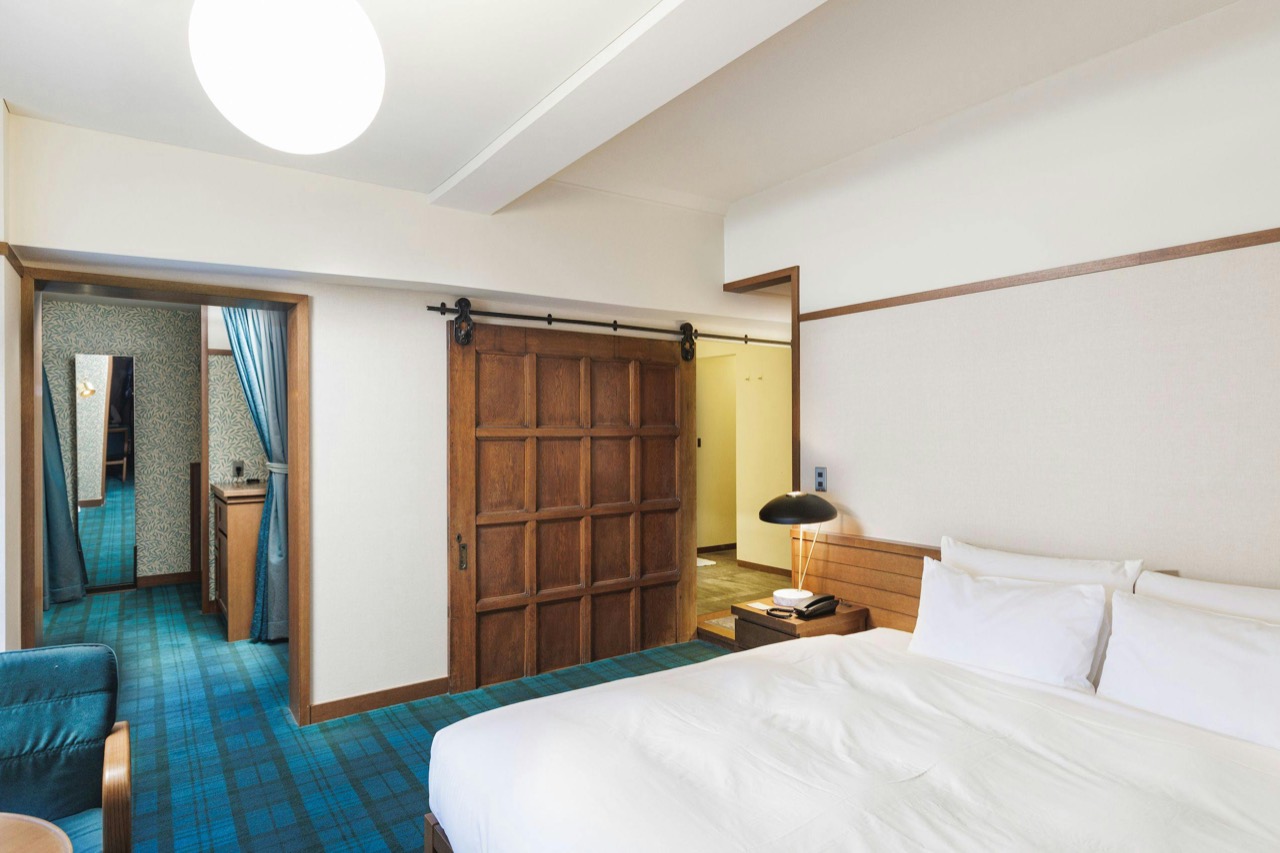
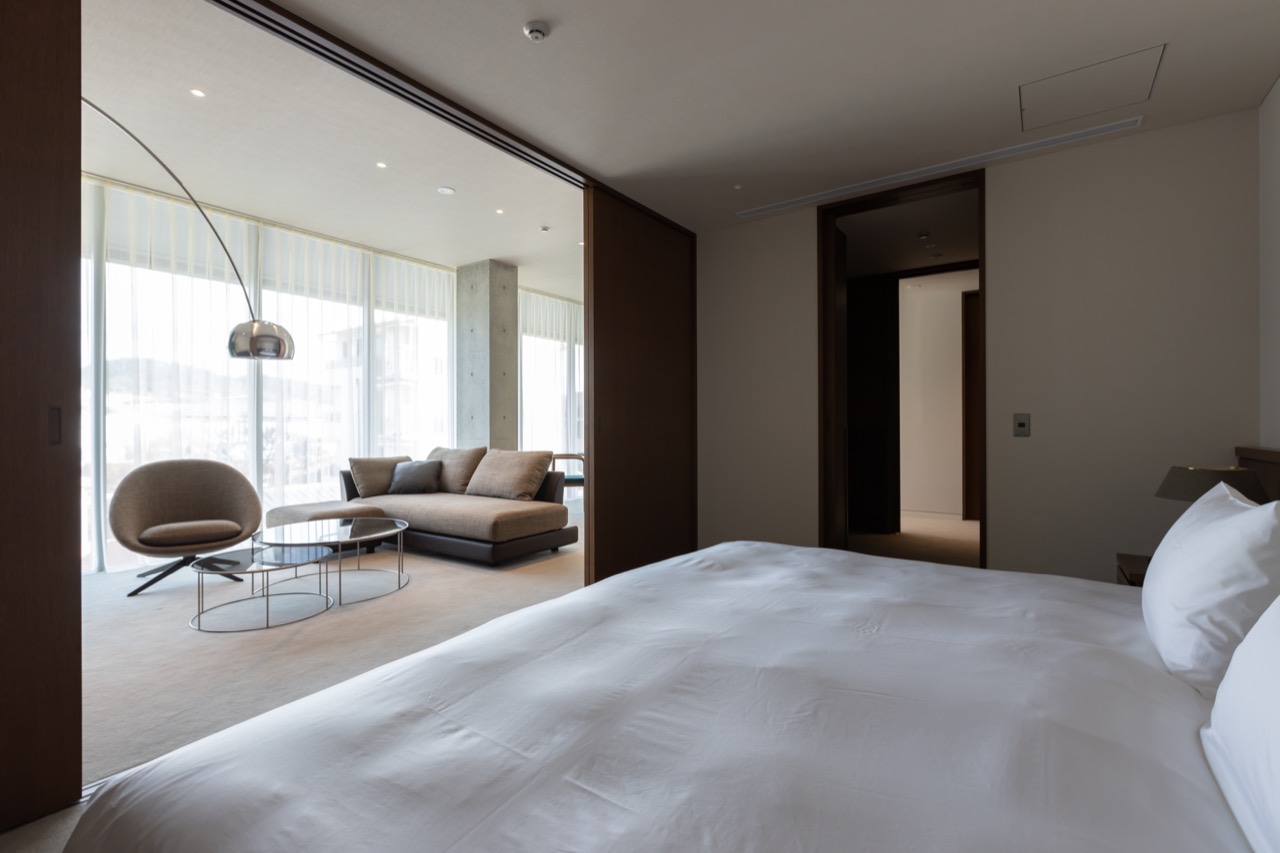
The doors were not thrown outA room in the existing building. Latticed timber doors from the old building were revived as sliding screens between bedroom and bathroom. ⓒMarufukuro / Ikyu.comThe new side keeps quietA suite in the new building. One exposed concrete column stands and the rest is left empty. It went in the opposite direction from the rooms in the old building. ⓒMarufukuro / Wallpaper*The area did not go into roomsThe same floor area divided by room count. One room sits on the space of four city business hotel rooms. Comparison figures are the writer's calculations.
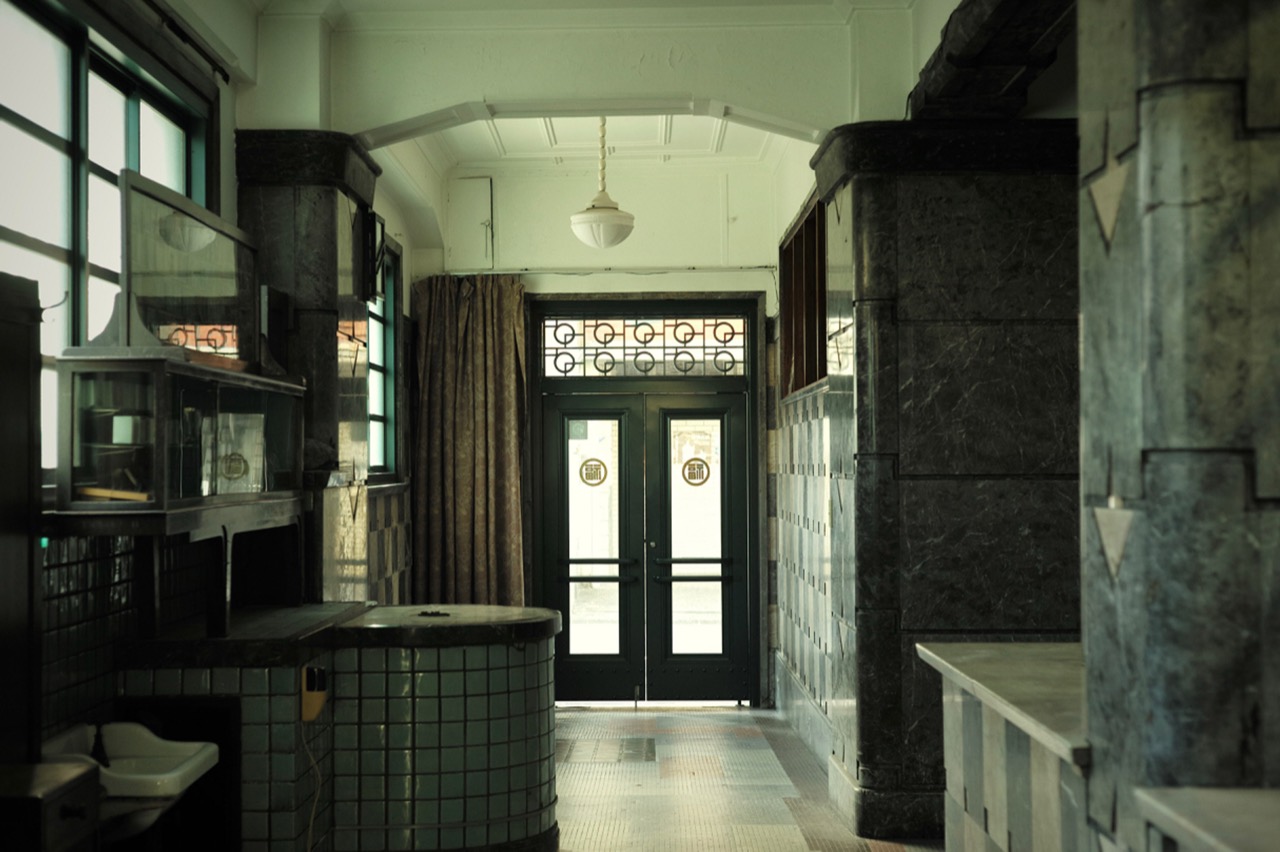
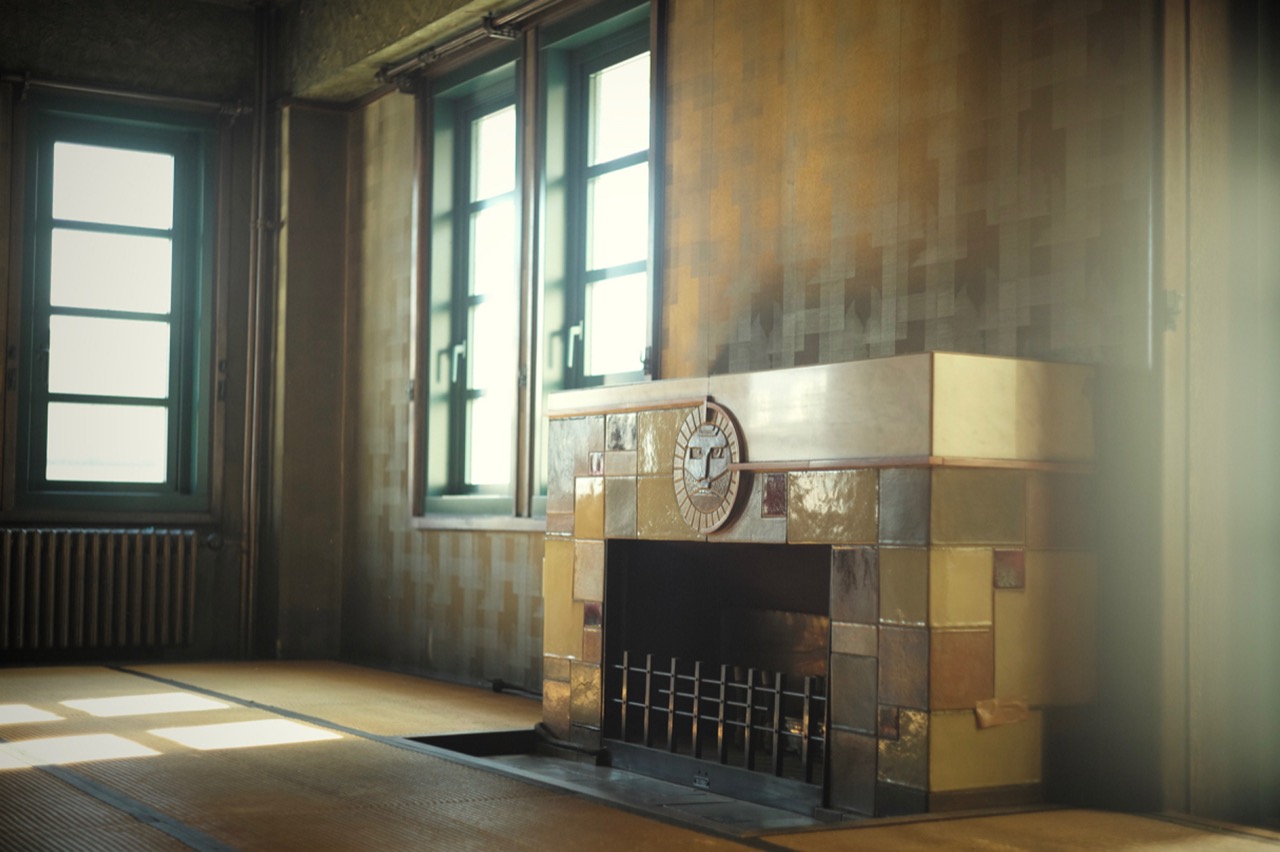
5.The old office entrance is framed in dark blue stone columns and tile, and the transom above the door carries a geometric lattice. The brass plate on the wall records Yamauchi Nintendo as the maker of playing cards and hanafuda, and the character for fortune is cut into the window grille. A fireplace faced in glazed tile remains in the tatami room of the old residence. These objects are the basis of the rate card.
The 1930 entrance is intactThe entrance hall of the old office building. Stone columns, tile and the lattice of the transom remain as they were at completion. ⓒMarufukuro / DezeenA fireplace on tatamiA room in the old residence. A fireplace built in glazed tile carries a relief of a face, and an old radiator remains by the window. ⓒMarufukuro / Dezeen
6.Into operations. The published rate is from JPY 100,000 for two people in one room, and not all of that is the room. A dinner course, breakfast, and drinks and light meals in the lounge are inside the rate. Put dinner and breakfast for two at around JPY 35,000 and the pure room charge comes down to about JPY 60,000 (estimate).
7.The Kyoto City Tourism Association put the average room rate across 117 major city properties at JPY 31,296 in April 2026. The highest monthly figure since the series began. Occupancy that month was 85.1 percent, down 4.8 points year on year. The market is turning into one that holds up on rate rather than on headcount, and the estimated room charge at Marufukuro is twice that average, and more than three times on the total.
8.Let us build up the revenue. Actual occupancy and average rate are not published, so everything below is estimated. Run 18 rooms at JPY 100,000 with 70 percent occupancy and that is JPY 1.26 million a day, JPY 460 million a year. A little over KRW 4.3 billion. Divide by 519 pyeong and monthly revenue per pyeong is JPY 74,000, KRW 690,000.
9.Non-rooms revenue was effectively absent for three and a half years after opening. The restaurant carta., supervised by the cook Ai Hosokawa, took non-resident guests only on a set few days each month, the two lounges and the library are for guests only, and there is no gift shop. The money a full-service hotel earns from banqueting, breakfast buffets and weddings, this hotel did not earn. It chose to push all of that value into a single room rate.
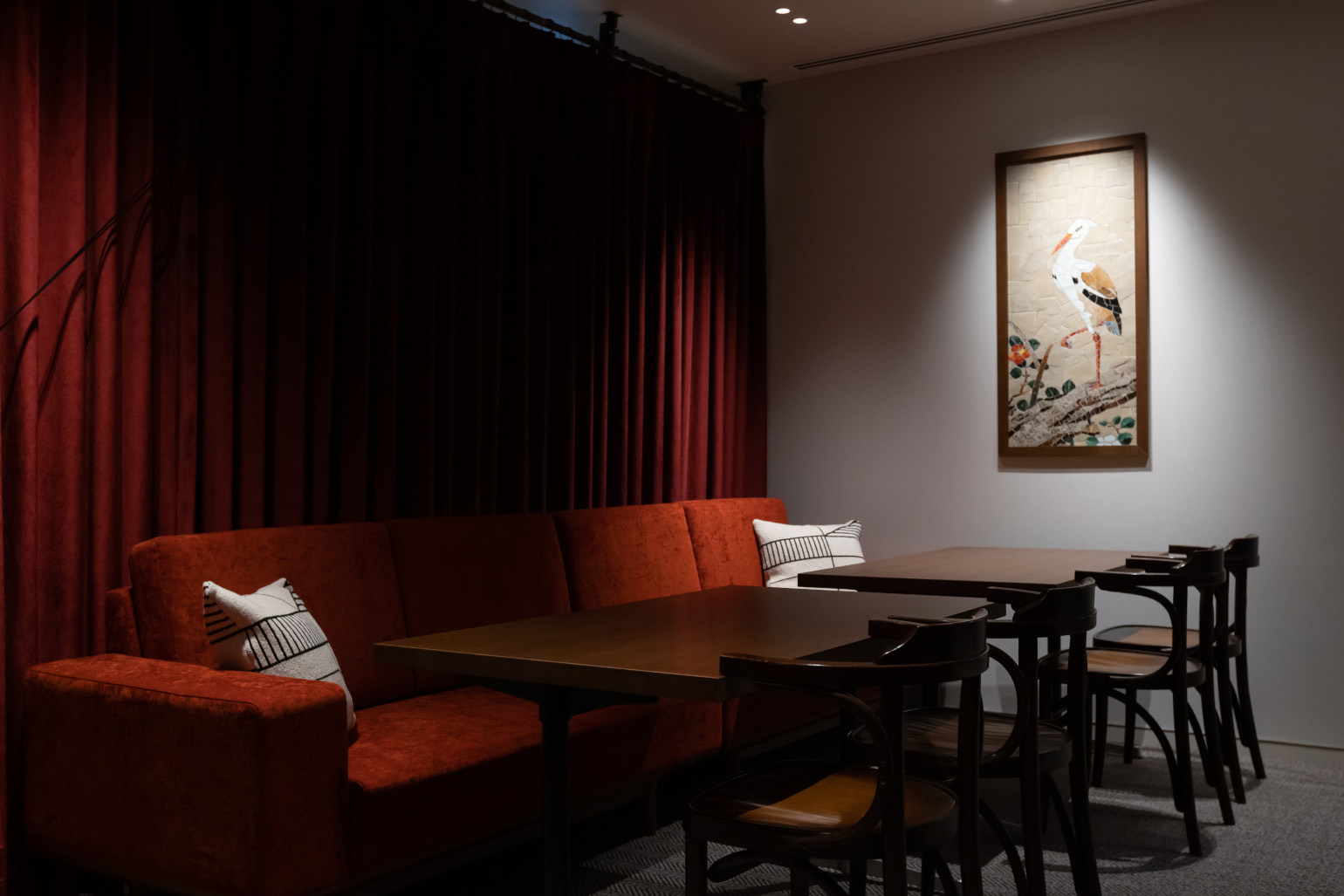
This space is not sold to the neighbourhoodThe dining lounge. Guests only, with seat counts matched to capacity, the exact opposite of a lifestyle hotel opening its lobby to local customers. ⓒMarufukuro / Wallpaper*
10.That structure shifted once, on 1 November 2025. A counter tempura restaurant, Tempura Marufuku, opened on the site, and reservations from non-resident guests started being taken that same day. It is a 23-seat room running two evening sittings, with a course at JPY 20,000 plus service. Fill every seat and more people come in than the hotel sleeps. The first door opened outward by a house that had held on with one room for three and a half years.
11.So staffing is heavy relative to the room count. A structure serving a dinner course and breakfast to 36 people and keeping lounges open all day takes twenty-five to thirty people across kitchen, service, front desk and housekeeping (estimate). Around 1.5 per room. In the same position, a city business hotel runs 0.2 to 0.3 per room.
12.One tax was laid on top of that. From stays on and after 1 March 2026, Kyoto's accommodation tax moved from three brackets to five, with the top reaching JPY 10,000 per person per night. The tax base, however, is the room charge with meals and consumption tax excluded. An auberge-style product selling breakfast and dinner bundled into the rate therefore drops one bracket. How the rate is split and displayed is what separates the tax.
How the rate is displayed separates the taxEven at a total of JPY 100,000 including meals, the tax base is the room charge with meals removed. A product bundling breakfast and dinner into the rate ends up in a lower bracket.
13.Why do guests sleep here. Not only because it was a games company's old office. The brass plate, the character for fortune in the grille and the fireplace in the tatami room are stock that money cannot make new. Whatever fine materials a newly built hotel uses, it cannot buy what this building had from the start.
The nameplate stayed onThe old plate still on the wall beside the entrance. It records Yamauchi Nintendo as the maker of playing cards and hanafuda. ⓒMarufukuro / DezeenThe trading name is set into the grilleInside the circle at the centre of the grille is the character for fortune from the old name Marufuku. A new building has nothing like it. ⓒMarufukuro / Dezeen
14.The market grew too. The Nintendo Museum opened in Uji on 2 October 2024, itself a converted former factory, with tickets sold by lottery. A pilgrimage route appeared in the south of Kyoto, and the starting point of that route is the founding site. Demand the company created rather than demand the hotel made.
15.This approach has run more than twenty years in Japan. Banks, schools and factories turned into accommodation have stacked up city by city, usually keeping the old frame and putting only the services in new. Where this one diverges is in standing a new building beside the old. Rather than imitating the old building, it pushed exposed concrete through and made the very fact of two eras sitting together the product. Exactly the method Ando used when intervening in old buildings in Venice and Paris.
16.That story has no stock, though. Guests who come on a pilgrimage come once in a lifetime and not twice. It is a product that does not attract return visits, so it has to find new guests every year, and with rooms as the only revenue source, there is nothing to fall back on when occupancy wobbles. In the year Kyoto's occupancy fell 4.8 points, this structure met its first test. The decision to open a tempura counter and take outside guests after putting it off for three and a half years looks like a move to fill that gap.
Summary
Three office buildings from 1930 took one new building alongside and eighteen rooms inside, leaving more than half the floor area as space that is not sold to guests. If one number survives, one room sits on 95 sqm. The space of four city business hotel rooms. It held on with that one room for three and a half years, and only in November 2025 opened a tempura counter as one door facing outward. The first thing anyone drawing the same picture in Korea meets is not the construction cost but change of use. Turning a 1930s reinforced concrete building into accommodation brings seismic performance, two means of escape and sprinklers along with the change of use under the Building Act, and the required parking count is recalculated the moment it becomes an accommodation facility. If it is a registered heritage property, one more permit for alteration attaches. And a plan putting only eighteen rooms on 802 sqm of land catches first at the loan review. You will be told to put forty on the same land, and the moment you follow that, this stops being the same business. The real cost of a hotel that sells a story is the decision to put in fewer rooms, and without making that decision first there is no need to draw anything.