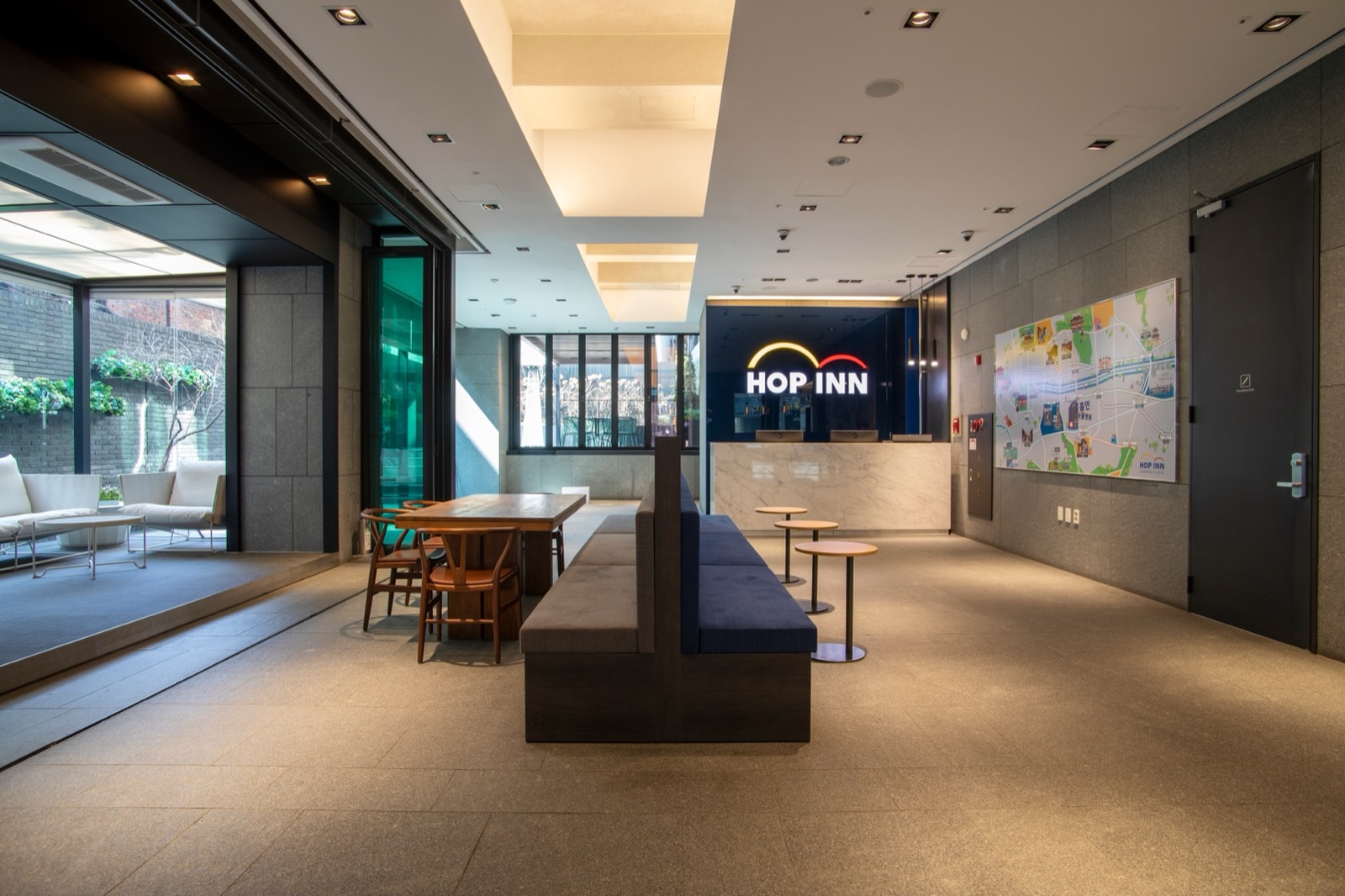
Ground-floor lobby and front deskA bench sofa runs down the middle, with a 24-hour front desk at the back. The lounge and garden sit behind the glass wall. ⓒHOP INN · Eats Me, Jax!
Daily Hotel
A Thai budget chain opened 97 rooms in Myeongdong, and they earn as much as 500 of its rooms in Thailand
2026.09.26
The Erawan Group, listed in Thailand, has opened the first Korean branch of its budget hotel brand HOP INN in Myeongdong. It did not build anything. It took a 97-room business hotel that opened in 2015, renovated it and changed the sign. In its first full quarter, those 97 rooms earned as much as 500 HOP INN rooms in Thailand.
1.On March 20, HOP INN Seoul Myeongdong opened in Jung-gu, Seoul, between Chungmuro and Euljiro 3-ga stations. The building is the former StayB Hotel Myeongdong, which opened in April 2015: 14 floors above ground, one below, 97 rooms. The 11-year-old hotel was renovated and renamed, and the room count stayed exactly the same. It is run by the budget hotel division of Thailand's The Erawan Group.
2.Erawan is a hotel investor listed on the Stock Exchange of Thailand and the owner of the Grand Hyatt Erawan in Bangkok. HOP INN started in Bangkok in 2014, moved into the Philippines and Japan, and Korea is its fourth country. At the end of June it had 8,042 rooms across the four, and the company has long said it wants 150 hotels by 2030.
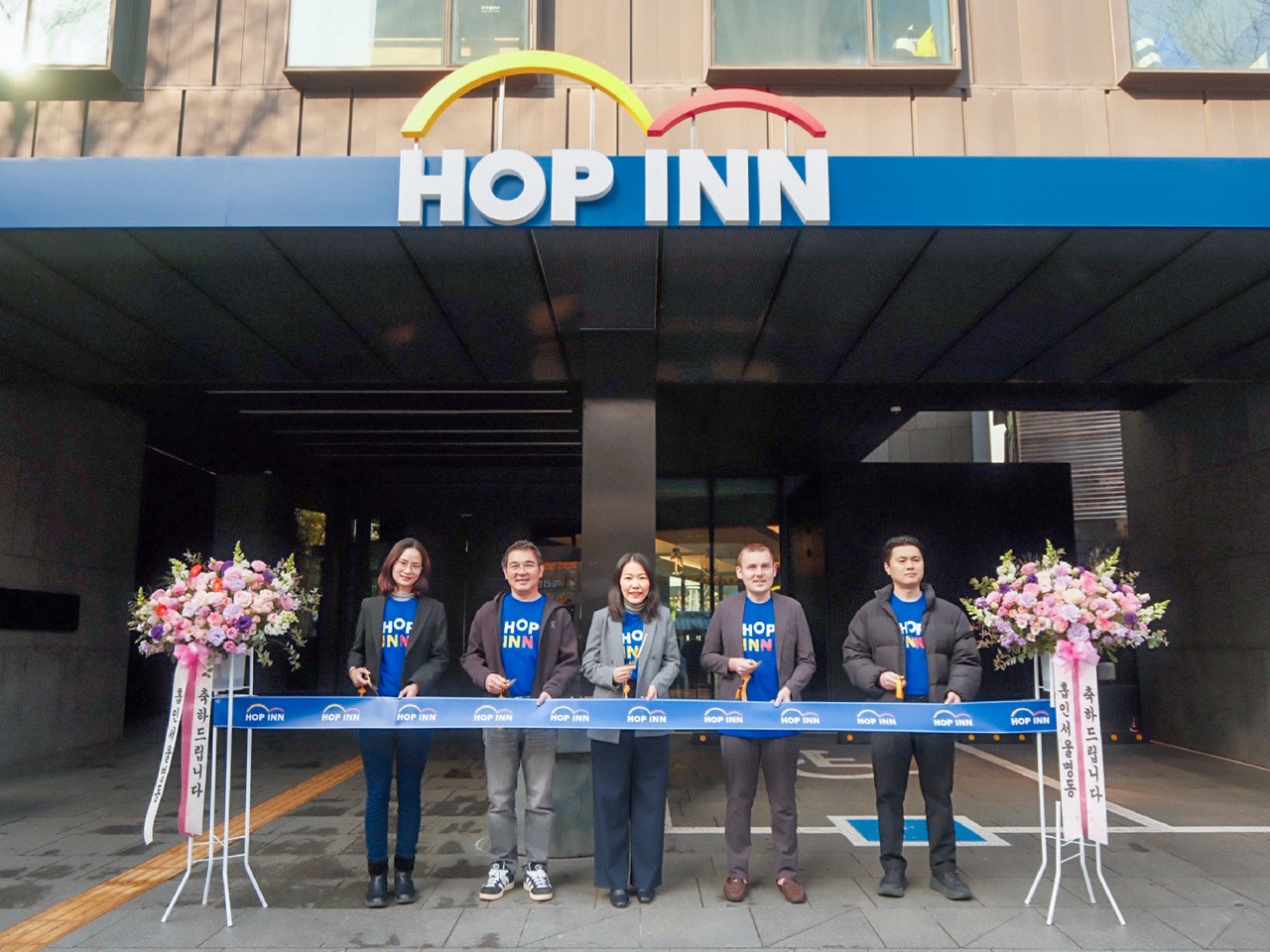
Opening ribbon cuttingThe HOP INN sign now hangs on the canopy over the old StayB entrance. In the center is HOP INN president Pichanun Boonpromgul. ⓒHOP INN · Eats Me, Jax!
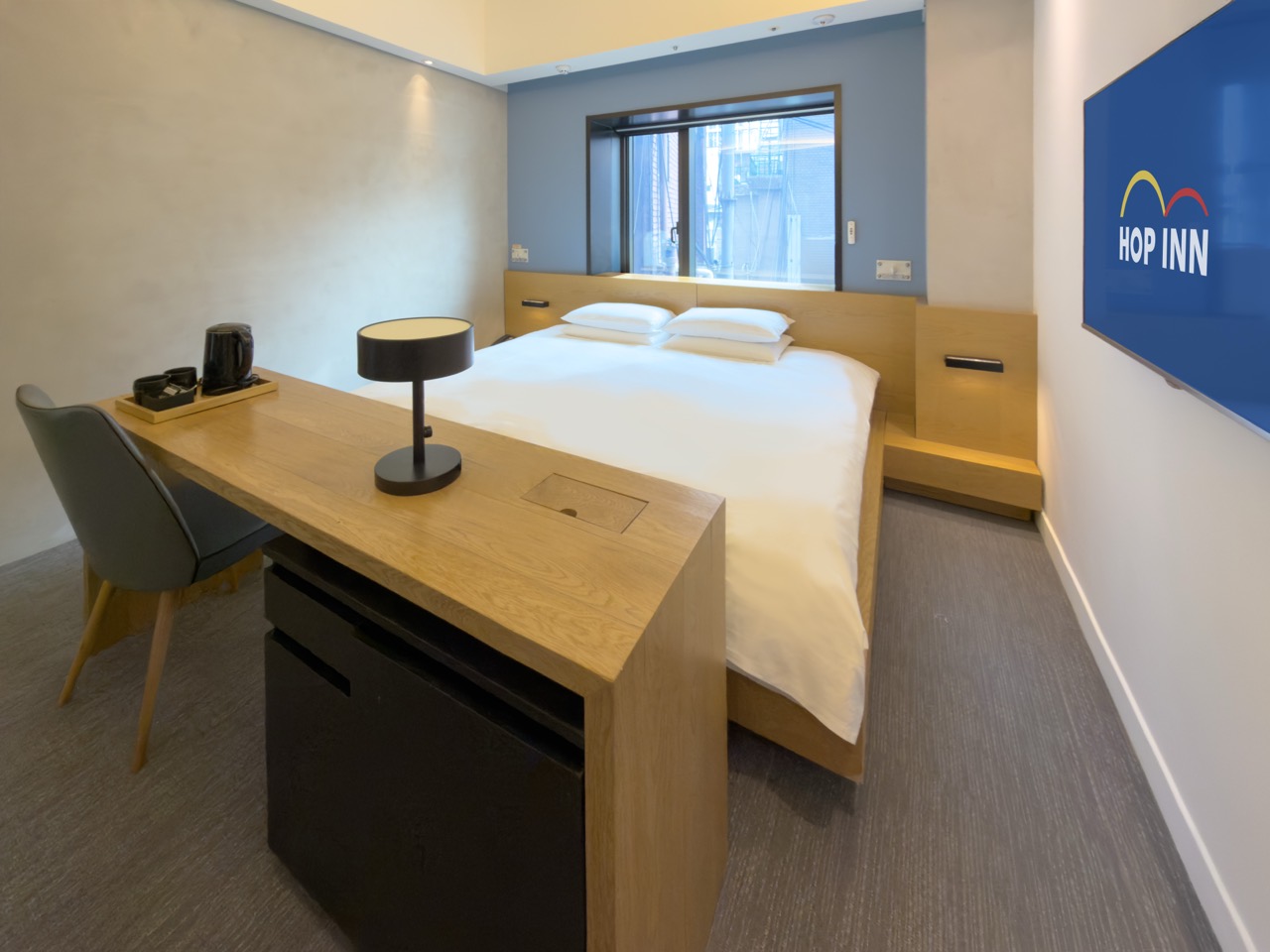
3.There are seven room types. The smallest, the Standard Double, is 15㎡; the King is 18㎡ and the Twin 21㎡; triples come in 23㎡ and 27㎡; the view room is 32㎡ and the duplex family room 49㎡. In Thailand, HOP INN's rule has been rooms of about 20㎡, no more than 79 per building. In Seoul the brand inherited walls and windows that were already there, which seems to be why room sizes change from floor to floor and position to position.
Standard King roomAn 18㎡ room with a timber desk running to the foot of the bed, leaving a clear aisle. ⓒHOP INN · Eats Me, Jax!
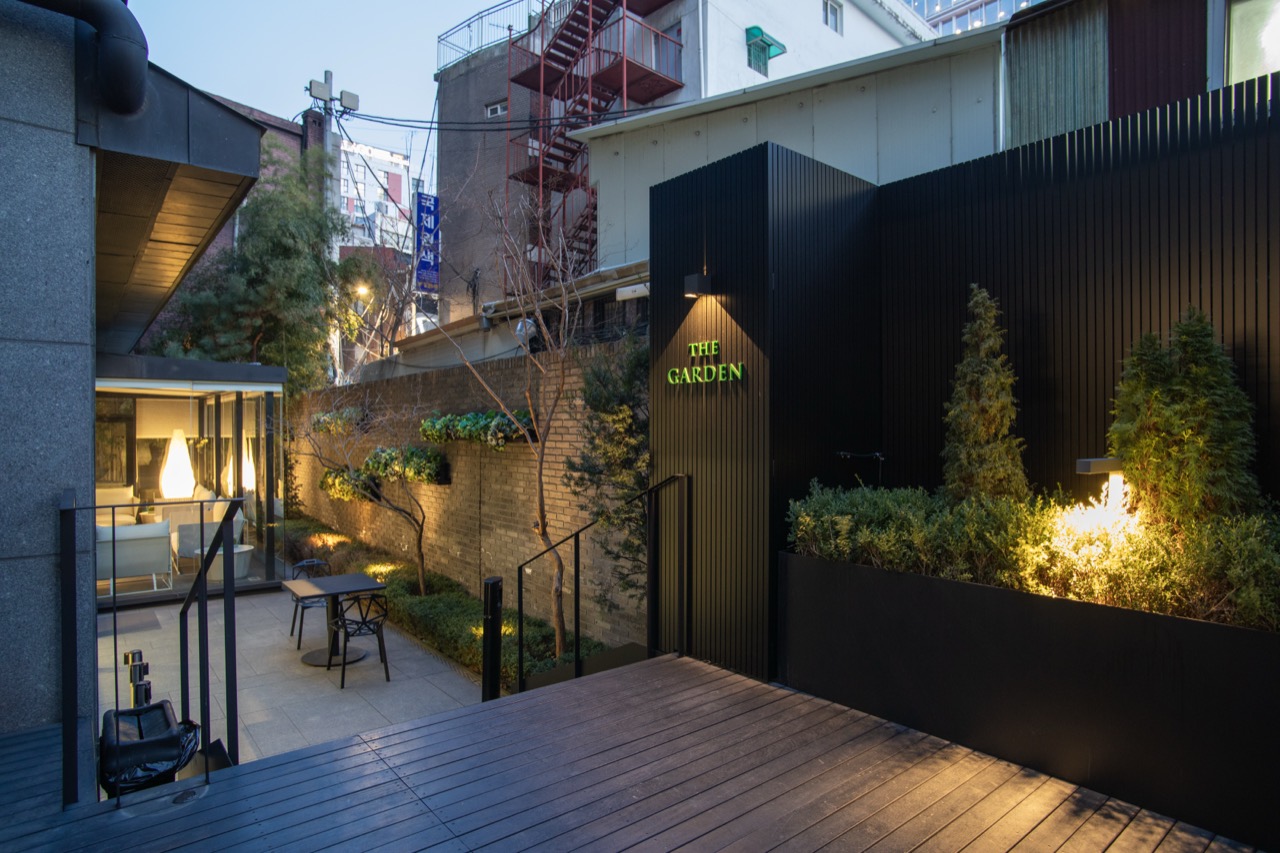
4.The ground floor holds a 24-hour front desk, a lounge, luggage storage and a small garden, and the roof has been opened as a terrace. The basement restaurant from the StayB days was not reopened. The only thing sold inside the hotel is the room; meals are left to the lanes of Myeongdong and Euljiro outside the door.
Ground-floor gardenA deck and small round tables sit in front of the lounge windows. Beyond the brick wall is the building next door. ⓒHOP INN · Eats Me, Jax!
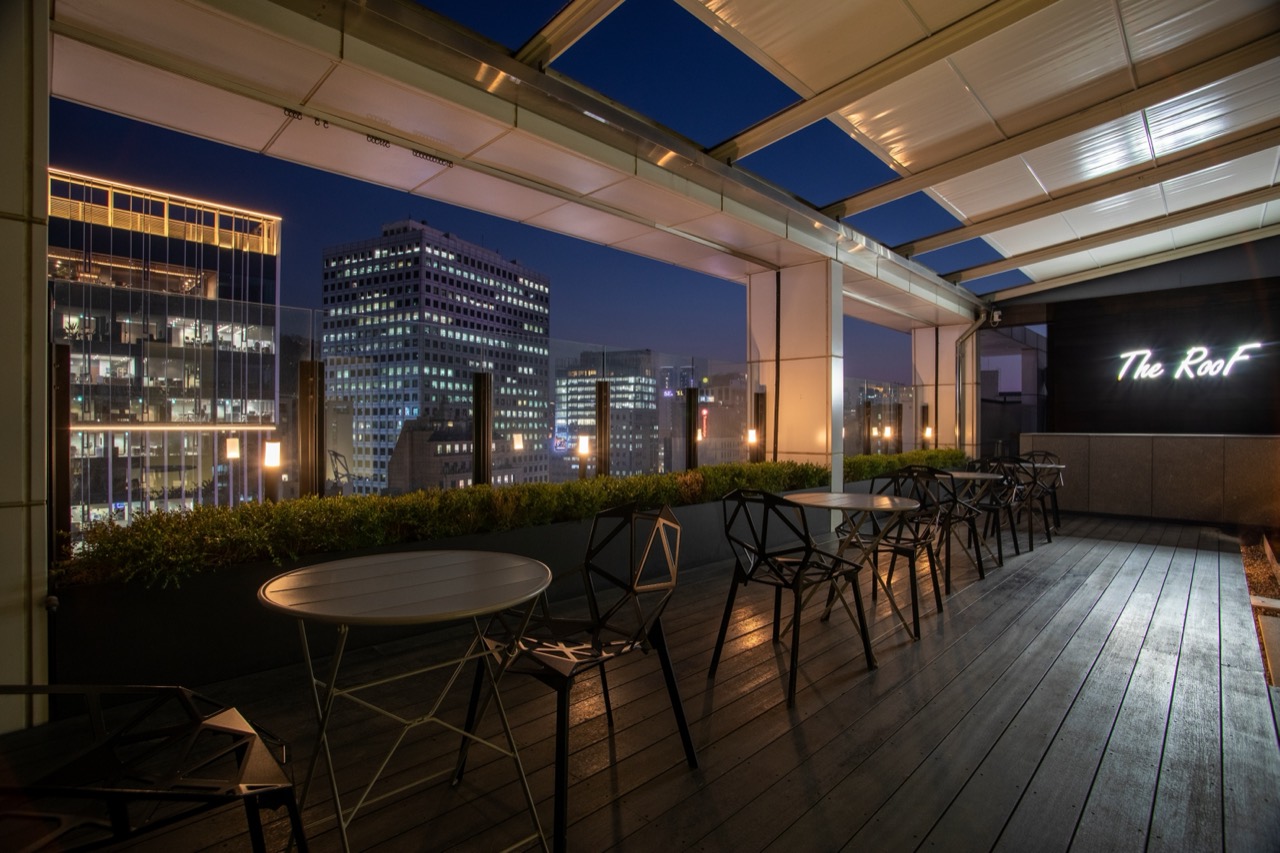
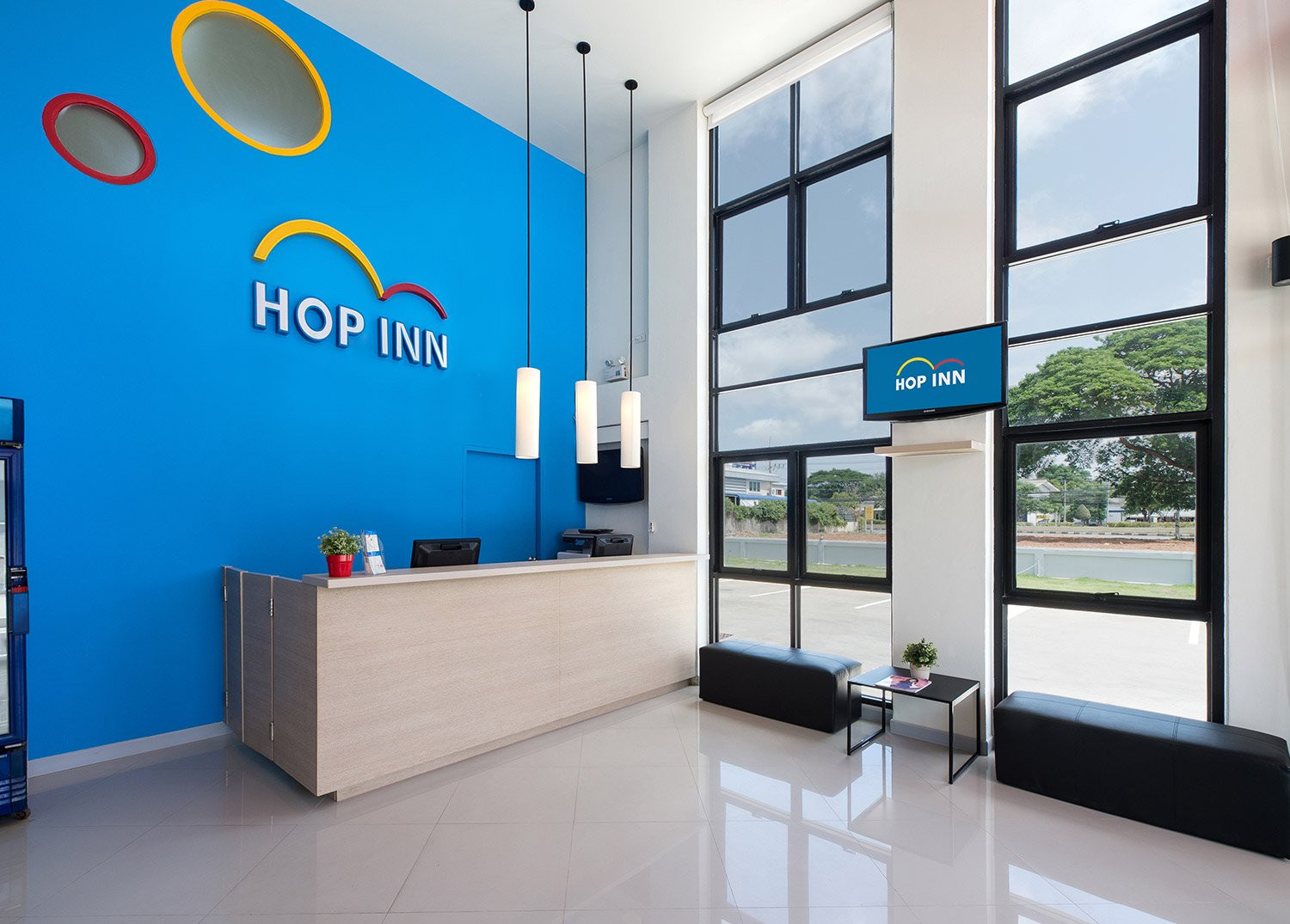
5.A single navy bench sofa splits the stone floor of the lobby, and behind the desk the rainbow-arc logo glows. Up in the room, past the gray carpet and white bedding, the same blue logo floats on the TV screen. It is the blue painted on the lobby walls of HOP INN in Thailand. After dark, from the rooftop terrace, the office towers of Euljiro light up floor by floor beyond the railing. A promise that the room is the same whichever country you sleep in: that is what the brand's line, "Consistency is Yours," means.
The Roof terraceMetal tables and steel chairs on a timber deck, with the office towers of Euljiro beyond the railing. ⓒHOP INN · Eats Me, Jax!
6.Korea showed up as its own line for the first time in the second-quarter management report Erawan published in August. From April to June, HOP INN Korea booked revenue of THB 27 million, about KRW 1.13 billion at 42 won to the baht. Those 97 rooms, 1.2% of all HOP INN rooms, produced 5.1% of the division's revenue, and the company wrote that Korea beat expectations in its first full quarter.
A bigger share of revenue than of roomsThe dark block at the far right is Korea: 1.2% of the rooms, 5.1% of the revenue.
7.Turn it into what each room earns per day and the gap widens. Divide quarterly revenue by rooms and by 91 days and Korea comes to THB 3,059, about KRW 128,000. By the same math Japan is THB 2,534, the Philippines THB 673 and Thailand THB 579, a little over KRW 24,000. One room in Myeongdong earns what five-odd rooms in Thailand do.
One room in Myeongdong, five in ThailandRooms under the same sign differ more than fivefold in daily revenue depending on the country.
8.Occupancy and room rates by country are not disclosed. Seoul's 3- and 4-star hotels ran at 88-90% in July this year; put Myeongdong at 85% for April to June and the average daily rate comes out around KRW 150,000 (estimate). HOP INN's existing hotels averaged THB 928, about KRW 39,000, in the second quarter. A room with the same sign and the same blue logo fetches close to four times as much in Seoul. The figure rests on an assumed occupancy, so read it with a wide margin.
9.Not much money went in. When Erawan launched the brand, it put the investment per HOP INN room in Thailand at THB 720,000, about KRW 30 million at today's rate. The Korean subsidiary was set up on September 25, 2025 with KRW 3 billion in capital; divided by 97 rooms, that is just over KRW 31 million a room. This February, the 297-room U5 Hotel in Euljiro sold for about KRW 400 million per room. KRW 3 billion cannot buy a Myeongdong hotel, so the structure looks like a lease on the building, with HOP INN handling the refit and operations (estimate).
A HOP INN lobby in ThailandBlue wall, timber desk, two sofas by the window. Thai branches repeat this layout. ⓒThe Erawan Group
10.A hotel in a leased building that sells rooms and no food has a short cost sheet. Kitchen and floor staff, ingredients, the space for a breakfast buffet: all of it drops out. According to broker reports, the HOP INN division's EBITDA margin in the second quarter was 37.8%. At a star-rated hotel, revenue outside the rooms would come from breakfast, banquets and the lobby bar. Here that share is close to zero, and so is the cost of the staff and floor area it would take.
11.Nearly every guest is foreign. Erawan says more than 95% of HOP INN Korea guests are international travelers, and in the second quarter Korea's top arrivals were from China, Japan and Taiwan, in that order. At HOP INN Thailand, more than 70% of room nights come from domestic business travel; in the Philippines, more than 80% of guests are locals. Same room, entirely different guests in each country.
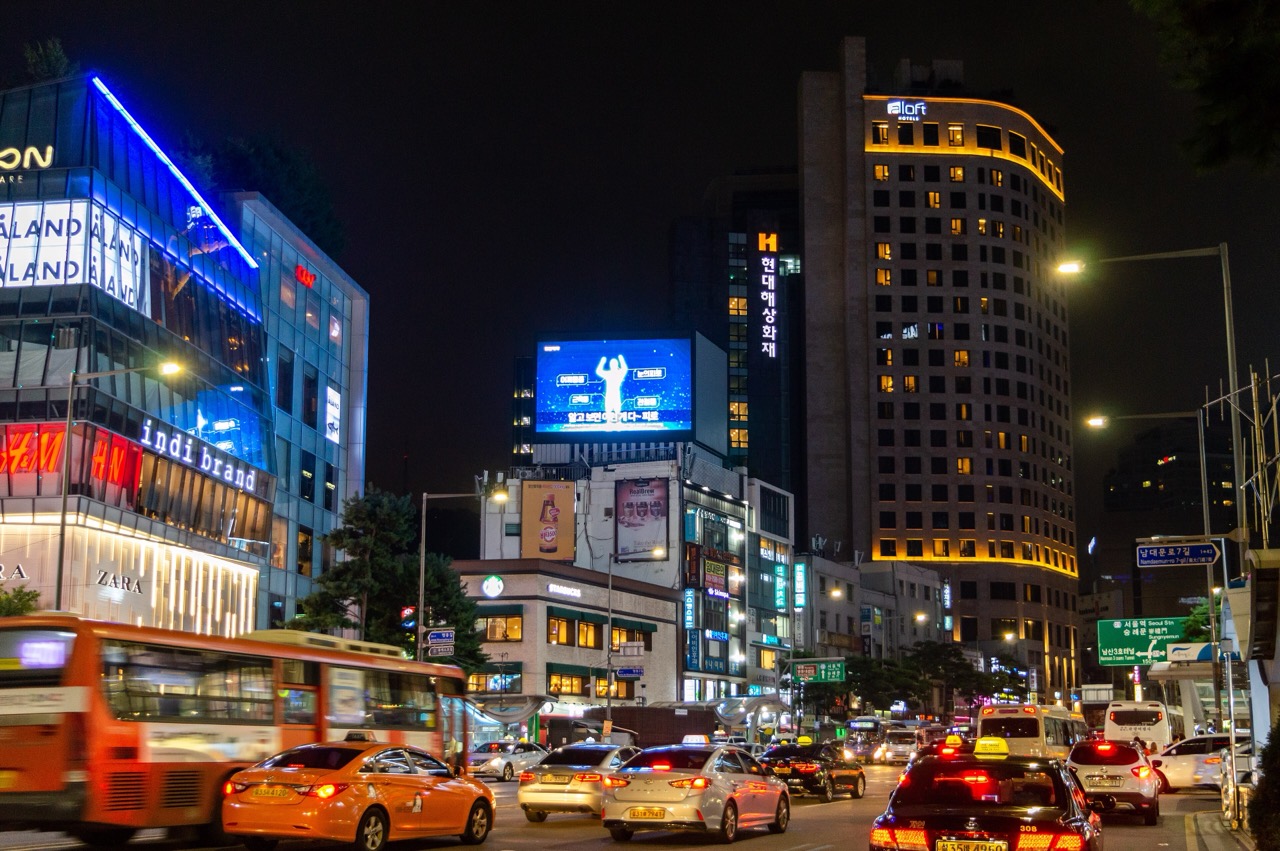
Namdaemun-ro at night, at the edge of MyeongdongShopping malls and hotels stand shoulder to shoulder around Myeongdong, where foreign tourists cluster for their stays. ⓒTristan Surtel (Wikimedia Commons) · CC BY-SA 4.0
12.Why do these rooms sell so well? The answer is on Seoul's supply side. Of the 249 hotel business plans the city approved through the second quarter of this year, only 24 were new builds; the rest were renovations or changes of use of existing buildings. Since 2023, new supply in Seoul has run at about 1,000 rooms a year. Foreign arrivals are forecast to rise from 18.93 million last year to 23.56 million this year. In a market short of land and money to build, whoever already holds permitted rooms sells first.
13.StayB opened in 2015, when the special act to expand tourist accommodation, in force from 2012, was filling Myeongdong and Euljiro with one business hotel after another. Those hotels were the first to wobble when Chinese group tours stopped in 2017. Ten years on, those same rooms have become the way foreign chains enter Korea. Skip the years of buying land, getting permits and building; change the sign and the booking system, and revenue starts in the first quarter.
14.In Japan the company has gone a step further. Its fifth Japanese hotel, a 69-room property in Tokyo announced this year, will be built by a Japanese partner and leased by HOP INN to operate. Opening is planned for the first quarter of 2028. A company that bought land and built its own hotels in Thailand is shifting to leasing other people's buildings abroad, and Myeongdong is the case where it took over a hotel that was already trading.
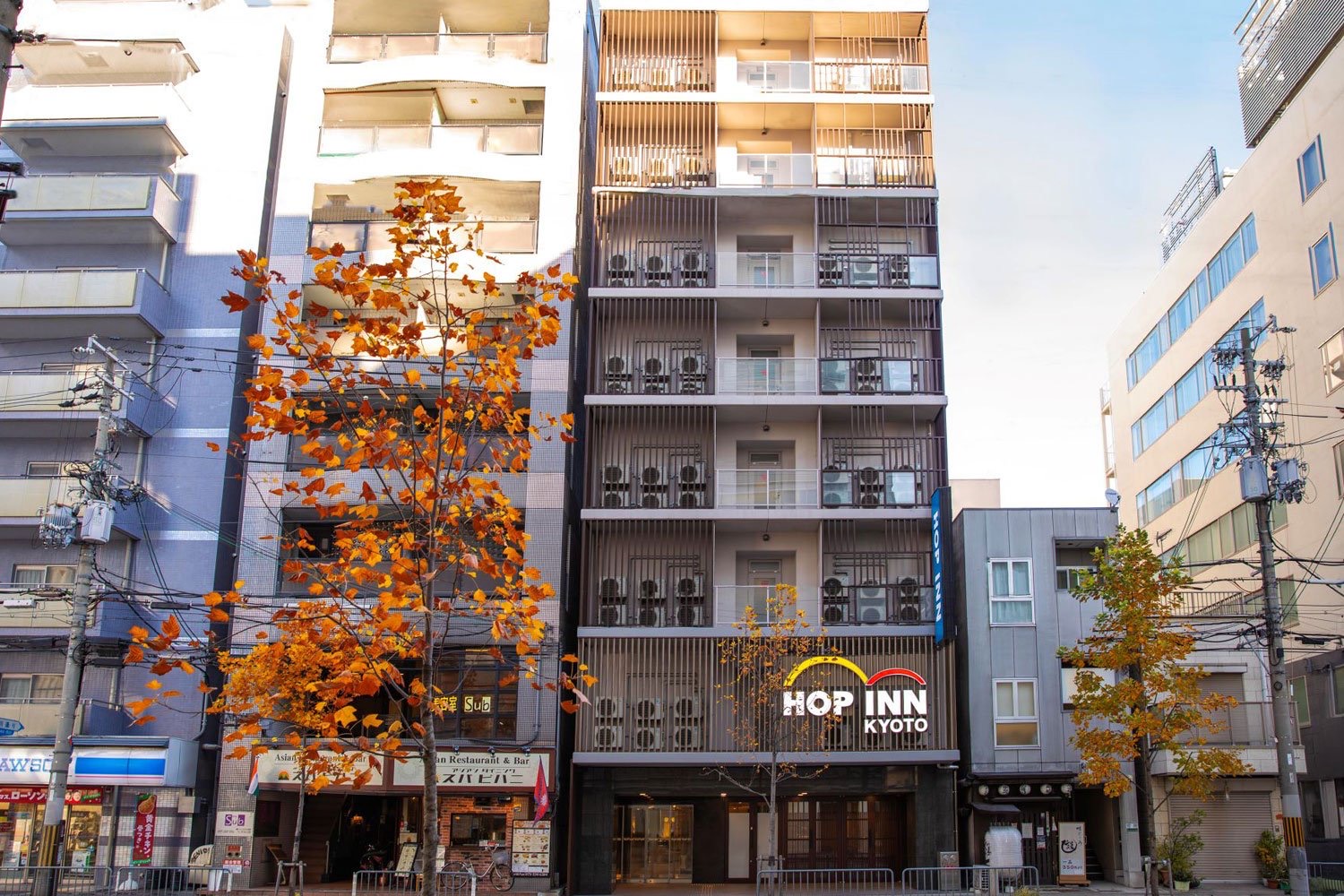
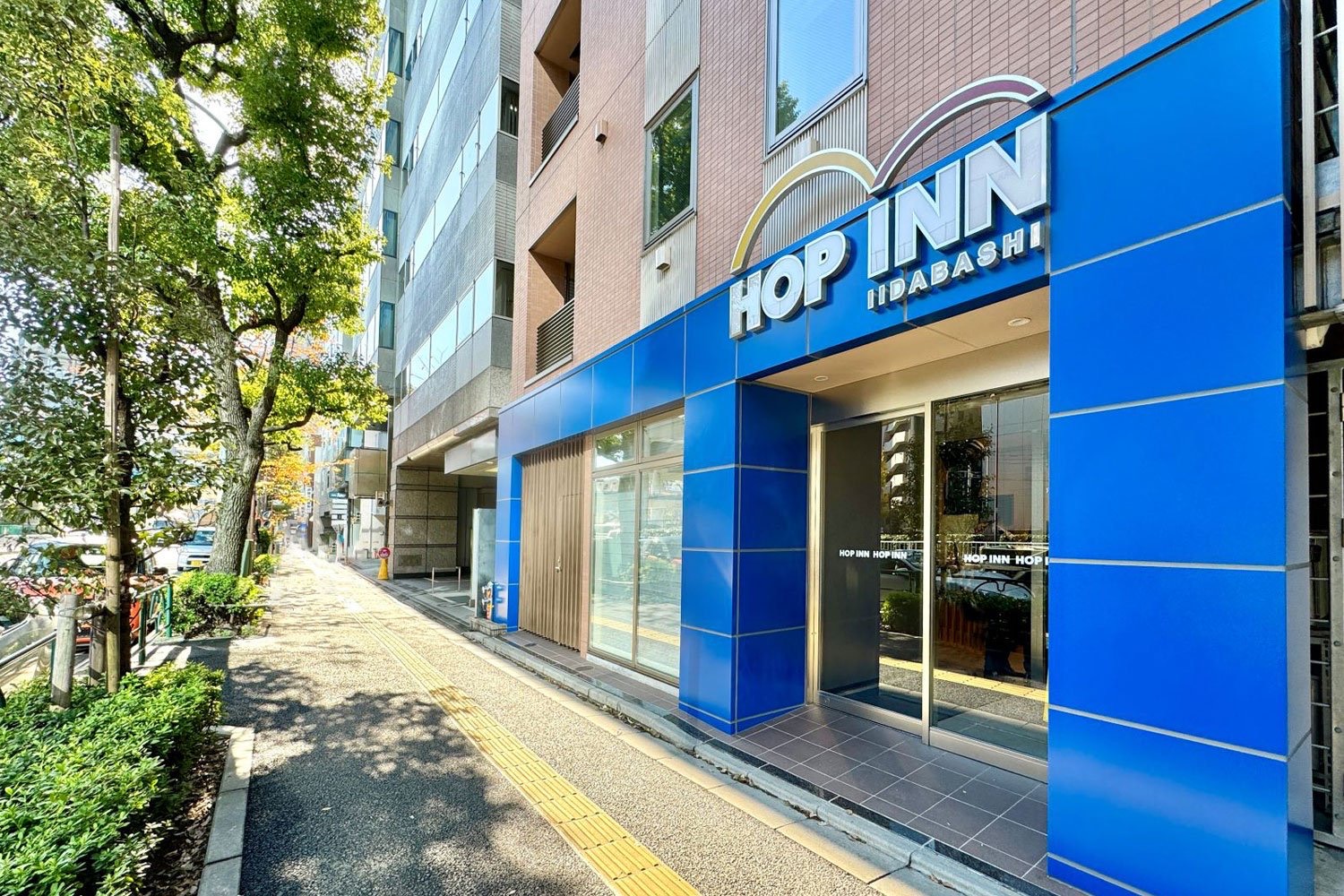
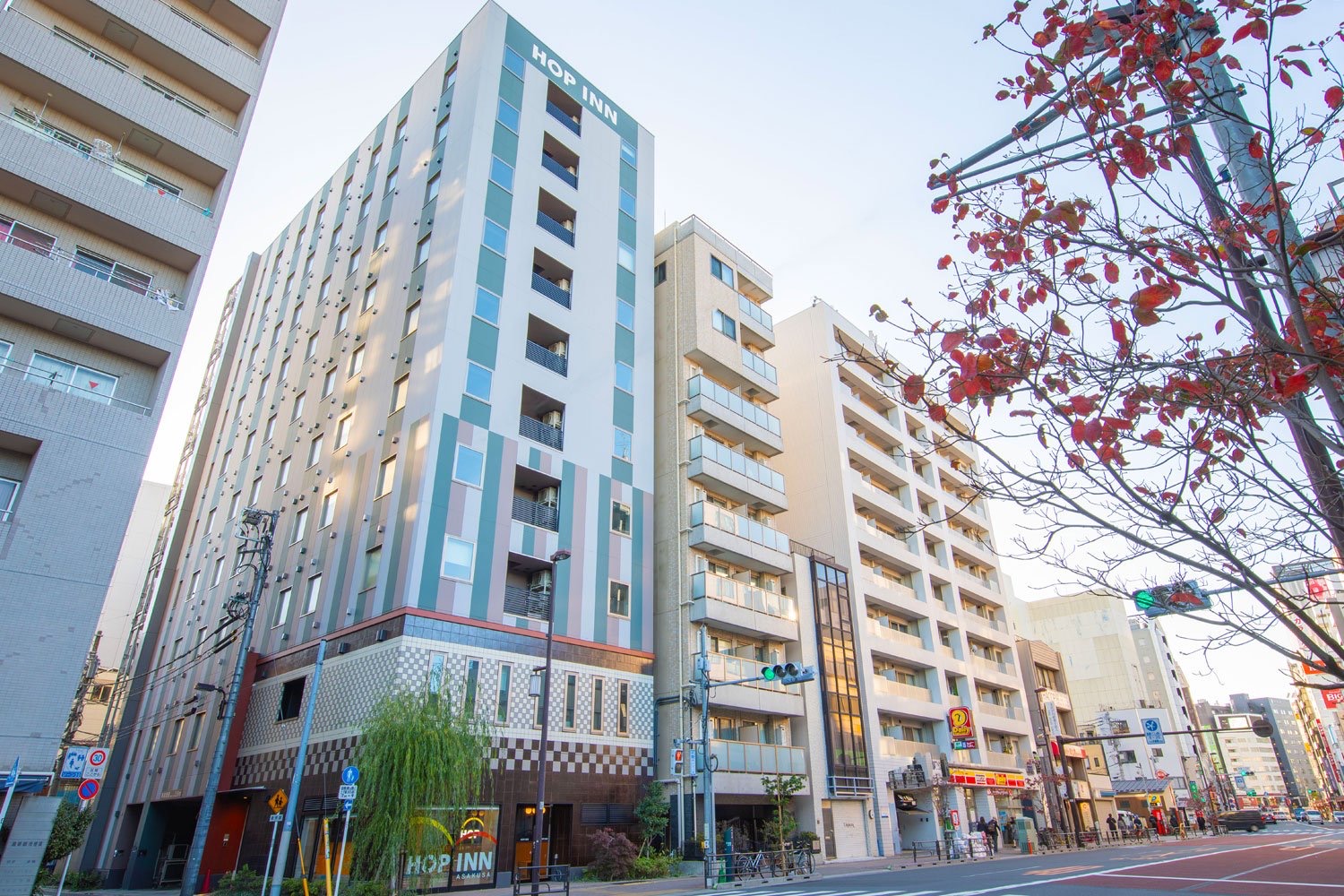
HOP INN in KyotoA building raised on a narrow city plot. The four Japanese branches add up to 373 rooms. ⓒThe Erawan GroupHOP INN Iidabashi, TokyoThe sign was changed by wrapping the ground floor of an existing building in blue panels. ⓒThe Erawan Group
15.The risk comes from the same place. More than 80% of HOP INN Japan guests are international, and when Chinese arrivals to Japan fell 58% in the second quarter, revenue in baht dropped 11%. HOP INN Korea's foreign share is higher still, at 95%. Foreign arrivals to Korea rose 20% to 6.0 million in the second quarter, with China at the top. If the arrival numbers turn, these 97 rooms have almost no domestic guests to fall back on.
HOP INN in urban JapanMore than 80% of HOP INN Japan's guests are international travelers. ⓒThe Erawan Group
Thailand's The Erawan Group renovated a 97-room Myeongdong hotel that opened in 2015 and turned it into the first Korean branch of its budget brand HOP INN. It did not reopen the restaurant and sold rooms only, and in its first full quarter revenue reached THB 27 million (about KRW 1.1 billion), or roughly KRW 128,000 per room per day, more than five times a HOP INN room in Thailand. In Seoul, where new hotels are hard to build, taking over rooms that were already registered and changing only the sign worked from the first quarter. Anyone in Korea taking over an existing tourist hotel to reopen it under a new name has to sort out the operator's hotel registration first: Article 8 of the Tourism Promotion Act requires whoever takes over the business or all of its facilities to report the succession within one month.